Stainless Steel Fittings & Valves for Oil & Gas Instrumentation
Oil and gas instrumentation is the classic compression-fitting duty: sampling systems, impulse lines and manifolds. State sour or sweet service on the RFQ, because H2S changes the material requirement.
Why oil and gas instrumentation needs stainless
This is the duty the instrumentation catalog was built for: connecting transmitters, gauges and analyzers to the process through small-bore tube that must not weep in a plant where a leak is a safety event, not a housekeeping problem. The material baseline is 316 stainless for corrosion resistance in hydrocarbon and coastal atmospheres, and the special case is sour service — streams containing hydrogen sulfide, where materials must meet NACE MR0175 / ISO 15156, the sour-service standard that limits hardness and qualifies materials to prevent sulfide stress cracking. That standard applies to the wetted metal of valves, fittings and sampling hardware, so a sour line is a different RFQ from a sweet one. The families and why they exist are mapped inwhat are instrumentation fittings.
Typical duties on an instrument hookup
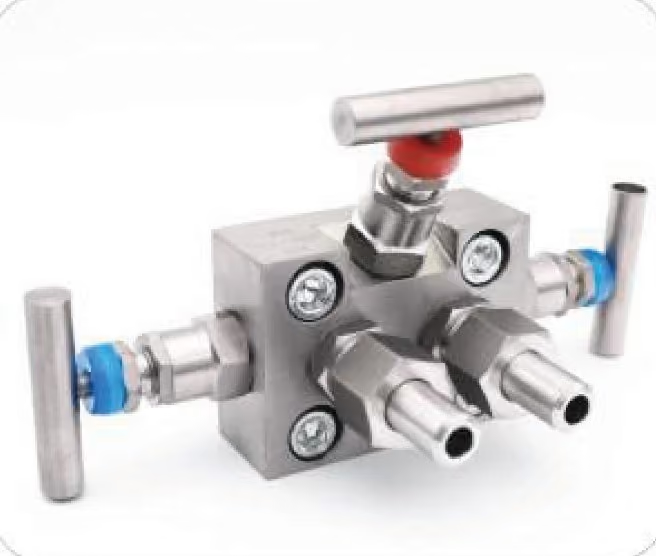
Differential-pressure transmitter hookups are the signature duty: a2-, 3- or 5-valve manifold isolates, equalizes and vents the transmitter without breaking a single tube joint. Around it sit the sample points where a needle valve meters flow into a sampling system, the impulse lines that carry process pressure to the transmitter, gauge and vent valves at local stations, and chemical-injection metering where check valves protect the pump. The tube-sizing discipline for impulse lines — actual OD, not pipe name — is the subject ofpipe vs tube, and the high-pressure valve choice is covered inhigh-pressure needle valves.
Duty to product family
| Duty | Recommended FerruleX family | Grade / note |
|---|---|---|
| DP transmitter hookup | Valve manifolds — e.g. the 3-valve manifold | SS316; 2-, 3- or 5-valve per the hookup drawing |
| Sample point metering | Needle valves | SS316; NACE compliance for sour sample points |
| Impulse lines to transmitters | Compression fittings + BA / precision tube | SS316; state tube OD × wall, not pipe size |
| High-pressure gauge and vent | High-pressure globe valve | SS316 for HP gauge stations |
| Chemical injection, one-way flow | Check valves | SS316; protects the injection pump |
| Pump and compressor vibration connections | Corrugated hose assemblies | SS316 where the service is sour or coastal |
| Mixed NPT/G wellhead panels | Adapters and weld fittings | Identify threads before ordering |
Standards context
Compression joints follow ISO 8434-1 / DIN 2353 practice frombite-type fittings explained, and instrument tubing follows ASTM A269 conventions frombright annealed tubing. For sour service, NACE MR0175 / ISO 15156 governs the wetted materials with hardness limits — for 316 stainless, solution-annealed with a hardness cap — and compliance is documented on the material certificates, so name the requirement on the RFQ. Sweet service follows the same catalog without the sour qualification.
What to state on the RFQ for oil and gas duty
- Sour or sweet service, and the H2S exposure where known — it decides whether NACE MR0175 / ISO 15156 compliance applies.
- CO2, chloride and temperature exposure alongside the H2S, since sour qualification reads them together.
- Design pressure class per line, plus manifold valve count from the hookup drawing.
- Grade call-out, normally SS316, and NACE compliance with certificates where sour.
- Tube OD × wall and thread standard per line — impulse lines are tube, not pipe.
Ready to order from the factory?