Stainless Fitting Cross-Reference: Find a Second Source
A cross-reference turns the part number on your existing fitting into a quoted equivalent from a second manufacturer: same tube OD, same thread form, same configuration — confirmed on drawing before we quote, never assumed from a number alone.
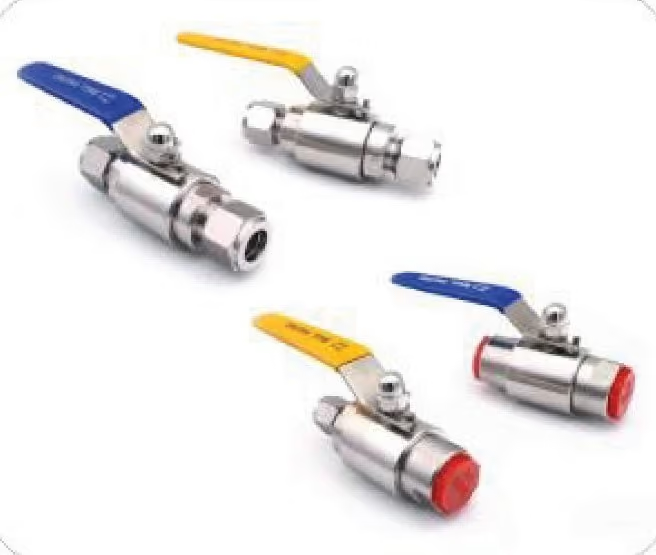
How this works
- Identify. Send the competitor part number from the fitting you need to replace — a photo of the marking works too.
- Confirm. We decode the verified parts of the number (material, tube size, configuration family), match it to the same configuration in our catalog, and confirm the equivalent on drawing — thread form, tube OD, geometry — before anything is quoted.
- Quote. You receive a factory quotation for the confirmed equivalent, complete sets only, with lead time and export packing.
Swagelok-style part numbers
The widely copied numbering reads in three layers. The material prefixSS denotes 316 stainless steel. The size field encodes tube OD in sixteenths of an inch — 4 means 1/4 inch, 8 means 1/2 inch, in the same dash-size convention used across instrumentation fittings. The trailing digits and letters identify the fitting family, series and end connections, and those are family-specific: the same digits mean different things in different families, so we read them against the catalog and the physical part, not a universal lookup table. Manifold configurations follow the same cross-reference path — the 2-valve,3-valve and5-valve manifolds each have their own catalog page. Send us the full number — for example a union or a male connector in SS material — and we match it to thecompression family with the same tube size and thread form. The single- versus double-ferrule question their numbering does not answer is answered by the part itself, as covered insingle ferrule vs double ferrule.
Parker-style part numbers (A-LOK and CPI)
Parker's inch-series nomenclature leads with the connection size rather than a material code. The worked example: 8MSC4N-316 decodes as 8 = first-end tube size, 8/16 inch (1/2 inch OD); MSC = male connector fitting style; 4 = second-end pipe size, 1/4 inch; N = NPT thread; -316 = 316 stainless steel. A-LOK and CPI are different fitting series — A-LOK is Parker's two-ferrule design, CPI the single-ferrule design — so the series named on your part matters as much as the size digits. Metric-series Parker numbers use metric size designations instead of the sixteenths convention. Send the number as marked and we match configuration, sizes and thread form from it, confirming anything ambiguous on the drawing.
DK-Lok and Hy-Lok
DK-Lok and Hy-Lok both build instrumentation tube fittings with single-ferrule bite-type lines to DIN 2353 / ISO 8434-1 and separate double-ferrule compression lines; both also ship instrument valves, manifolds and weld fittings. Their bite-type lines follow the 24-degree cone system described in bite-type fittings explained, and that standard defines the interchange dimensions — tube OD, thread, cone interface — that let one maker's body thread onto another's nut in the same series and size. Send the part number or a photo of the fitting and its marking, and we confirm the equivalent in our bite-type or double-ferrule family accordingly.
FITOK
FITOK covers the same instrumentation ground with both single- and double-ferrule tube fittings, valves and manifolds, and numbers its series by its own catalog conventions. The cross-reference path is identical: part number or photo in, configuration and size decoded, equivalent confirmed on drawing, quote returned for the complete set.
Configuration to FerruleX family
| Configuration | Typical competitor-series shorthand | FerruleX family | What to state on the RFQ |
|---|---|---|---|
| Union | SS union style; A-LOK union; DIN bite-type union | Compression straight union | Tube OD + "union" + competitor part number |
| Male connector | SS male connector; A-LOK MSC style; DIN male stud | Tube-to-male connector | Tube OD + thread standard and size (NPT or G) + part number |
| Female connector | SS female connector; A-LOK FSC style | Tube-to-female connector | Tube OD + thread standard and size + part number |
| Elbow | SS elbow style; A-LOK elbow; DIN bite-type elbow | Compression union elbow | Tube OD both ends + angle + part number |
| Tee | SS tee style; A-LOK tee; DIN tee | Compression male-female tee | Run and branch sizes + thread on branch + part number |
| Cross | SS cross style; A-LOK cross | Compression cross | All four end sizes + part number |
| Union tee / reducing tee | SS reducing union; A-LOK reducing tee | Compression reducing tee | Both run sizes + branch size + part number |
| Bulkhead union | SS bulkhead style; A-LOK bulkhead; DIN bulkhead | Compression bulkhead union | Tube OD + panel hole size + part number |
Reading the numbers
| Numbering system | Verified decoding | What we confirm from the drawing |
|---|---|---|
| Swagelok-style (SS-…) | SS = 316 stainless steel; size field = tube OD in 16ths of an inch (4 = 1/4 in, 8 = 1/2 in) | Trailing digits and letters are family-specific (fitting family, series, end connections) — read against the catalog and the physical part, not a universal table |
| Parker-style (A-LOK example 8MSC4N-316) | 8 = first-end tube size 8/16 in; MSC = male connector; 4 = second-end 1/4 in; N = NPT; -316 = 316 stainless | Series identity (A-LOK two-ferrule vs CPI single-ferrule) and metric-nomenclature equivalents, from the part and catalog |
Two truths about interchange
Ferrule sets do not cross brands. Each manufacturer's ferrule set is engineered to its own body geometry — cone angle tolerances, bite edge, hardening — and a body from one maker with ferrules from another is a joint that may assemble and will not seal reliably. Our standing rule, consistent with ferrule mechanics: quote and install complete sets — body, nut and ferrules from one source.
DIN 2353 bite-type fittings are a different case. The 24-degree cone standard defines interchange dimensions — tube OD, thread, cone interface — so within the same series and size, bodies, nuts and cutting rings from different makers assemble together by design; that is the point of the standard, as covered inbite-type fittings explained. Thread standards still have to match line by line — the NPT-versus-G question is answered in NPT vs G.
What to send us
The competitor part number as marked on the fitting, or clear photos of the fitting and its marking; the tube OD and thread standard if you know them; and the quantity. We reply with the confirmed equivalent from thecompression-fittings catalog — configuration, sizes and thread form confirmed on drawing before quoting, and complete sets only. For the bigger picture of which families suit which duty, see what instrumentation fittings are.
FerruleX is an independent manufacturer and is not affiliated with, endorsed by, or a distributor of Swagelok, Parker, DK-Lok, Hy-Lok, or FITOK. All brand and part numbers are the property of their respective owners and appear here only to help buyers identify the configuration they need to replace.
Ready to order from the factory?