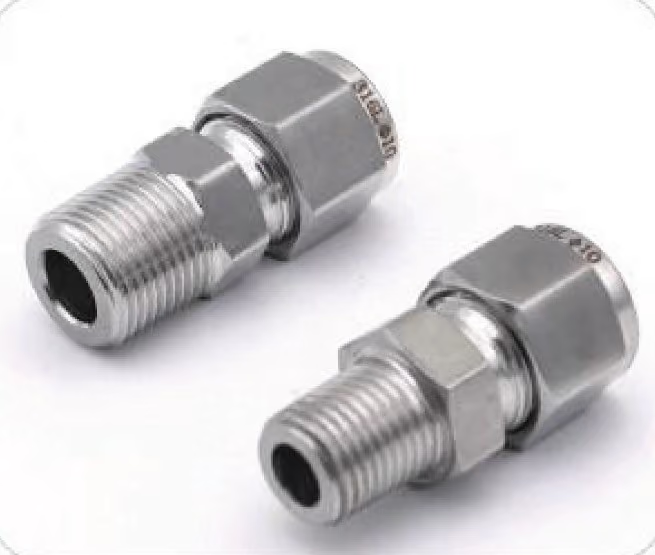
Bite-type fittings are the European compression standard: DIN 2353 tube fittings that seal on a 24-degree cone and grip the tube with a cutting ring — a hardened sleeve whose edges bite into the tube’s outside diameter as it tightens. If a drawing says “24° cone,” “cutting-ring fitting” or simply “metric compression,” it is describing this one system. Here is how the cone works, what the LL, L and S series mean, and how the pressure ratings step across them.
Key takeaways
- A bite-type fitting (DIN 2353) seals on a 24° cone inside the body and grips the tube with a cutting ring — a hardened bite-type sleeve whose edges cut into the tube OD as the nut tightens.
- The series are wall-duty classes: LL is the very-light series (4–12 mm tube, up to about 100 bar), L is the light series (6–42 mm, up to about 315 bar on the smaller sizes), and S is the heavy series (6–38 mm, up to about 630 bar on the smaller sizes).
- Ratings step down as tube OD grows within a series, and stainless assemblies may rate lower than the steel figures in the table — the manufacturer’s datasheet for the exact size governs.
- Buyers searching “bite type” and “DIN 2353” are looking for the same parts; both phrases describe the 24° cone system on metric tube.
The 24-degree cone principle
Three parts do the work. The body carries a 24° cone seat machined into its bore. The cutting ring — the “bite” sleeve — sits between nut and body with two sharpened edges facing the tube. As the nut tightens, the ring is driven forward and inward: its front edge cuts into the tube’s outside surface while its back edge seats against the cone, and the ring deforms into a wedge that locks the tube against pressure. Tightening creates both the seal and the grip in one motion — there is no separate sealing washer and no thread sealant on the tube end. That is why the cut must be square, the tube end deburred, and the ring replaced rather than re-bitten after a joint is opened; the mechanics are the same subject as the ferrule mechanics in what is a ferrule fitting, with the cutting geometry doing the gripping.
The DIN 2353 series
| Series | Tube OD range | Typical maximum working pressure |
|---|---|---|
| LL (very light) | 4–12 mm | Up to ~100 bar across the range |
| L (light) | 6–42 mm | Up to ~315 bar at 6–18 mm; ~160 bar at 22 mm; ~100 bar at 28–42 mm |
| S (heavy) | 6–38 mm | Up to ~630 bar at 6–14 mm; ~400 bar at 16–25 mm; ~315 bar at 30–38 mm |
Read this table as ranges, not promises. The pressure a given fitting earns depends on tube OD, wall, material and the exact fitting design, and it steps down within each series as the tube gets larger — which is why the L and S rows carry several values. Stainless assemblies can rate below the steel figures shown in general catalogs, so the governing number is always the manufacturer’s rating for the exact size and material, requested on the datasheet with the quote. What the table settles is the selection logic: LL for light instrument duties like lubrication and return lines, L for general hydraulic and process runs, S for high-pressure working lines — matched to metric tube from 6 mm upward, with the fractional-versus-metric question handled in metric vs fractional tube sizes. A printable version of this table lives on our DIN 2353 pressure chart sheet.
Why two names for one system
“Bite type” describes what the cutting ring does; “DIN 2353” names the standard that defines the 24° cone, the ring and the interchange dimensions. A buyer searching either phrase needs the same parts, and a drawing marked “DIN 2353” will accept any manufacturer’s ring and body within the same series and size — that interchangeability is the point of the standard. The standard also lives on internationally: ISO 8434-1 absorbed DIN 2353’s 24-degree flareless connection dimensions, so a datasheet citing either points to the same interchangeable system — the ISO citation is what to look for when a drawing says either. FerruleX’s compression catalog is built on this DIN-style family for metric and fractional tube alike.
How to order DIN 2353 fittings
State the series, the tube OD and the end form: “L-series bite-type union, 12 mm tube OD, both ends” or “S-series tube-to-male connector, 8 mm OD to 1/4 NPT.” The series call-out sets the pressure class and the nut geometry, the OD sets the body bore and the ring size, and the end form sets the port. If the existing line carries no series marking, measure the tube OD and check the nut thread against the drawing before ordering — an L and an S fitting of the same tube size do not interchange.
FerruleX supplies the DIN-style family: compression fittings for metric and fractional tube, including the ground-finish tube-to-male connector for panel take-offs and the ground-finish straight union for line-to-line joints. Send series, tube OD and end form on the RFQ and we quote the body, ring and nut as a matched set. Request a factory quote.
FAQ
What is a bite-type fitting? A compression tube fitting to DIN 2353 that seals on a 24° internal cone and grips the tube with a cutting ring — a hardened sleeve whose edges bite into the tube OD as the nut tightens, forming both seal and mechanical grip at once.
What are the LL, L and S series in DIN 2353? Three wall-duty classes for metric tube. LL (very light) covers 4–12 mm tube at up to about 100 bar; L (light) covers 6–42 mm at up to about 315 bar on smaller sizes; S (heavy) covers 6–38 mm at up to about 630 bar on smaller sizes. Ratings step down as tube OD increases within a series.
Are DIN 2353 pressure ratings fixed numbers? No — they vary with tube OD, wall, material and fitting design, and stainless assemblies can rate lower than steel. Treat published values as typical ranges and confirm the exact rating on the manufacturer’s datasheet for your size before specifying.
Can I mix cutting rings and bodies from different makers? Yes, within limits: DIN 2353 defines the interchange dimensions, so a same-series, same-size ring and body from different manufacturers assemble together. What you should not mix is series or tube sizes — an L fitting and an S fitting of the same OD do not interchange.
Is a bite-type fitting the same as a DIN 2353 fitting? Yes. “Bite type” describes the cutting-ring action; “DIN 2353” is the standard defining the 24° cone and the interchange dimensions. Both names point to the same compression system on metric tube.


