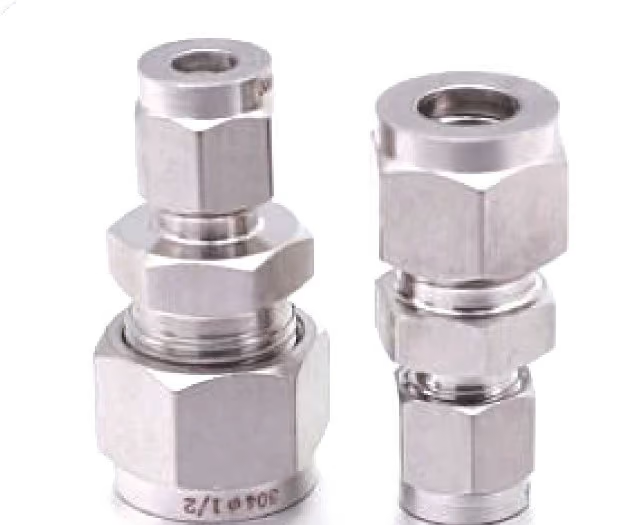
Metric compression fittings and fractional-inch tube are parallel universes that look interchangeable until you try to join them. The trap is the near-miss: 6 mm tube is almost — not — 1/4 inch, and a fitting bought on that assumption arrives wrong. Here is the map, the conversions, and how to order the right system the first time.
Key takeaways
- Compression fittings are sized by tube outside diameter, and fractional and metric series are separate catalogs: 1/4 inch is 6.35 mm, 3/8 inch is 9.53 mm, 1/2 inch is 12.7 mm — close to 6, 10 and 12 mm, but no pair is interchangeable.
- Ferrules are size-specific to a tenth of a millimeter: a metric ferrule on fractional tube (or vice versa) under- or over-bites, and the joint leaks no matter how carefully it is made.
- Identify what you have before ordering: measure the tube OD with calipers and read the fitting stamp — then state the system, size and tube OD explicitly on the RFQ.
Why two systems coexist
Regional OEM convention. European and most Asian equipment is drawn in millimeters — 6, 8, 10, 12 mm tube runs dominate those panels. North American panels run fractional inches — 1/4, 3/8, 1/2 inch. Both catalogs are complete in their own system: every body style, union, elbow and adapter exists in both. Export buyers inherit both on the same plant, which is why mixed-system mistakes top the list of cross-border fitting errors. The ferrule-level mechanics and pressure classes are the same either way — see single ferrule vs double ferrule for those.
The conversion table — and the trap
| Fractional OD | Closest metric | Actual mm | Interchangeable? |
|---|---|---|---|
| 1/8” | 3 mm | 3.18 mm | No |
| 1/4” | 6 mm | 6.35 mm | No — the classic near-miss |
| 3/8” | 10 mm | 9.53 mm | No |
| 1/2” | 12 mm | 12.70 mm | No |
| 5/8” | 16 mm | 15.88 mm | No — closer still, still not |
| 3/4” | 18 / 20 mm | 19.05 mm | No |
| 1” | 25 mm | 25.40 mm | No |
Even the closest pairs — 5/8” against 16 mm, 1” against 25 mm — differ by more than a tenth of a millimeter. That sounds like nothing until you remember how a compression joint works: the ferrule is engineered to swage a specific tube diameter, and a tenth of a millimeter of under- or oversize means the bite lands wrong. Metric tube in a fractional fitting (or the reverse) produces joints that assemble, feel snug and weep at pressure — the leak shows up on gas service first.
Identifying what you have
Two checks settle it in a minute. Measure the tube: calipers across the tube OD, and compare against the table — 6.35 mm says fractional, 6.0 mm says metric, and rounding to “about six” is exactly the mistake that costs a reorder. Read the fitting: bodies and nuts are stamped with the system and size — 6MM, 8MM, or 1/4, 3/8. If the stamp is gone, the caliper reading is the answer. When an existing panel mixes systems, mark each run before ordering replacements; ferrule brands add another layer, and the no-mixing rule from the ferrule guides applies within a system too.
What to state on the RFQ
The system, the size, and the tube OD in the fitting’s own language — “10 mm compression union, both ends” or “3/8 inch tube × 1/2 NPT male connector.” If the two ends of one fitting differ, name both. If you are converting between systems on one skid, say so explicitly and we quote proper adapters rather than letting the mismatch hide in the BOM. And if the tube itself is unmarked and origin unknown, send the OD measurement — we can identify the system from it.
FerruleX stocks compression fittings in both metric and fractional series — straight unions and reducing unions bridge sizes within a system, and mixed system adapters bridge between them. Send tube OD, system, material and end connections, and we quote the stocked size. Request a factory quote.
FAQ
Is 6 mm tube the same as 1/4 inch? No. 1/4 inch is 6.35 mm — three tenths of a millimeter larger than 6 mm. A 1/4 inch fitting on 6 mm tube under-bites and leaks; a 6 mm fitting will not accept 1/4 inch tube at all. Measure before ordering.
Can I mix metric and fractional fittings on one panel? You can serve both tube systems on one panel, but each joint must match its tube’s system, and system-to-system transitions need proper adapters. What you must never do is force one system’s ferrule onto the other system’s tube — the bite geometry is size-specific.
Which system should I standardize on for a new project? Match your equipment’s convention: metric for European and most Asian OEM skids, fractional for North American. Standardizing one system per project avoids spare-parts duplication and assembly errors — mixing systems to save a line item is false economy.
How do I measure tube OD accurately? Digital calipers across the tube end, away from the ferrule bite marks, read to 0.01 mm. Compare against the conversion table: values like 6.35, 9.53, 12.70 mm are fractional signatures; 6.0, 10.0, 12.0 are metric.
What if my fitting has no size stamp? Measure the tube OD it was made for — the fitting follows the tube. If the tube is gone too, measure the ferrule bore or the nut’s tube entry with calipers and compare against the table; a tenth of a millimeter separates the systems, which is precisely why calipers beat eyeballs.


