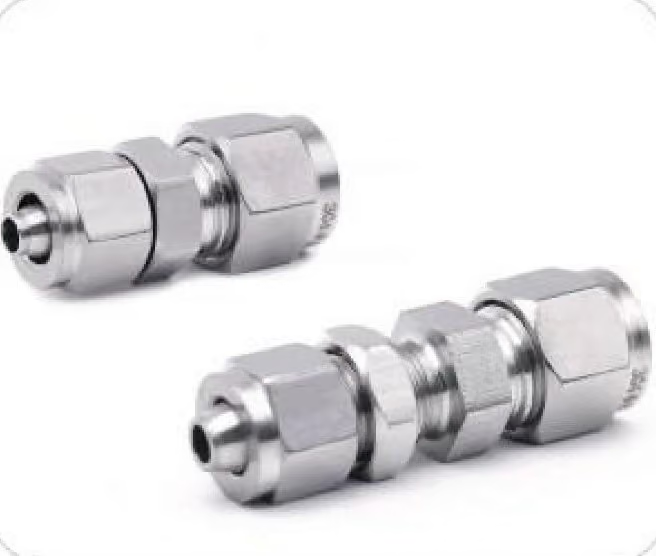
A compression joint can only fail two ways: at the seal or at the grip. Single-ferrule and double-ferrule fittings divide that work differently, and the difference decides which one belongs on your line — and what the joint costs you over its service life.
Key takeaways
- A compression joint can only fail at the seal or at the grip: single-ferrule fittings make one ring do both jobs, while double-ferrule fittings split the work between a sealing front ring and a gripping back ring.
- Standard ferrule fittings are rated up to ~11,000 psig (760 bar) in stainless, medium-pressure designs reach 20,000 psig (1378 bar), and cone-and-thread styles go to 60,000 psig (4134 bar) — but the body rating is never the assembly rating.
- Ferrules deform permanently on first makeup, so remaking a joint without replacing the ferrules — or mixing ferrule brands in one fitting — is how compression joints leak.
The anatomy of a ferrule joint
Every ferrule compression fitting has the same cast of parts: a body, a threaded nut, and one or two ferrules that deform around the tube when the nut is driven forward. The ferrules do all the work; the body and nut only supply the force. For a full primer on the joint itself, see what a compression fitting is and what a ferrule fitting does.
How a single-ferrule fitting works
One ring does both jobs. As you tighten the nut, the single ferrule bites into the tube OD and seals against the body nose in the same stroke. The stack-up is simple — nut, ferrule, body — with fewer parts, faster assembly and a lower price. DIN 2353 bite-type designs and progressive-ring (EO-style) fittings are the common single-ferrule patterns, and they serve general hydraulic and process lines well inside their rated pressures.
How a double-ferrule fitting works
Two rings split the load. The front ferrule forms the primary seal against the body and tube surface; the back ferrule grips the tube, resists pull-out and absorbs vibration. You carry more parts and a stricter assembly order — front (conical) ferrule first, then the back ring — but you get a joint that holds up on vibrating instrument panels, gas service and high-pressure lines that get remade during maintenance.
Side by side
| Factor | Single ferrule | Double ferrule |
|---|---|---|
| Seal / grip | One ring does both | Front seals, back grips |
| Parts count | Fewer, faster assembly | More, strict order |
| Vibration service | Moderate | Superior |
| Leak integrity | General service | Critical and hazardous fluids |
| Typical patterns | DIN 2353 bite type, progressive ring | Twin-ferrule instrumentation style |
| Cost | Lower | Higher |
Sizes and pressure classes
Ferrule fittings are sized by tube OD, not pipe size: fractional 1/16” to 2”, metric 2 mm to 50 mm. The connection should never be the weak point — manufacturers class them roughly as:
- Standard: up to ~11,000 psig (760 bar) in stainless
- Medium pressure: 11,000–20,000 psig (to 1378 bar), 316 SS or alloy 625
- Cone-and-thread high pressure: up to 60,000 psig (4134 bar) for severe service
A fitting’s body rating is not the assembly rating — the tube wall, material and temperature derate it. Match ferrule and body material to service: SS304 for general duty, SS316/316L for chlorides and marine exposure, brass on copper systems, and Monel or Hastelloy ferrules for seawater or strong acids.
The ferrule hardness rule
A ferrule must be harder than the tube it bites, or it cannot swage and lock. Fully annealed stainless tube in the maker’s hardness range seats most reliably; hard hydraulic tube refuses the bite and leaks on gas service no matter which design you pick. If you are unsure about your tube, say so on the RFQ — it changes the recommended ferrule set.
Assembly and remaking
No special tools are needed: cut square, deburr, slide on nut and ferrules in order, seat the tube to the body shoulder, then tighten — typically 1-1/4 to 1-1/2 turns past finger-tight, or the maker’s gauge. Over-tightening damages the ferrule; under-tightening leaks. Two rules that prevent most callbacks: never mix ferrule brands in one fitting (geometries are not interchangeable), and replace the ferrules whenever you remake a joint — they deform permanently on first makeup. The full sequence is in how to install compression fittings.
How to choose
- Stationary hydraulic or light industrial line, cost-sensitive: single ferrule rated for your pressure class.
- Instrument panel, gas service, vibration, or joints you will remake: double ferrule.
- Severe cyclic pressure or vibration beyond fitting ratings: step up to cone-and-thread medium/high-pressure styles rather than forcing a standard joint.
FerruleX manufactures double-ferrule stainless steel compression fittings in SS304 / SS316 / SS316L — including replacement ferrules, straight unions and bulkheads for metric and imperial tube OD. Send tube size, material and service on the RFQ and we match the ferrule set.
FAQ
Is double ferrule always better than single? No. On a stationary line inside the rating, single ferrule performs the same at lower cost. The double-ferrule advantage shows up under vibration, on gas service, and where joints are remade.
Can I mix ferrules from different brands in one fitting? Do not. Front ferrule, back ferrule, nut and body are matched as a set by geometry and hardness. Mixing brands produces leaks at best and pulled joints at worst.
What tube hardness works with double-ferrule fittings? Use fully annealed tubing in the hardness range the fitting maker specifies. Hard hydraulic tube is a common cause of first-time leaks on gas lines.
How many times can I remake a compression joint? The fitting body usually survives many remakes, but the ferrules do not — replace them every time you disassemble. Cut the tube back to an undamaged section before reassembly.
Are single-ferrule fittings approved for gas service? Only when the specific series carries that approval. Check the manufacturer’s rating for the complete assembly — do not assume from the body material.


