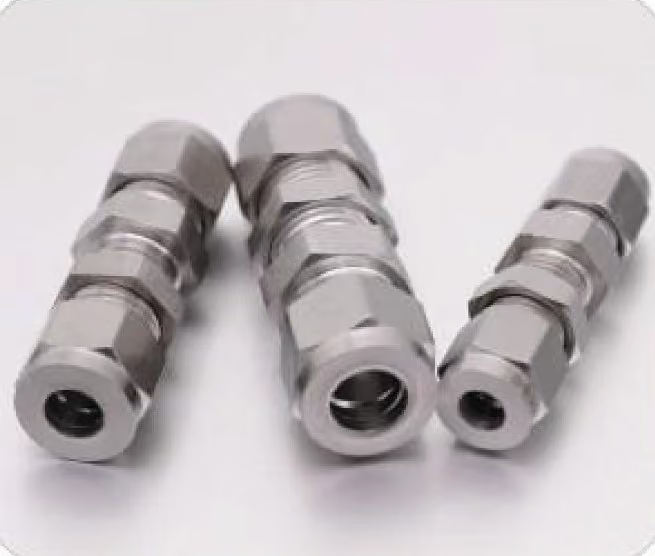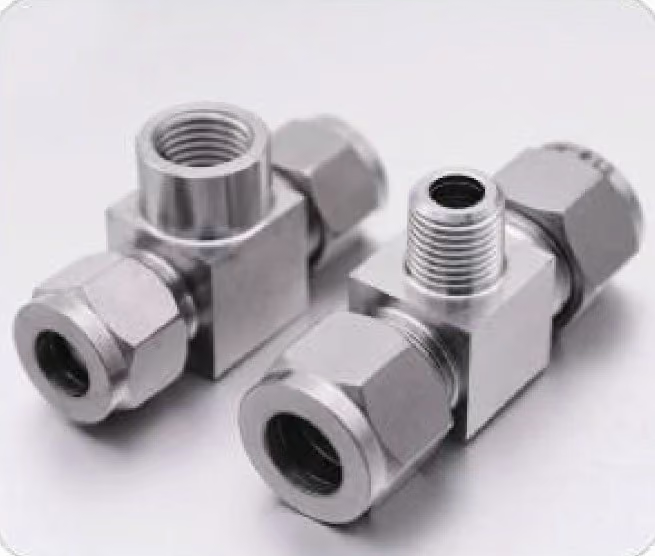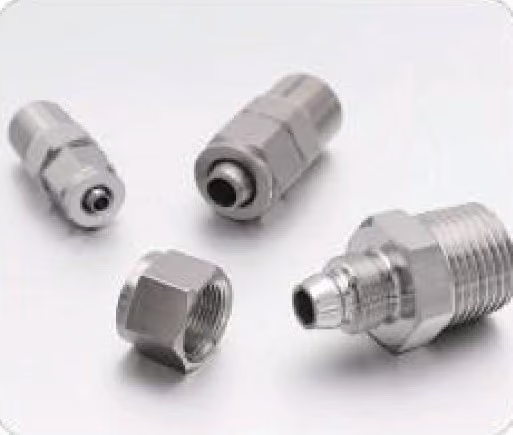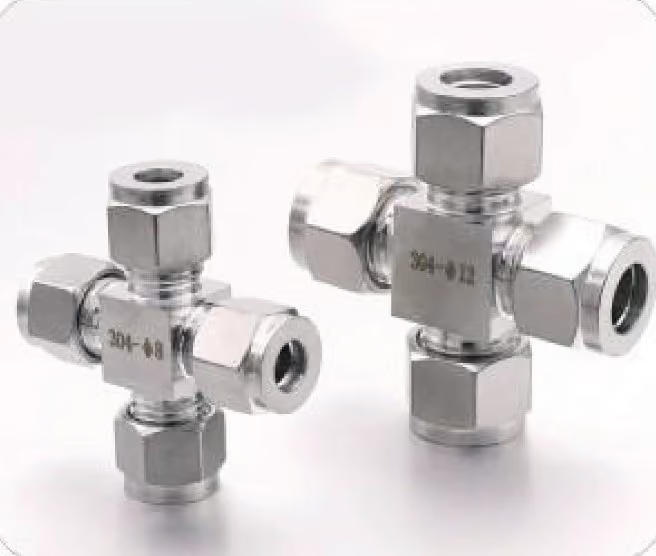
A compression fitting joins metal tubing to a port or to another tube without welding, threading the tube, or any hot work at all. The joint is made by tightening a nut, which drives ferrules onto the tube surface until they bite and seal — a mechanism that has carried instrumentation panels for decades because it is remakeable, portable and dependable on clean tube.
Key takeaways
- A compression fitting seals by mechanical bite: tightening the nut drives one or two ferrules onto the tube OD, forming a metal-to-metal seal and grip in the same assembly — no welding, no thread sealant, no heat.
- Compression fittings are sized by tube outside diameter, not pipe size: fractional 1/16” to 2” and metric 2 mm to 50 mm cover the practical range.
- Choose compression when the joint must be assembled and remade in the field; choose threaded adapters for pipe ports and weld ends only where the joint will never need to come apart.
How the complete joint works
Every compression joint — whatever the brand or pattern — has the same working cast: a body with a conical seat, one or two ferrules (metal rings), and a threaded nut. Assembly follows one logic:
- The tube is cut square, deburred and slid through the nut and ferrules.
- The tube end seats against the shoulder of the body.
- Tightening the nut pushes the ferrules forward into the body’s cone.
- The cone forces the ferrule(s) to swage — bite — into the tube surface while pressing a seal against the body seat.
The ferrules do all the sealing and gripping; the nut and body only supply the force. Because the seal is mechanical, it tolerates vibration and remaking better than any dope-and-thread joint, provided the tube is within the maker’s hardness range and the ferrules are assembled in the right order.
Single or double ferrule?
Two patterns divide the family. A single-ferrule fitting makes one ring do both jobs — seal and grip — and suits stationary lines inside its rated pressures. A double-ferrule fitting splits the work: the front ferrule forms the primary seal while the back ferrule grips against pull-out and absorbs vibration. The double pattern is the default on instrumentation, gas service and anywhere joints are remade. The full comparison of patterns, pressure classes and selection rules lives in single ferrule vs double ferrule — the short version: vibration and remaking push you to double.
Compression vs threaded vs weld
| Need | Typical choice | Why |
|---|---|---|
| Removable instrument tube run | Compression (double ferrule) | No hot work, remakeable, vibration-proof |
| Connection into a pipe thread port | Threaded adapters / valves | The port already has the thread |
| Permanent process joint | Weld ends | No mechanical joint at all, highest purity |
| Soft tubing that cannot take a bite | Compression with insert | Tube ID support against collapse |
Threaded pipe joints seal on tape or sealant and suit pipe; compression suits tube; weld suits permanence. Mixing them on one skid is normal — the skill is putting each where its mechanism belongs.
Tube OD sizing
Compression fittings are sized by tube outside diameter — never by pipe size and never by the thread on the port end. Fractional sizes run 1/16” to 2”; metric runs 2 mm to 50 mm. A “6 mm compression fitting” expects 6.0 mm tube; a “1/4 inch” expects 6.35 mm. They are close but not interchangeable, and ordering the wrong system is a classic cross-border mistake — check the tube marking before the RFQ, not after the leak test.
Where compression fittings earn their place
Analyzer and sample lines, gauge and instrument manifolds, pneumatic and hydraulic control tubing, food and beverage process instrumentation, marine and offshore panels — anywhere a clean tube run needs dependable, remakeable joints without a welder on site. They are not the answer for everything: slurries and solids plug the fine seal geometry, and very high-pressure severe service belongs to cone-and-thread or welded systems.
Factory RFQ tip
Send tube OD, thread on the port end, material and quantity — for both ends if they differ. Soft annealed tube seals more reliably on gas service; if you are unsure about tube hardness, say so and we flag it before quoting (see how to install compression fittings for what happens at assembly). Browse the compression category or request a quote.
FAQ
Is a compression fitting the same as a ferrule fitting? Almost — “ferrule fitting” names the family after its sealing element, and catalogs use both terms for the same joints. The ferrule-level detail — bite mechanics, hardness rules, remake limits — is covered in what is a ferrule fitting.
Can compression fittings be reused? The fitting body and nut survive many remakes; the ferrules do not — they deform permanently on first makeup and must be replaced every time the joint is opened. Remake with new ferrules on a freshly cut tube section and the joint performs like new.
Do compression fittings need sealant or tape? No. The seal is metal-to-metal between the ferrule and the body seat. Sealant on the tube can actually lubricate the bite and cause under-tightening — assemble clean and dry, then tighten to the maker’s prescription.
What is the difference between tube OD and pipe size? Pipe size (NPS) describes a nominal bore with a fixed OD per schedule; tube size is the actual outside diameter of the tube. Compression fittings grip the tube OD, so a 1/2” compression fitting fits 1/2” tube — its bore has nothing to do with pipe schedules.
Can I mix tube sizes in one fitting? Yes — reducing unions and connectors join different tube ODs in one body, and adapters step from tube OD to pipe thread on the port side. List both sizes explicitly on the RFQ so the factory quotes the right body.
Related: flare vs compression fittings.