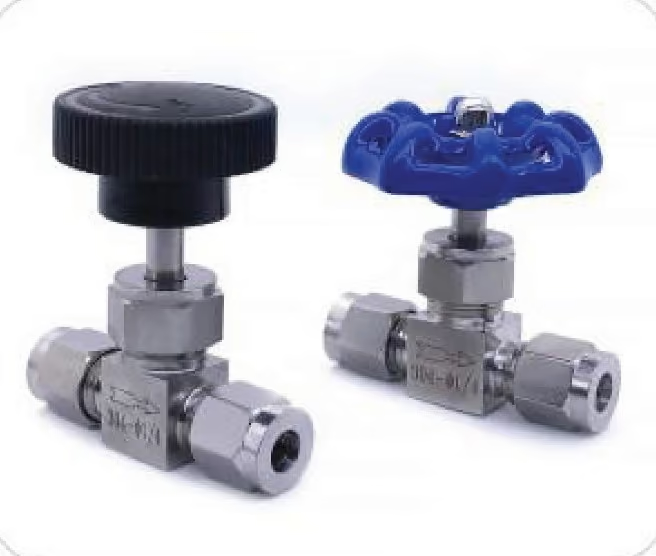
Buyers searching tube fitting types usually need a map of the stainless options before they open a size chart. FerruleX manufactures five families, and each earns its place on a different property: sealing mechanism, speed of assembly, or permanence. This hub orients you; the deep dives and product categories linked below carry the numbers.
Key takeaways
- The five families — compression (double ferrule), quick-screw, push-to-connect, threaded adapters and weld — differ mainly in how they seal and whether the joint is meant to come apart again.
- Compression is the leak-tight, remakeable default for metal instrument tube; push-to-connect and quick-screw trade some integrity for assembly speed on air and light-fluid lines; weld is for joints that should never move again.
- Match the family to the medium, pressure and maintenance plan first — then let tube OD and thread standard pick the exact SKU.
Compression / double ferrule
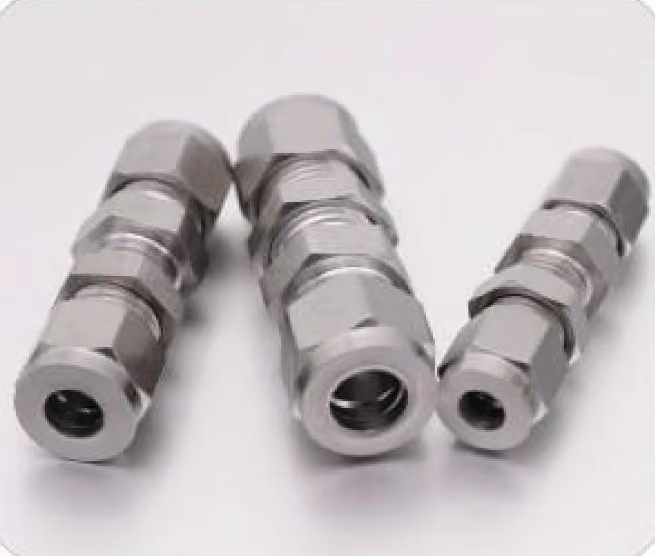
The instrumentation default. A nut drives front and back ferrules onto the tube: the front seals metal-to-metal, the back grips and absorbs vibration. No hot work, no sealant, and the joint remakes with new ferrules when maintenance demands it. Best for gas service, analyzer lines, gauge manifolds and anywhere leak integrity matters most. Limitation: it is deliberate assembly, not fast assembly, and soft or undersized tube needs the right ferrule set. Depth: single ferrule vs double ferrule and tube compatibility.
Quick-screw / push-in
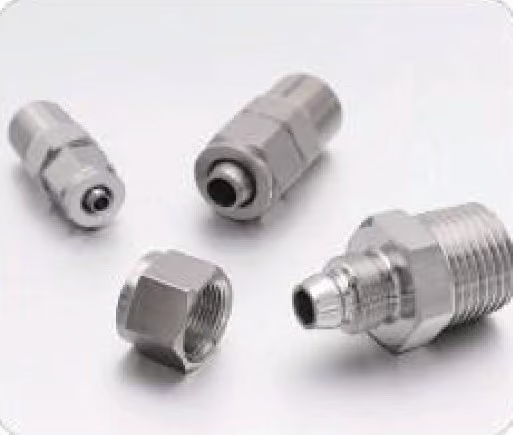
A FerruleX middle ground between compression and push-in: a screw-retained collet pattern that assembles faster than a full ferrule makeup while keeping a metal sealing geometry on stainless tube. It suits light-fluid and pneumatic skids where panels are built in volume and rework is occasional rather than constant. Limitation: it is not the choice for high-integrity gas service — for that, step up to compression.
Push-to-connect
Collet teeth grip the tube and an O-ring seals the surface — push the tube in, press the collar to release. It is the fastest assembly of the five and thrives on OEM pneumatic panels that are reconfigured often. The limits are mechanical: tube must meet the series’ OD tolerance and surface condition, the joint dislikes side loads and vibration, and rigid metal tube only works where the series explicitly approves it. Depth: how push-to-connect fittings work.
Threaded adapters and plugs
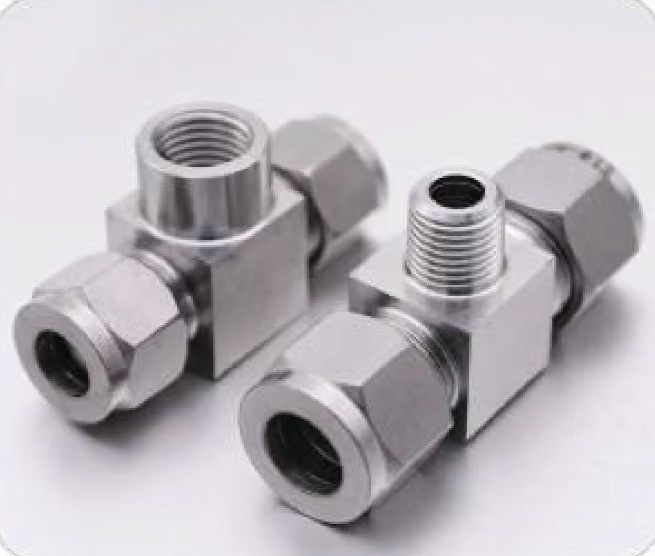
The pipe-port family: male and female adapters, elbows, tees, plugs and caps in NPT, G and metric threads. Adapters bridge tube systems to pipe threads; plugs and caps seal unused ports for hydrotest and shipping. They seal on tape or sealant (taper threads) or bonded washers and O-rings (parallel threads) — pick the standard per the port, and never mix NPT with G. Depth: NPT vs G threads.
Weld connectors
Permanent by construction: butt-weld or socket-weld ends fused to the tube or pipe. No mechanical joint to loosen, no crevice at the seal — the pick for high-purity, high-pressure and sanitary process runs. The cost is inflexibility: the joint needs a cutting torch or saw to open, so maintenance-heavy instrument lines belong on compression instead.
How the families map to media
The mechanism decides the medium. Metal-sealed compression and weld joints tolerate gases, solvents and high temperatures that creep or attack elastomer-sealed quick connectors. Push-to-connect O-rings and quick-screw seals prefer air, water and light fluids at modest temperature. Threaded adapters follow the port, not the media. When a skid carries several media, it is normal — and correct — for two or three families to share the same panel.
How to choose quickly
| Priority | Start here | Why |
|---|---|---|
| Leak-tight gas or instrument run | Compression | Metal-to-metal seal, remakeable |
| Fast pneumatic assembly | Quick-screw / push-to-connect | Speed, tool-light panel building |
| Pipe thread port only | Adapters / plugs | The port already dictates the thread |
| Permanent process joint | Weld | No mechanical joint at all |
| Mixed needs on one skid | Combination | Each joint gets its best mechanism |
Browse the families: quick-screw fittings, compression fittings, push-to-connect, plugs & barbs and adapters & weld.
Send media, pressure and tube OD on the RFQ if two families could fit — we will pick the stocked series that ships fastest.
FAQ
Which fitting type is best for gas service? Compression with a double-ferrule set. The metal-to-metal seal holds tight on gas where elastomer-sealed quick connectors creep, and the joint can be remade correctly with new ferrules.
Can I use push-to-connect on stainless steel tube? Only where the specific series approves that tube type and size — most push-in fittings are designed for nylon or polyurethane. Check the maker’s tube list before assuming; on rigid metal tube, compression is usually the safer answer.
What is the difference between quick-screw and push-to-connect? Both assemble fast, but quick-screw adds a screw-retained collet with a metal sealing pattern aimed at stainless tube, while push-to-connect relies on collet teeth plus an O-ring and is happiest on approved polymer tubing. Quick-screw leans toward durability; push-in leans toward speed.
When should I choose weld ends over compression? When the joint must never leak and never come apart: high-purity process lines, high-pressure permanent runs, sanitary systems. If maintenance will ever need to open the joint, compression or threaded is the honest choice.
Do I need different fittings for metric and imperial tube? Each family carries both: metric tube OD (2 mm and up) and fractional imperial sizes are parallel catalog ranges. Just state which system your tube follows on the RFQ — a 6 mm and a 1/4” fitting are close in size but not interchangeable.