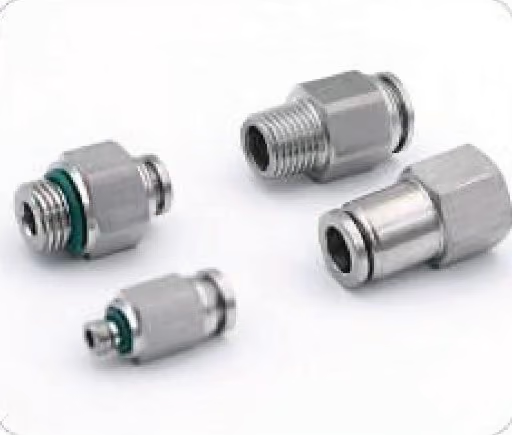
Push-to-connect fittings are reliable for correctly specified pneumatic tubing in ordinary stationary service — but they are not magic. The fitting grips with a metal collet and seals with an O-ring, and both only work when the tube matches the series’ tolerances and the line is protected from side loads. Understand the mechanism and you will know exactly where the limits are.
Key takeaways
- A push-to-connect fitting holds a line with only two working elements — angled collet teeth for grip and an O-ring for seal — so tube OD tolerance, undamaged surface and full insertion depth decide whether it leaks.
- Push-to-connect pressure ratings are series-specific, not category-wide: SMC’s KQ2 range lists ~1 MPa (145 psi) while Festo’s QS line rates −0.95 to +6 bar, and ratings must be verified at the operating temperature, not the 20 °C catalog condition.
- For a permanent gas line, rigid metal tube, or any line that will be tugged or worked by vibration, a compression fitting is the more robust joint; push-to-connect earns its place on panels that are assembled and reconfigured often.
What is inside the fitting
Five parts do all the work:
- Release collar — the ring you press to disconnect
- Collet (chuck) — angled metal teeth that wedge against the tube OD
- O-ring — the primary seal against the tube surface
- Body — houses the collet and O-ring, ends in your thread port
- Thread seal — typically pre-coated or with thread sealant
Push the tube through the collar and into the body. The collet teeth bite the tube OD and resist pull-out — pulling the tube outward actually tightens their grip — while the O-ring seals the surface. Press the collar and the teeth lift; the tube slides out. That is the entire mechanism: collet for retention, O-ring for sealing. Nothing else is holding your line together, which is why tube condition and routing discipline decide reliability.
Tube requirements
- OD tolerance: the tube must match the fitting’s nominal size. Major pneumatic makers specify roughly ±0.1 mm for nylon and about +0.15/−0.2 mm for polyurethane.
- Surface condition: round, undamaged OD, cut square with a tube cutter — not shears, which oval the end. Scratched or oval tube leaks at the O-ring.
- Insertion depth: push fully home until it seats against the internal stop. Partial insertion is a top cause of first-run leaks.
- Material approval: nylon and polyurethane are the standard pair. Stainless or other rigid tube is compatible only where the series explicitly lists it — a collet designed for polymer tube may not bite or seal on hard metal tube at all.
| Reliability factor | What the fitting needs | What goes wrong when it’s missing |
|---|---|---|
| OD tolerance | Tube matches the series’ nominal size (≈±0.1 mm for nylon, +0.15/−0.2 mm for polyurethane) | Collet grips unevenly and the O-ring cannot conform — leaks from day one |
| Surface condition | Round, undamaged OD, cut square with a tube cutter | An oval or scratched end bypasses the O-ring seal |
| Insertion depth | Tube pushed fully home against the internal stop | Partial insertion is a top cause of first-run leaks |
| Tube material approval | The series explicitly lists the tube type — stainless only where stated | A polymer-rated collet may not bite or seal hard metal tube at all |
| Side loads and vibration | Routing and supports keep bending loads off the joint | Collet and O-ring are worked by tube movement — leaks appear only under vibration |
| Reuse condition | Cut the tube back past the collet marks before reinsertion | The previously gripped zone is scratched or ovalized and leaks on reassembly |
Pressure and temperature
Ratings are series-specific, not category-wide. For reference, SMC’s KQ2 range is listed to 1 MPa (~145 psi), while Festo’s QS documentation rates −0.95 to +6 bar across its temperature range. Temperature, tube material and size, fluid and the exact series all move the allowable working pressure — verify at your operating temperature, not at the 20 °C catalog condition, and remember polyurethane swells under pressure, which is why a tube that fit yesterday can resist reinsertion today.
Shapes for panel building
Push-in bodies come in the same routing shapes as compression fittings — straight, elbow, union, bulkhead — plus function fittings like throttle valves for flow control at the joint. Stainless-body versions suit corrosive washdown environments where brass or nickel-plated bodies pit. For an overview of how these sit alongside other tube connection styles, see types of stainless tube fittings.
Installation in six steps
- Cut the tube square; verify OD with calipers if the tube is not from the fitting maker.
- Deburr and clean the end; check the tube is round, not oval.
- Mark the insertion depth if the fitting has no shoulder stop.
- Push straight in — no twisting — until the tube bottoms.
- Pull back gently to confirm the collet has engaged.
- Pressurize and check with leak-detection fluid, not just your ear.
Vibration, pull-out and reuse
- Vibration and side loads: makers warn against twisting, pulling, moment loads and impact. Route and support the tube so bending and vibration never reach the joint; use rotary fittings for oscillating lines.
- Pull-out: retention depends on tube material, OD, insertion depth and external load — there is no single category rating. If a line will be tugged or bent sharply, a compression fitting is the more robust joint.
- Reuse: tube removal is designed to be repeatable — press the collar, withdraw, inspect the end. But a tube scratched or ovalized where the collet gripped should be cut back before reinsertion. Thread-seal reuse limits (some makers allow ~5 reuses on the threaded side) do not apply to the tube interface.
When compression fittings win
Spec a compression fitting instead when the tube is rigid metal, when external loads or vibration exceed push-in ratings, or when the tube material is not on the approved list. Push-to-connect earns its place where panels are assembled and reconfigured often — just respect its tolerances and keep the loads off the joint.
FerruleX stocks stainless push-to-connect fittings for OEM panels, plus quick-screw styles where you want tool-light assembly with a metal sealing pattern.
FAQ
Are push-to-connect fittings airtight? Yes, when the tube OD is in tolerance, the surface is undamaged and the tube is fully inserted. Most leaks trace to one of those three.
Can push-to-connect fittings be used on stainless steel tubing? Only if the specific series approves that tube type and size. Do not assume compatibility from the catalog name — check the maker’s tube list.
Why does my polyurethane tube pop out under pressure? Check insertion depth first, then OD tolerance. Pressure-swollen polyurethane can also make reinsertion difficult — cut the tube back to a fresh, round section.
Push-to-connect or compression for a permanent gas line? Compression. Push-in fittings are built for pneumatic convenience, not permanent high-integrity service.
Why do my fittings leak only when the machine vibrates? The collet and O-ring are being worked by tube movement. Add tube supports to carry the bending load away from the fitting, or switch to a compression joint at that station.
Why does my fitting spin freely on the tube and never grip? Work the checks in order. First, that the tube OD actually matches the fitting size. Second, insertion depth: the tube must be pushed in until it bottoms — for common 4–12 mm pneumatic tube that is roughly 14–22 mm of engagement, and makers provide depth marks or gauges for the exact figure. Third, the tube surface: scratches, paint, dirt or a deformed cut let the collet teeth skate instead of bite. Last, the collet itself — worn or sprung teeth grip nothing regardless of tube condition. A fitting that spins with zero axial resistance usually means the tube never reached the collet at all: re-cut, mark the depth, insert fully and pull-test. If the tube instead pops out under pressure, that is the swelling and depth failure covered above.


