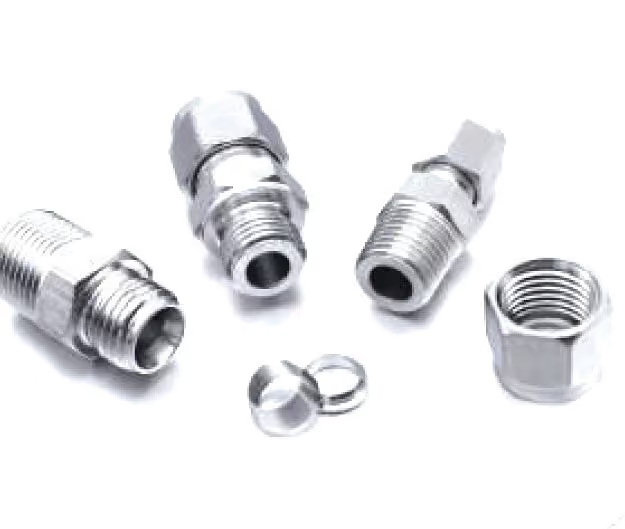
Sometimes — but “stainless fitting” alone is not a compatibility guarantee. Whether a stainless compression fitting holds on copper or plastic tube depends on three things: ferrule material, tube hardness, and usually a support insert. Get any one of the three wrong and the joint leaks, creeps, or pulls out months after installation.
Key takeaways
- A ferrule must be harder than the tube it bites, which is why fitting makers recommend brass ferrules — not stainless — on soft copper tube.
- Plastic tubing such as nylon, PE, PP, PTFE and vinyl needs a metal fitting series approved for that tube plus a support insert sized by both OD and ID, or the joint creeps, weeps or pulls out under load.
- The working pressure limit of a stainless fitting on any tube belongs to the complete assembly — fitting, ferrule, insert, tube, fluid and temperature — so the lowest-rated component sets the limit.
The basic rule: match materials, with exceptions
Fitting makers’ default guidance is to use like materials — stainless ferrules on stainless tube, brass on copper, plastic on plastic. The reason is mechanical: the ferrule must be harder than the tube so it can swage and lock (the fitting family covered by ISO 8434-1, metallic 24° cone connectors). A brass ferrule on stainless tube never gets its full bite; a hard stainless ferrule on soft tube bites too aggressively.
The exceptions matter too. On copper tube, brass ferrules are the recommendation precisely because brass is a copper-zinc alloy — functionally a like material that grips without galling. And sometimes you deliberately want a soft ferrule: a Teflon front ferrule with a nylon back ferrule lets you seal around a thermocouple probe or glass tube without locking it in place or fracturing it.
Copper tubing
The conservative rule from major fitting makers: on copper, use brass ferrules and bodies, not stainless — a hard stainless ferrule can score, oval or crack soft copper instead of seating cleanly, and several installation specs explicitly exclude stainless ferrules on copper tube. If you must join stainless to copper (a mixed-metal instrument run, for example), use a fitting series the maker explicitly approves for that tube, and verify the copper’s hardness and wall thickness first. Also plan for galvanic corrosion at the joint in wet service — a dielectric separation or sealed environment extends the life of any stainless-to-copper transition.
Plastic tubing: nylon, PEX, PTFE
Several metal compression-fitting families are approved for plastics such as nylon, polyethylene, polypropylene, PTFE and vinyl — with normal makeup procedure and a properly sized insert when required. The insert is a sleeve that supports the tube ID so the ferrule cannot collapse or creep it under load. Select it by both tubing OD and ID; a soft-tubing insert is not automatically right for rigid PEX or PTFE.
Quick reference by tube type:
| Tube | Ferrule approach | Insert |
|---|---|---|
| Soft copper | Brass ferrules (not stainless) | Not normally |
| Nylon / PE / PP / vinyl | Approved metal fitting + ferrule set | Yes, size by OD + ID |
| PTFE | Own approved arrangement | Check maker — rigid tube |
| PEX | Own approved arrangement | Check maker — do not assume soft-tube insert fits |
| Stainless | Stainless ferrules | No |
Pressure and temperature
There is no single rating for “stainless on plastic.” The working limit belongs to the complete assembly — fitting, ferrule, insert, tube, fluid and temperature together. A 6,000 psi stainless body tells you nothing about a nylon tube run at 60 °C; plastics soften, swell and creep with temperature, so the derating curve matters more than the headline number. Get the assembly rating from the maker for your actual conditions, and treat the lowest-rated component as the limit.
Common failure modes
- Leaks from under-tightening or skipping the prescribed turns past finger-tight
- Tube pull-out from inadequate grip or a missing insert
- Plastic creep under the ferrule over weeks of load, showing up as a slow weep
- Tube collapse or flow restriction where an insert was required but omitted
- Scored or cracked tube from a mismatched (too hard) ferrule
- Galvanic corrosion on stainless-to-copper joints in damp enclosures
What to send with your RFQ
Tell FerruleX the tube material, OD and ID, the fluid, and the working pressure and temperature — not just the thread size. That is the difference between a fitting that holds and a callback. We supply stainless compression tube fittings from male connectors to bulkhead unions, and we will flag when your tube calls for an insert, a brass ferrule set, or a different series entirely.
FAQ
Can I put a stainless compression fitting on soft copper tube? Most manufacturers recommend brass ferrules on copper. Stainless ferrules risk scoring or ovaling the tube. Use an approved series if you must mix, and protect the joint from galvanic corrosion.
Do I always need an insert with plastic tubing? Use one whenever the fitting manufacturer requires it — typically on soft tubing. Choose it by tubing OD and ID.
Why did my plastic tube fitting leak after a month? The usual causes are creep under the ferrule, a missing or wrong-size insert, or temperature above the assembly rating. Re-cut the tube past the grip marks and remake with a new ferrule set.
Is PTFE tube treated like nylon? No. PTFE is rigid and needs its own approved fitting arrangement; do not assume a soft-tubing insert fits it.
What if my tube is harder than the ferrule? Swap to a harder ferrule set or a series designed for hard tube. A soft ferrule on hard tube cannot swage, and the joint will pull out under pressure.
Can I use a brass compression fitting on brass tube? Usually, yes — fitting makers sell brass ferrule sets explicitly for brass, copper and iron tube. It is a like-on-like pair (brass is a copper-zinc alloy), and the same-metal sliding risk behind thread galling in stainless steel does not really apply: a ferrule is pressed radially into the wall, not slid under torque, and brass — ductile and among the more galling-resistant metals — swages a clean bite. It follows the domestic-plumbing convention (BS EN 1254-2). The boundary is duty, not the pairing: brass tops out near 3,000 psi where stainless instrument fittings reach 10,000, its temperature ceiling is hundreds of degrees lower, and ammonia service or dezincifying water attack the zinc in the alloy.


