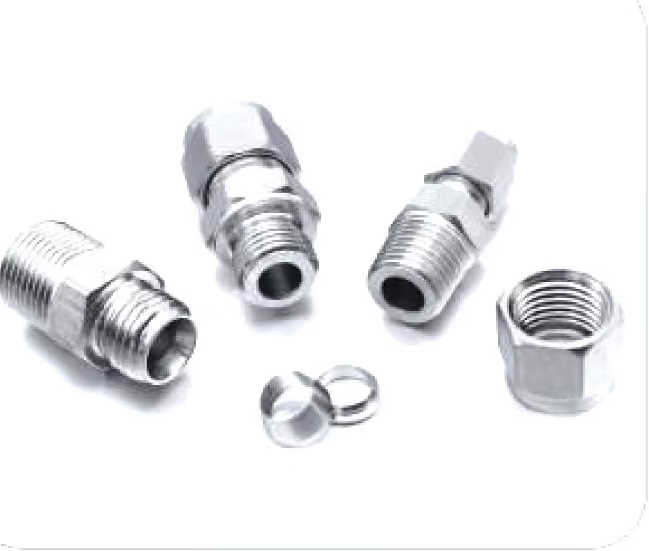
Instrumentation fittings are the precision connectors and valves that join small-bore tubing to process instruments — pressure transmitters, flow meters and analytical devices — in measurement and control systems. Their job is to keep gas-tight, leak-tight tube systems sealed at working pressure while the instrument reads the process accurately. That definition sounds close to plumbing, but the duty is fundamentally different — and the difference explains every design choice in the family. Here is what the term covers, family by family.
Key takeaways
- Instrumentation fittings are precision components for process measurement and control: they connect small-bore tubing to instruments like pressure, flow and analytical devices, and are built to hold a gas-tight seal at working pressure.
- The families: tube compression bodies and unions; instrument valves (needle, ball, check); manifolds (2-, 3- and 5-valve); gauge blocks and gauge valves; and tube supports.
- They are typically 316 stainless with tight dimensional tolerances because instrument lines carry gas and process fluid where a weep is a failed reading — corrosion resistance and a reliable ferrule seal both start with the material and the machining.
- They are not plumbing fittings: instrument work uses small OD tube, controlled service and leak-tight criteria, while plumbing joins larger pipe for water and drainage — the two are not interchangeable even at matching nominal sizes.
The families at a glance
| Family | What it does | Typical service |
|---|---|---|
| Tube compression bodies and unions | Join tube runs and connect tube to ports with a ferrule seal on the OD | Every instrument impulse and supply line |
| Instrument valves — ball, needle, check | Shut off, throttle or prevent reverse flow at the instrument | Isolation and vent points, sampling lines |
| Manifolds — 2-, 3- and 5-valve | Combine block, equalize and vent valves in one body for transmitters | Differential-pressure transmitter hookups |
| Gauge blocks and gauge valves | Mount and isolate a pressure gauge or transmitter, with bleed where designed | Local gauge stations |
| Tube supports and crossovers | Hold small-bore tube in position and carry lines across panels | Anywhere vibration or movement must be managed |
The manifold row deserves a word, because it is where instrumentation fittings most visibly differ from ordinary valves: a 2-valve manifold isolates and vents a static-pressure instrument, a 3-valve manifold adds equalization for a differential-pressure transmitter, and a 5-valve version adds vent ports so calibration and maintenance happen without breaking the line. One body replaces several threaded joints — fewer potential leak points on exactly the connections that must never weep. The three standard configurations have their own catalog pages: the 2-valve manifold, 3-valve manifold and 5-valve manifold.
Why 316 and tight tolerances
Instrument lines fail in a different way from water lines: a joint that weeps a trace of gas does not flood the floor — it drifts the measurement. Gas molecules escape through imperfections water never finds, and analytical instruments turn contamination into wrong readings. The material answer is 316 stainless steel, chosen for corrosion resistance across the broad run of process fluids, and the machining answer is tight dimensional control so the ferrule lands exactly where the seal geometry expects it. That seal logic is shared across the family — the single- versus double-ferrule choice is the same engineering question covered in single ferrule vs double ferrule fittings, and the tubing it bites into is covered in bright annealed tubing.
How they differ from plumbing fittings
Plumbing fittings join larger pipe — water, drainage, building services — with threaded, soldered or push-fit joints sized for flow and convenience. Instrumentation fittings join small OD tube to instruments under a leak-tight criterion, sized by actual tube diameter, machined to close tolerances and tested as a sealed system. A half-inch plumbing elbow and a half-inch instrument compression body share nothing but the word “half inch”: different sizing systems, different sealing mechanisms, different failure costs. Even where a nominal size appears to match, the parts are not interchangeable — the instrument fitting’s port, ferrule and pressure rating exist for a duty the plumbing fitting was never designed to meet.
What this means for an RFQ
Specifying instrumentation fittings is mostly a statement of tube and duty: tube OD (metric or fractional) and wall, the service — gas, process fluid, pressure and temperature — and the families needed to land it: compression bodies and unions for the runs, a needle or ball valve at each isolation point, a manifold at each transmitter, gauge blocks at local stations, supports where the tube must not move. Stating service alongside size is what lets the factory match material and rating rather than just dimensions.
FerruleX builds the instrument-panel side of the catalog: instrumentation tubing in 316 stainless, needle valves for throttling isolation, and check valves for reverse-flow protection. Send the tube OD, service conditions and the hookup sketch on the RFQ and we quote the fittings as a panel list. Request a factory quote.
FAQ
What are instrumentation fittings? Precision components that connect small-bore tubing and instruments in process measurement and control systems. They join tube runs and instruments such as pressure, flow and analytical devices, and are designed to hold a leak-tight seal at working pressure.
What are the main types of instrumentation fittings? Five families: tube compression bodies and unions; instrument valves (ball, needle and check); manifolds (2-, 3- and 5-valve); gauge blocks and gauge valves; and tube supports. Together they cover the run, the isolation points and the instrument take-offs.
Why are instrumentation fittings made of 316 stainless steel? For corrosion resistance across a wide range of process fluids and atmospheres. Instrument lines carry gas and analytical samples where material contamination or a weeping joint corrupts the measurement, so the material is chosen for the process environment, not just the pressure.
What is the difference between instrumentation and plumbing fittings? Sizing, sealing and duty. Instrumentation fittings join small OD tube to instruments with a leak-tight criterion; plumbing fittings join larger pipe for water and drainage. The two families are not interchangeable even where a nominal size appears to match.
What is a 3-valve manifold used for? It connects a differential-pressure transmitter to its two impulse lines with block valves on each leg and an equalizing valve between them — allowing isolation, equalization and calibration without loosening a single tube fitting.


