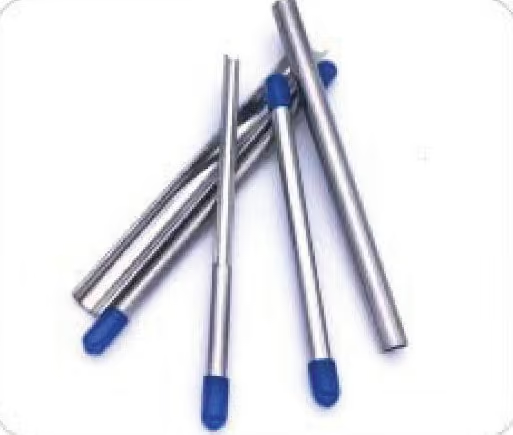
Bright annealed tubing — BA tube — is stainless tubing whose final heat treatment happens in a closed furnace under hydrogen or vacuum, so the metal never oxidizes and exits bright, clean and unpickled. That single process difference changes the surface chemistry, the cleanliness and the sealing behavior of the tube — which is why instrumentation and high-purity systems specify it almost by default.
Key takeaways
- Standard annealing happens in air and leaves oxide scale that must be pickled off; bright annealing happens in a hydrogen or inert atmosphere, so no scale forms, no pickling is needed, and the passive chromium-oxide layer stays intact.
- The payoff is measurable: BA surfaces run roughly Ra 0.04–0.6 µm depending on grade, versus ~0.9–1.4 µm for pickled tube — a smoother, more corrosion-resistant surface that also gives compression ferrules a consistent, clean bite.
- BA tube is normally written to ASTM A269 — but A269 alone does not mandate a Ra value, so the purchase order must state the finish explicitly (for example, ID Ra ≤ 0.4 µm) or two “A269 BA” deliveries can differ wildly.
The process difference
Standard tube is annealed in open or combustion atmospheres. Oxygen attacks the surface, and the tube exits the furnace with oxide scale that must be removed by pickling — an acid bath that strips the scale but also roughens the surface and damages the corrosion-protective oxide layer, which must then be passivated back. Bright annealing replaces the air with a controlled atmosphere of hydrogen or inert gas in a closed furnace: the tube heats, recrystallizes and cools without oxidizing, exits mirror-bright, and skips the pickle-and-passivate cycle entirely. The passive layer forms naturally in the furnace and stays intact.
BA vs standard annealed
| Aspect | Standard annealed (pickled) | Bright annealed (BA) |
|---|---|---|
| Furnace atmosphere | Air / combustion gases | Hydrogen or inert / vacuum |
| Surface after anneal | Oxide scale; pickled matte finish | Bright, scale-free, no pickling needed |
| Oxide / passive layer | Stripped by pickling, re-passivated | Intact, formed in the furnace |
| Typical ID Ra | ~0.9–1.4 µm | ~0.04–0.6 µm depending on grade |
| Cleanliness | Pickling residue risk | No acid residues |
| Cost | Lower | Higher |
| Typical service | General hydraulics, utilities | Instrumentation, high-purity, corrosive duty |
The smoother surface is not cosmetic. Bacteria and particles shelter in surface valleys — the reason hygienic and high-purity systems cap roughness — and pitting corrosion initiates at damaged passive films. BA’s intact, enriched passive layer resists pitting initiation better than a pickled surface at the same nominal grade, which matters in chloride-bearing instrument service.
Why instrumentation specifies it
Three engineering reasons. Sealing: compression fittings bite and seal on the tube OD, and a smooth, consistent, clean surface takes an even swage — rough or residue-bearing tube bites inconsistently, and inconsistent bites are the leaks that appear months later. Cleanliness: no pickle residues, no scale inclusions; the tube arrives chemically quiet, which analyzer, pharma and semiconductor lines demand. Corrosion: the undisturbed passive layer starts life stronger in chloride and marine environments. Consistent hardness matters too — instrument BA tube is controlled soft enough to accept the ferrule bite (manufacturers hold it under roughly 90 HRB), which ties directly to the hardness rule in our compression fitting guides.
Specifying it correctly
The specification trap is real: ASTM A269 is the usual standard for seamless and welded instrument tubing, but it requires only a “workmanlike finish” and does not mandate Ra values. Two suppliers can both ship compliant “A269 BA tube” at 0.4 and 0.8 µm — a two-fold difference that matters to a high-purity system. Write the finish into the purchase order: “bright annealed, ID Ra ≤ 0.4 µm,” or reference ASTM A270 where surface finish is defined by grade. Grades in practice: standard BA around Ra ≤ 0.6 µm for general instrumentation, precision BA ≤ 0.4 µm for pharmaceutical and food contact, and ≤ 0.25 µm for semiconductor and ultra-high-purity gas service. Where standard annealed tube is fine: general hydraulics and utilities where surface cleanliness is not a requirement and the budget rules.
FerruleX supplies BA and precision stainless tubing alongside the instrumentation tubing range and matching compression fittings — including BA tube in 304/316/316L. Send the standard (A269 with a stated Ra, or A270), the OD and wall, and the service, and we quote tube and fittings as one system. Request a factory quote.
FAQ
What does “bright annealed” actually mean? The tube’s final heat treatment runs in a closed furnace under hydrogen or inert gas, preventing oxidation. The tube exits bright and scale-free, needing no pickling — unlike standard annealed tube, which scales in air and must be acid-pickled, roughening the surface.
Why is BA tubing better for instrumentation? Three reasons: the smooth, clean surface gives compression ferrules a consistent bite and seal; there are no pickling residues to contaminate analyzer or high-purity lines; and the undisturbed passive layer resists pitting initiation better in chloride service.
What Ra should I specify for BA tubing? General instrumentation is well served around Ra ≤ 0.6 µm; pharmaceutical and food contact usually calls for ≤ 0.4 µm; semiconductor and UHP gas service goes to ≤ 0.25 µm. Critically, ASTM A269 does not mandate Ra — state it explicitly in the purchase order or deliveries will vary.
Is BA tubing softer than standard tube? It is annealed to a controlled softness — manufacturers hold instrument BA tube under roughly 90 HRB — precisely so it accepts the ferrule bite. Hard tube refuses the swage; that is the hardness rule from the compression fitting guides, and BA tube is made to satisfy it.
When is standard annealed tube fine? General hydraulics, plant utilities and any service where surface cleanliness and corrosion initiation are not the governing concerns. Standard annealed tube costs less and performs identically there — buy BA where the surface is doing engineering work.


