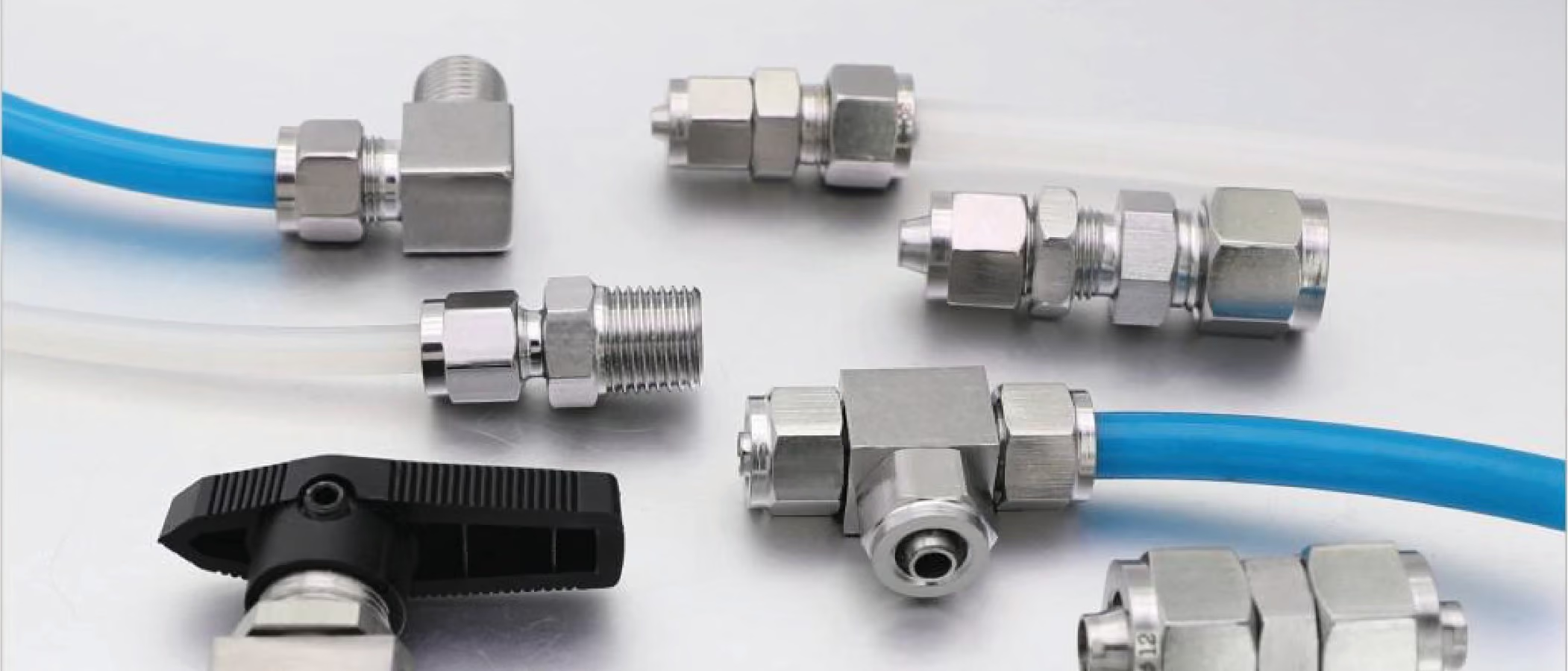
Pipe vs tube is a sizing question that quietly decides whether your fittings fit at all. Pipe is sized by a nominal name — NPS, Nominal Pipe Size — whose real outside diameter comes from a standard table, while tube is sized by its actual outside diameter and wall thickness. Order on the wrong system and the part that arrives will not match the line on the skid. Here is the difference and how to state sizes so the quote comes back right.
Key takeaways
- Pipe is sized by Nominal Pipe Size (NPS), and the name is not the measurement: NPS 1/2 pipe actually measures 0.840 inch outside, with the wall set by a schedule number (Sch 40, 80, 160) rather than a simple decimal.
- Tube is sized by actual outside diameter and wall thickness: 1/2 inch tube measures 1/2 inch (12.7 mm) on the OD, and a compression fitting seals by gripping that OD with a ferrule.
- The classic failure is asking for a “1/2 inch fitting” without saying pipe or tube — NPS 1/2 pipe takes a threaded fitting that seals in the thread taper, while 1/2 inch tube takes a compression body that seals on the OD.
- On the RFQ, state tube as OD × wall and pipe as NPS + schedule — two numbers each, and both are needed for a clean quote.
Pipe vs tube at a glance
| Aspect | Tube | Pipe |
|---|---|---|
| Dimension basis | Actual OD — 1/2 inch tube measures 0.500 inch | Nominal (NPS) — NPS 1/2 pipe actually measures 0.840 inch OD |
| Wall spec | Wall thickness as a decimal (e.g. 0.035 inch, 0.049 inch) | Schedule number (Sch 40 / 80 / 160) fixed by NPS + schedule together |
| How the fitting seals | Ferrule grips and seals on the tube OD | Thread taper seals in the threads (NPT or BSPT) |
| How it is ordered | OD × wall — “1/2 inch × 0.049 inch tube” | NPS + schedule — “1/2 inch Sch 40 pipe” |
| Typical duty | Instrumentation, hydraulics, small-bore process lines | Main process piping, threaded distribution, plumbing |
Why “half inch” means two different sizes
The nominal pipe sizes are legacy labels, not measured dimensions. For the small sizes used on instrument and process skids, the NPS name never equals the actual OD — and the wall is a second lookup, because each schedule number assigns a different wall to the same NPS. The OD reference for the sizes that come up most on fittings orders:
| NPS | Actual OD (inch) |
|---|---|
| 1/8 | 0.405 |
| 1/4 | 0.540 |
| 1/2 | 0.840 |
| 3/4 | 1.050 |
| 1 | 1.315 |
Two things to read in that table. First, the schedule changes the wall, not the OD: NPS 1/2 Sch 40 and Sch 80 have the same 0.840 inch outside diameter and different walls. Second, the gap between the two systems is why compression fittings ask for tube OD — the ferrule is engineered to swage one exact diameter, and a pipe-sized guess lands on the wrong part. Tube walls come in fractional and metric conventions; the near-misses between them are covered in metric vs fractional tube sizes, and the pipe thread that does the sealing is explained in NPT vs G (BSP) threads. A printable version of the OD and wall table lives on our pipe schedule chart sheet.
The fitting follows the sizing system
A compression fitting for tube grips the OD: the nut drives a ferrule that bites and seals around the tube’s outside surface, so the body must be bored for the actual diameter — 12.7 mm for 1/2 inch tube. A threaded pipe fitting seals in the taper of the thread itself, and its port is sized to the pipe standard, not to any measured inch. The same logic decides what you can retrofit: compression fittings join only the tube materials they are rated for, which is why the question gets its own treatment in compression fittings on copper or plastic tubing.
How to state sizes on an RFQ
For tube, give OD and wall: “6 mm OD × 1.0 mm wall 316 seamless” or “1/2 inch OD × 0.049 inch wall” — the OD selects the ferrule and body, the wall confirms the tube sits within the fitting’s grip range. For pipe, give NPS, schedule and the thread standard: “1/2 inch NPT Sch 80”. A line like “need 1/2 inch fittings” produces a follow-up question at best and the wrong part at worst; a line with OD × wall or NPS + schedule produces a quote.
FerruleX supplies both sides of this table: instrumentation tubing in metric and fractional OD, and compression fittings bored and stamped for the actual tube size. Send tube OD × wall or NPS + schedule on the RFQ and the quote comes back with the right bodies, ferrules and nuts. Request a factory quote.
FAQ
What is the difference between pipe and tube? Pipe is sized nominally: an NPS name plus a schedule number, with the actual outside diameter fixed by the pipe standard table (NPS 1/2 = 0.840 inch OD). Tube is sized by its actual outside diameter and wall thickness — 1/2 inch tube really measures 1/2 inch OD.
Is the OD of a pipe the same as its NPS size? No — for the small sizes used on skids and instrument lines, the nominal name does not match the measured OD. NPS 1/8 measures 0.405 inch and NPS 1/2 measures 0.840 inch. Always read pipe OD from the standard table, not from the name.
What does a pipe schedule number mean? The schedule is the wall-thickness series. For a given NPS, each schedule (40, 80, 160) assigns a specific wall; the OD stays the same across schedules. So “NPS 1/2 Sch 80” is a thicker-walled pipe than “NPS 1/2 Sch 40” with an identical outside diameter.
Can I use a compression fitting on pipe? No. Compression fittings are built for tube: the ferrule must grip an actual, published OD. Pipe’s OD does not match tube sizes of the same name (NPS 1/2 pipe is 0.840 inch, not 0.500), and pipe is normally joined by threaded or welded fittings rather than ferrules.
How do I measure my tube to find its size? Measure the outside diameter with calipers and the wall thickness with a gauge or from the tubing marking, then state OD × wall on the order. Do not infer tube size from a pipe name — the two systems are not interchangeable at any nominal size.
That measurement gives you the OD — and that number is the fitting’s size number, the ordering grammar of the whole compression category: fittings size by tube OD, never ID, which is also why a bare “3/16” on a drawing is a trap (a real 3/16 tube OD versus plumbing-copper nominal). The size-system rules and the pre-order checks are collected in compression fitting sizes: OD vs ID.
How do I connect tubing to pipe? With a transition fitting — never by forcing a tube ferrule onto pipe (see above). The standard families: a compression male or female connector, whose tube end grips a true tube OD and whose threaded end (NPT or BSPT) screws into the pipe; a weld-end transition adapter, with a socket- or butt-weld pipe end and a tube end; and flange adapters joining a tube run to a flanged pipe connection. Which family the code allows where depends on service: ASME B31.3 restricts threaded joints by fluid service (para. 314), so high-hazard or severe cyclic duty pushes the choice toward the welded and flanged families. The weld-end families are compared side by side in socket weld vs butt weld fittings. Match the pipe end’s pressure class to the pipe rating, not to the tube’s working pressure.


