Socket weld vs butt weld fittings is the first branch point when a line goes permanent. Both make welded joints that outlast any thread; they get there by opposite routes — one slips the pipe into a socket and fillet-welds around it, one bevels both ends and welds them full-penetration, end to end. The choice is written in the pipe size, the service and the inspection requirement, and it is made at the RFQ, not at the welder’s bench.
Key takeaways
- Socket weld (ASME B16.11): pipe bottoms in the socket, is backed off about 1/16 in for expansion, then fillet-welded — the small-bore standard through roughly NPS 2.
- Butt weld (ASME B16.9/B16.25): beveled ends, full-penetration groove weld — as strong as the pipe and fully radiographable; the standard for larger bore and cyclic service.
- The socket weld’s 1/16 in gap is thermal expansion room, during welding and in service; bottoming the pipe and welding it invites a cracked root.
- Fillet welds cannot be properly X-rayed; socket welds are inspected by visual and surface methods (PT/MT). Butt welds take RT or UT.
- Socket welds leave a crevice at the socket bottom — avoided in crevice-corrosion and severe-cyclic service; codes restrict socket welds above NPS 2 in severe cyclic conditions.
Socket weld: insert and fillet
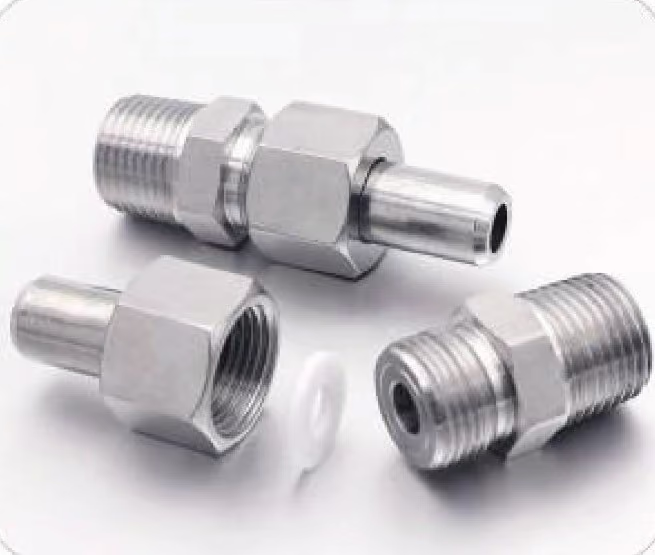
A socket weld fitting carries a bored socket sized to the pipe OD. Assembly is fast: insert the pipe to the bottom, back it off about 1/16 inch (1.6 mm), weld the fillet around the joint. The gap is the whole trick — it gives the pipe room to expand as the weld heat hits it and through service temperature swings. Weld the pipe bottomed out and the expansion strains the weld root until it cracks. Fit-up is forgiving (no beveling, no precise land), which is exactly why socket welds own small-bore work: above roughly NPS 2, the economics invert, and codes reinforce the convention — ASME B31.3 prohibits socket welds larger than NPS 2 in severe cyclic service and advises against them where crevice corrosion or severe erosion can occur. The B16.11 socket weld classes — 3000 and 6000 — cover the high-pressure small-bore territory in the adapters and weld range and the weld straight connector line.
Butt weld: full penetration
A butt weld joint is two beveled ends — typically 37.5° each with a small root face — aligned and welded full-penetration. The result has a smooth internal profile and a strength at least equal to the pipe itself; its stress concentration factor sits near 1.0 where a fillet-welded socket joint concentrates stress at the weld toe. Bevel prep costs more per joint, and that is precisely why butt weld takes over as bore grows: the fitting is cheap relative to the labor either way, and the full-penetration joint buys inspectability and cyclic-life that a fillet cannot. Our weld-end ball valve line shows the same end form on valves.
Strength and inspection
The inspection difference decides more jobs than the strength difference. A socket weld is a fillet weld: its geometry does not lend itself to radiography or ultrasonics, so inspection is visual plus surface methods — dye penetrant or magnetic particle — which see the surface, not the root. A butt weld is a groove weld: RT and UT see inside it, produce a permanent record, and are what critical-service specs demand. Add the socket’s built-in crevice — the annular gap at the socket bottom traps stagnant fluid and is a documented crevice-corrosion site — and the pattern is clear: socket weld for accessible, non-cyclic, non-crevice small-bore; butt weld where the joint must prove itself. One caution on rhetoric you will see elsewhere: claims that socket welds run at “half the strength” of butt welds overstate it — the honest statement is higher stress concentration at the fillet toe and no internal inspectability, which is why the codes restrict service, not a blanket strength ratio.
Which for instrument lines
Instrument lines overwhelmingly run compression fittings — the mechanical workhorse — for exactly the reasons in push-to-connect vs compression on stainless tubing: removability, no hot work, verified remakeability. Welding enters when the parameters outgrow the mechanical seal: high pressure or temperature past the compression comfort zone, hazardous or high-purity media where a trace leak is unacceptable, or permanent runs never meant to open. In those zones, small-bore socket weld is the common instrument-pipe answer; butt weld appears on the larger bore and the severe cyclic circuits. Either way, weld-end work should follow the thread galling discipline’s larger lesson — assembly conditions decide joint life, and on welds that means qualified procedures and specified inspection.
RFQ lines
end form— socket weld or butt weld, with the fitting standard (B16.11 / B16.9).NPS and schedule— pipe size and wall series.service note— cyclic, corrosive or crevice-sensitive duty changes the recommendation; say it.inspection requirement— PT/MT for socket welds; RT/UT percentage for butt welds.
FAQ
Can socket welds be X-rayed?
Not meaningfully. A fillet weld’s geometry does not lend itself to radiographic or ultrasonic examination — the techniques cannot image its root condition reliably. Socket welds are inspected visually and by surface methods, dye penetrant or magnetic particle. If the spec demands volumetric inspection, that is a butt weld spec.
Why the 1/16 inch gap in socket welds?
Thermal expansion room. During the welding heat cycle and in service, the pipe expands axially; the bottom gap gives it somewhere to go. Weld a bottomed-out pipe and expansion loads the weld root — the classic crack site. Insert to the bottom, back off about 1/16 in, then weld.
Is socket weld limited to 2 inches?
By convention, yes — socket weld fittings are a small-bore product, generally NPS 2 and under — and by code, partially: ASME B31.3 prohibits socket welds above NPS 2 in severe cyclic conditions and advises against them where crevice corrosion or severe erosion may occur. Outside those clauses it remains an economics convention, not a blanket ban.
Which is stronger, socket weld or butt weld?
A full-penetration butt weld develops the full strength of the pipe, with a smooth internal profile and a stress concentration near 1.0. A socket weld fillet carries higher stress concentration at the weld toe and leaves a crevice at the socket bottom. For static, accessible small-bore service the socket weld is entirely adequate; for cyclic, critical or inspectable service, butt weld wins on engineering grounds.
When do instrument lines get welded instead of compression?
When the mechanical seal’s limits are exceeded: high pressure or temperature, hazardous or high-purity media where no leak is acceptable, or permanent runs never meant to disassemble. Below those thresholds, compression fittings are cheaper, faster and remakeable — weld only what the service actually demands.