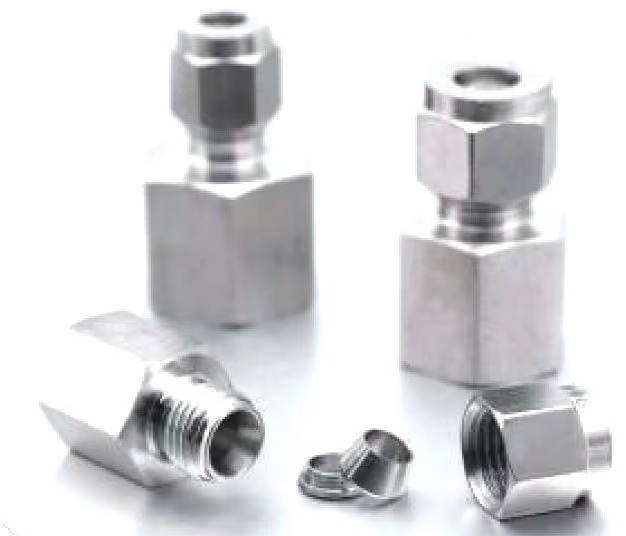
“Can I use push-to-connect on stainless steel tubing?” has a one-line answer: only where the specific series explicitly approves that tube. Most push-in fittings are engineered for nylon and polyurethane — their collets bite polymer, their O-rings seal polymer — and rigid stainless tube defeats both unless the maker designed for it. For everything else, compression is the default on stainless.
Key takeaways
- A push-to-connect joint grips with collet teeth and seals with an O-ring — a mechanism tuned for polymer tube; on rigid stainless it works only in series that explicitly list metal tube, and even then the collet’s mechanical bite and the O-ring’s surface seal are the weak links.
- A compression joint bites and seals on metal by design: the ferrule swages into the tube surface for a metal-to-metal seal that tolerates vibration, pressure and remaking — the reason it owns stainless instrument lines.
- Choose push-to-connect where panels are reconfigured constantly and the series approves the tube; choose compression for pressure, vibration, gas service or any line expected to hold for years.
Why the tube material matters so much
The push-in mechanism assumes the tube can deform slightly: collet teeth wedge against the tube OD and dig in under pull-out load, while an O-ring seals against the tube surface by radial compression. Nylon and polyurethane comply; hard 304 or 316 tube does not — the teeth skate on the smooth metal surface instead of biting, and the O-ring seals a surface it was never sized against. Some makers do publish stainless-compatible series with hardened collets and metal-rated seals, and those work — but the approval must come from the maker’s tube list, never from the catalog name. The mechanism itself is covered in depth in how push-to-connect fittings work.
Push-to-connect vs compression on the decision axes
| Aspect | Push-to-connect (approved metal-tube series) | Compression (double ferrule) |
|---|---|---|
| Mechanism | Collet grip + O-ring seal | Ferrule bite + metal-to-metal seal |
| Tube compatibility | Listed polymer; stainless only where approved | Stainless and most metal tube |
| Pressure integrity | Series-specific; generally moderate | High; instrument-rated classes |
| Vibration / pull-out | Moderate; dislikes side loads | Superior; resists vibration |
| Reconfiguration | Instant: press collar, pull tube | Slower: wrench makeup, new ferrules |
| Gas service | Only where series approves | The standard choice |
| Best for | Frequently rebuilt OEM air/light-fluid panels | Permanent instrument and process tube |
When push-to-connect wins
Panels assembled and reassembled weekly — prototyping benches, packaging machines, pneumatic manifolds in constant flux — earn the push-in’s speed. Tube goes in by hand, comes out by thumb, and no ferrules are consumed. On those panels, even stainless-body push-in fittings are usually feeding approved polymer tube; if your panel truly runs rigid stainless, confirm the series’ metal-tube listing in writing and stay inside its pressure and temperature table. Where the load on the joint exceeds the push-in’s comfort — tugged hoses, vibrating stations, hot or oily service — support the tube or move the joint to compression.
When compression wins
Almost everywhere else on stainless. Gas service and instrument air, where the metal-to-metal seal holds integrity the O-ring cannot match. Vibration, where the back ferrule’s grip absorbs what a collet transmits to its teeth. Pressure, where compression classes run far above typical push-in ratings. Permanence, where a joint made once should outlast the panel. And honesty about tube condition: a compression joint bites into the tube itself, so hard-drawn or unknown tube is a known quantity — the ferrule either swages or it does not, and the RFQ can flag it. The mechanics and pressure classes are in single ferrule vs double ferrule.
FerruleX stocks both families for export OEM work — the push-to-connect category for fast-assembly panels, and compression fittings in SS304 / SS316 / SS316L for the stainless lines. Tell us the tube material and OD, media, pressure and how often the panel is reconfigured; we will point the RFQ at the right joint. Request a factory quote.
FAQ
Can I use push-to-connect fittings on stainless steel tubing? Only if the specific series explicitly lists stainless tube in its approvals — most push-in fittings are designed for nylon and polyurethane. Check the maker’s tube list rather than assuming from the catalog name, and stay inside the published pressure and temperature table for metal tube.
Why does push-to-connect leak on metal tube? Two mechanisms fail: the collet teeth are shaped to bite compliant polymer and skate on hard, smooth metal, and the O-ring seals a surface texture it was not sized for. Approved metal-tube series harden the collet and re-spec the seal; unapproved ones simply underperform.
Is compression better than push-to-connect? For stainless instrument and process tube, yes — the ferrule’s metal-to-metal seal beats an O-ring on pressure integrity, vibration tolerance and gas service. Push-in wins only where assembly speed and frequent reconfiguration outweigh those properties.
What about mixed panels — polymer tube and stainless tube together? Common and correct: push-ins on the pneumatic polymer runs, compression on the stainless instrument lines. Just keep the systems separate at the joint — a fitting approved for one tube type is not approved for the other by proximity.
How do I spec the right joint on an RFQ? Send tube material and OD, media, working pressure and temperature, vibration or side loads, and how often the connection must be remade. Those five facts decide the family; the factory fills in the series and size.


