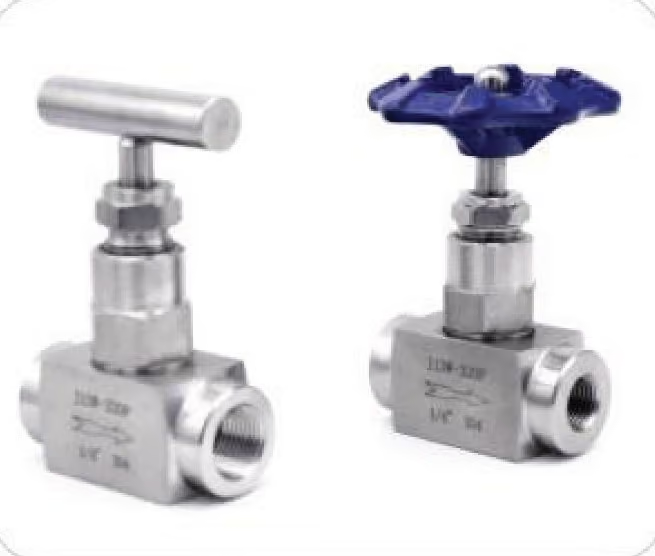
Once a needle valve leaves the 3,000 psi neighborhood, its bonnet construction — the way the stem assembly seals to the body — becomes the specification that matters most. High-pressure needle valves come in two families: integral bonnet, machined from one piece, and union bonnet, a threaded separable joint. Each wins in a different corner of HP duty.
Key takeaways
- The bonnet is the stem’s pressure boundary: integral bonnets are machined into the body for compactness and economy in fixed HP service, while union bonnets join by a threaded union for repacking and trim maintenance without removing the valve from the line.
- Typical classes line up by construction: integral bonnet designs commonly run to about 6,000 psi (414 bar), while union bonnet families cover 6,000 psi standard and extend to 10,000 psi (690 bar) in high-pressure series.
- Packing picks the temperature ceiling — PTFE to about 450 °F (232 °C), graphite to 700 °F (371 °C) and beyond with high-temperature options — so the bonnet choice, pressure class and packing must be specified together, not as afterthoughts.
What the bonnet actually does
The bonnet carries the stem through the pressure boundary: it holds the packing that seals around the moving stem, anchors the stem threads, and on better designs provides back-seating that isolates the packing when the valve is fully open. Everything that keeps an HP valve leak-tight at the stem lives in the bonnet. That is why, above utility pressures, two constructions divide the market.
Integral bonnet: one piece, fixed duty
An integral bonnet is machined from the same barstock or forging as the body — no separable joint at all. The virtues follow directly: fewer leak paths, a compact envelope that suits dense instrument panels, lower cost, and a body that tolerates vibration well. Forged integral designs commonly rate to roughly 5,000–6,000 psi. The trade is maintenance: the packing is adjusted and replaced through the stem hardware, and reaching internal trim means the valve leaves the line. For HP points that are set once and rarely touched — gauge roots, calibration ports, fixed dosing lines — the integral construction is the economical, robust answer.
Union bonnet: built to be maintained
A union bonnet screws into the body across a precision threaded joint, sealed with a metal or soft gasket. The union exists for service: loosen it and the whole stem-and-packing assembly lifts out for repacking, trim inspection or seat work, with the body — and the line — undisturbed. Union designs also dominate the higher classes: 6,000 psi (414 bar) as the standard series and 10,000 psi (690 bar) in the high-pressure families, in stainless and exotic alloys. The construction resists accidental disassembly under pressure and puts the packing below the power threads, protecting lubricant from the media. The cost is price, envelope and one more sealing joint — a fair exchange where the valve will be opened, adjusted or repacked during its service life.
Side by side
| Factor | Integral bonnet | Union bonnet |
|---|---|---|
| Construction | One piece with body | Threaded union joint to body |
| Typical classes | To ~6,000 psi (414 bar) | 6,000 psi standard; to 10,000 psi (690 bar) |
| Maintenance | Packing via stem; trim needs removal | Stem assembly lifts out in the line |
| Leak paths / size | Fewer joints, more compact | One extra joint, larger envelope |
| Cost | Lower | Higher |
| Best fit | Set-and-forget HP points, panels | Serviced HP lines, highest classes |
Packing: the temperature half of the spec
Whatever the bonnet, the packing sets the thermal ceiling and much of the stem life. PTFE is the standard: chemically inert, low friction, good to about 450 °F (232 °C). Above that, graphite (Grafoil) takes over — to roughly 700 °F (371 °C), with high-temperature constructions rated far higher still — at the cost of higher operating torque. Between them sits PEEK for demanding middle ground. Pair the packing with a non-rotating lower stem, which eliminates the grinding that shortens both packing and seat life, and specify blowout-proof back-seated stems anywhere the operator or process is at risk.
How to choose
- Fixed HP point, panel-mounted, set once: integral bonnet — compact, fewer joints, cheapest honest answer.
- HP line that will be repacked, retipped or serviced in place: union bonnet — the maintenance access pays for itself the first time.
- Above 6,000 psi: union bonnet territory; state the class explicitly on the RFQ.
- Hot service: graphite packing, and say so — a PTFE-packed valve in steam service is a slow leak waiting for a calendar.
FerruleX supplies high-pressure stainless needle and globe-pattern valves in SS304 / SS316 with NPT, compression and weld ends — start from the needle valve category or the high-pressure female valve and weld-end needle valve styles, and send pressure class, temperature, media and end connections. Request a factory quote. For the metering mechanism these valves carry, see how does a needle valve work; for the material side of the same spec — 316 vs 17-4 PH stems, PTFE vs graphite packing — see valve trim materials explained.
FAQ
What is the difference between integral and union bonnet needle valves? Integral bonnets are machined into the body as one piece — compact, fewer joints, economical, but the valve must leave the line for trim service. Union bonnets join by a threaded union so the stem assembly lifts out for repacking and repair in place, at higher cost and a slightly larger envelope.
What pressure class are high-pressure needle valves? Integral bonnet designs commonly run to about 6,000 psi (414 bar). Union bonnet families cover 6,000 psi as standard and extend to 10,000 psi (690 bar) in high-pressure series. State the class and the temperature on the RFQ — both drive the construction.
Which packing should I specify? PTFE to about 450 °F (232 °C) — the default for most instrument duty. Graphite (Grafoil) for higher temperatures, roughly 700 °F (371 °C) and beyond with high-temperature options. PEEK sits between. The wrong packing fails quietly as stem leakage long before the body is challenged.
Can I repack a needle valve in the line? Union bonnet valves, yes — that is what the union is for. Integral bonnet valves allow packing adjustment through the stem hardware, but deeper trim work means removing the valve. If in-line serviceability matters, say so at specification time.
Are these the valves for shutoff duty too? At instrument scale they close positively, but metering valves live longest metering: pair the needle valve with a ball valve for isolation, and never force the handle past finger-tight — a deformed tip ends repeatable control.


