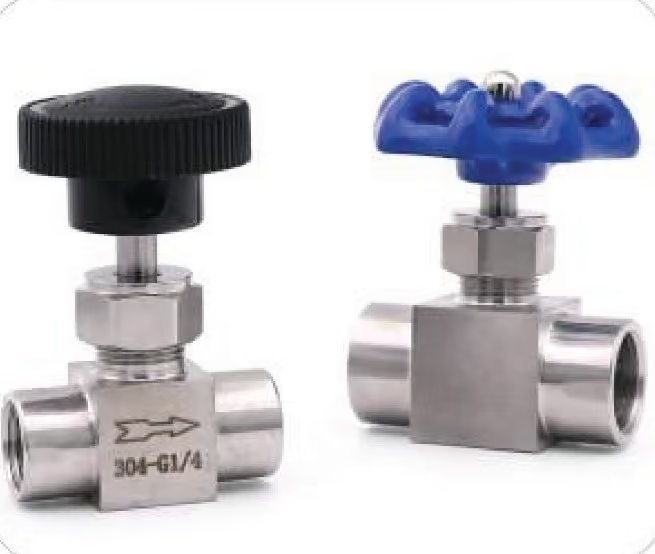
A stainless steel needle valve is a manual metering device built around one idea: a long, finely tapered stem driven by an even finer thread into a matching conical seat, so that one turn of the handle changes the flow only a little. That geometry is why it exists — and why it is the wrong tool when you only want on and off.
Key takeaways
- A needle valve meters by geometry: the shallow taper of the needle against a conical seat means each turn of the fine-pitch stem advances the tip a fraction of a millimetre, shrinking or opening a small annular orifice for precise, repeatable flow control.
- The orifice is deliberately small — flow through a needle valve is restricted even fully open — so it sets flows and bleeds pressure, but it never passes full line flow like a ball valve.
- Most needle valves throttle in either direction but are happiest installed flow-to-open; and the valve is a metering device, not a shutoff device — over-torquing or slamming it closed deforms the tip and ruins repeatability.
The mechanism, step by step
Turn the handle and the fine-pitch stem thread — commonly 20–32 TPI on industrial patterns — advances the needle axially into the seat. The needle’s taper is very shallow, a few degrees, so the annular gap between needle and seat closes gradually rather than all at once. Flow follows the orifice equation: rate is proportional to the orifice’s effective area and the square root of the pressure drop. Because the stem moves so little per turn, one valve covers many turns of travel — commonly 6 to 10 or more depending on series — and each position holds a stable, settable flow. That is the entire mechanism: no springs, no ports to align, just a precision cone approaching a precision cone.
Non-rotating stems: a detail that decides life
In better instrument valves the lower stem does not rotate as it advances — it is driven through a swivel or knuckle joint. That matters more than the spec sheet suggests: a rotating tip would grind against the seat on every closure, wearing both surfaces and losing shutoff tightness within months. The non-rotating design closes by translation, not rotation, so the metal-to-metal seat stays intact and the shutoff stays repeatable through thousands of cycles. When comparing needle valves, the stem construction is worth the extra line in the RFQ.
Flow direction
A standard needle valve throttles in either direction, but most designs assume flow-to-open — media arriving under the seat lifts the needle off as it opens. Installed backward, the same valve runs higher operating torque and pushes harder against the stem packing, shortening packing life. The body is usually marked; match the arrow to the intended flow unless the drawing says otherwise. Note also the difference from a true flow-control valve, which pairs a needle with a check element to throttle in one direction and free-flow in the other — a different catalog item with a different job.
Where needle valves earn their place
The classic homes all share one trait: small, controlled flows that must be set by hand and hold steady. Gauge and transmitter isolation, where the valve damps pulsation and lets the instrument bleed down and re-zero. Sampling and calibration lines, where a repeatable trickle matters more than capacity. Chemical dosing and reagent bleed ports. Vent and purge circuits. Anywhere a small flow must be set and left — a needle valve holds position indefinitely without power or supervision.
What a needle valve is not for
Two misapplications account for most needle valve casualties. First, full-flow duty: the orifice is much smaller than the port, so a needle valve asked to pass line flow simply throttles the whole system — put a ball valve there instead. Second, routine shutoff: the precision tip is not designed to be hammered against pressure repeatedly; that is how seats get wire-drawn and tips get deformed. Use the needle valve to set the flow and a ball valve upstream to isolate. The two-valve layout costs little and doubles the life of both.
| Duty | Needle valve? | Better choice |
|---|---|---|
| Setting a small, steady flow | Yes — its core job | — |
| Gauge or transmitter isolation and bleed | Yes, at instrument scale | Ball valve upstream for process isolation |
| Sampling, dosing, vent and purge lines | Yes | — |
| Full-flow on/off isolation | No | Ball valve |
| Fast emergency shutoff | No | Ball valve |
FerruleX stocks stainless needle valves in straight, angle and male-female patterns with compression or female thread ends — start from the needle valve category, see the straight female needle valve and straight compression needle valve styles, and request a factory quote with the media, pressure and Cv. For the metering-versus-isolation decision itself, see needle valve vs ball valve. A printable valve symbols chart maps the P&ID forms to the families.
FAQ
How many turns does a needle valve take to open? Typically 6 to 10 or more turns from closed to fully open, depending on the series and stem thread. The many turns are the point: fine travel is what gives the valve its resolution at low flow.
Can a needle valve shut off completely? Yes at instrument scale — the metal-to-metal seat closes positively, and many buyers use one valve to isolate and bleed a gauge. But it is slow compared with a quarter turn, and repeated slamming against high pressure damages the precision tip. Isolate with a ball valve; meter with the needle.
Does flow direction matter in a needle valve? The valve throttles in either direction, but most designs assume flow-to-open: installed backward, operating torque rises and stem packing loads increase. Follow the body arrow unless the drawing specifies otherwise.
Why does my needle valve leak past the seat after a year of service? The usual causes: a tip deformed by over-torquing, a seat wire-drawn by operating at very small openings under high ΔP, or contamination galling the seating surfaces. A weep past the seat means new trim; a weep around the stem means adjusting the packing.
What is the difference between a needle valve and a flow control valve? A needle valve throttles in both directions and holds its set flow in both. A flow control valve adds a check element so it throttles in one direction and free-flows in the reverse — used where a cylinder or actuator needs metered extension and fast retraction.


