Valve trim materials are where a stainless valve data sheet stops being one line. “Trim” is the working stack inside the valve — body, ball or needle, stem, seat, packing — and the right material differs by part. A grade that makes an excellent body makes a mediocre stem, and the seat and packing are not metals at all. Buyers who write “316 valve” and stop get whatever the factory had in mind. Here is the part-by-part map and the exact lines to write on the RFQ.
Key takeaways
- Trim is specified per part, not per valve: 316/316L bodies and stems for corrosive duty, 17-4 PH stems and balls where strength leads, 410/420 where hardness matters more than chloride resistance, PTFE or PEEK seats, PTFE or graphite packing.
- 17-4 PH is a precipitation-hardening martensitic stainless (UNS S17400, Grade 630): a chromium-copper analysis that reaches roughly 1380 MPa tensile in the H900 aged condition — it is not austenitic.
- 316 carries 2–3% molybdenum, lifting pitting resistance (PREN ≈ 24–25) clearly above 304’s ≈ 19 — the margin that matters in chloride-bearing lines.
- A material grade alone does not qualify a valve: pressure class, trim and seat together do, and all three belong on the RFQ.
What “trim” covers
Trim means the parts that do the work and touch the media: the closure element (ball, disc, needle), the stem that drives it, the seat it closes against, and the packing that seals the stem where it leaves the body. Data sheets single out trim because these parts wear and corrode first — a body can outlive two sets of trim. Some makers count the body as trim, some do not, which is exactly why the RFQ should name a material per part instead of trusting the word.
The three metal grades
Three stainless grades dominate metal trim, trading corrosion resistance against strength:
- 316 / 316L (austenitic). The default for bodies and corrosive-duty trim. Its 2–3% molybdenum raises the pitting resistance equivalent (PREN) to roughly 24–25, against about 19 for 304 — the line-in grade wherever chlorides are present. It does not harden by heat treatment: strong enough for bodies and standard-duty stems, not the first choice where a slender stem must resist bending under high pressure.
- 17-4 PH (UNS S17400 / Grade 630). A martensitic, precipitation-hardening stainless: about 15–17.5% chromium with 3–5% nickel and 3–5% copper. The copper precipitates during an aging treatment — the common H900 condition ages at about 480 °C — taking tensile strength to roughly 1380 MPa and hardness to 40 HRC and above, where annealed 316 sits around 500–620 MPa. Corrosion resistance is close to 304’s, below 316’s. Strength near the top of the stainless range with 304-class corrosion behavior is why high-pressure stems and balls default to it.
- 410 / 420 (martensitic). Straight-chromium grades hardened by heat treatment, with 420 the higher-carbon sibling reaching about 50 HRC. They suit stems and balls where wear resistance dominates and the media is mild: clean gases, non-chloride liquids. In chloride service neither substitutes for 316 — hardness does not buy pitting resistance.
Seats and packing: the polymer half
The soft parts set the temperature ceiling long before the metal is challenged. PTFE seats are class-typical to about 200 °C — chemically inert, low friction, the reason ball valves turn easily. Filled PTFE trades some chemical purity for pressure capability, spanning roughly 180–230 °C by fill and maker. PEEK seats extend duty to about 250 °C and above, with the steam and pressure resistance to match, at a price. On the stem, PTFE packing typically serves to about 204–230 °C depending on construction, while graphite packing takes duty to roughly 450 °C and tolerates thermal cycling better, at the cost of higher operating torque — the standard swap on hot and steam service, where the bonnet choices that carry it are covered in high-pressure needle valves: integral vs union bonnet.
The part-by-part RFQ table
| Part | Candidate materials | Why chosen | RFQ line to write |
|---|---|---|---|
| Body | 316 / 316L | Corrosion boundary and weldability | Body: 316 |
| Ball / needle | 316, 17-4 PH, 420 | Strength and wear at the closure point | Ball: 17-4 PH |
| Stem | 316, 17-4 PH | 17-4 resists bending at high pressure; 316 for chloride media | Stem: 17-4 PH |
| Seat | PTFE, filled PTFE, PEEK | Temperature and pressure ceiling | Seat: PTFE |
| Packing | PTFE, graphite | Temperature, thermal cycling, torque | Packing: graphite |
Honest angle: the grade is not the qualification
“316 trim” on its own qualifies a valve for nothing — pressure class, trim and seat together do. A 6000 psi valve with 316 trim and a PTFE seat is not “better” than a 1000 psi valve with the same trim; they are different valves. Over-spec is real too: on a clean, dry instrument-air line at moderate pressure, 316 everywhere adds cost without adding life — 304 is the honest value. And 316 can be not enough: in seawater or aggressive chloride service its PREN of about 24–25 is borderline, and at high pressure a 316 stem may need the strength of 17-4 regardless of the body grade. State the media, the class and the temperature, and let the trim follow — the flow side of the same specification is what Cv means on a valve datasheet.
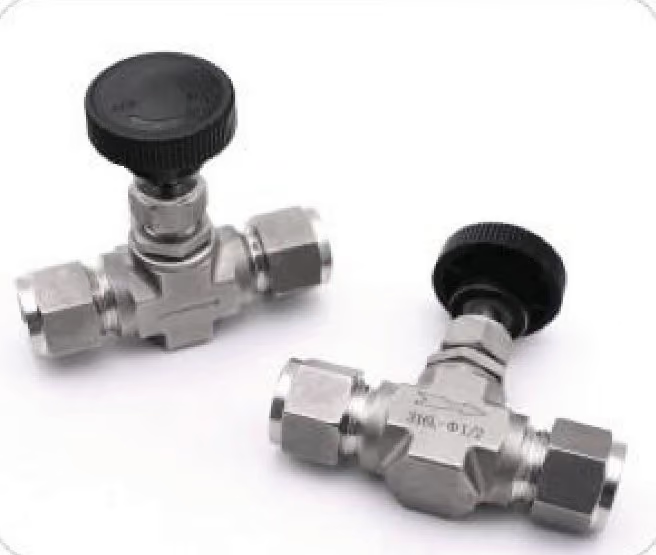
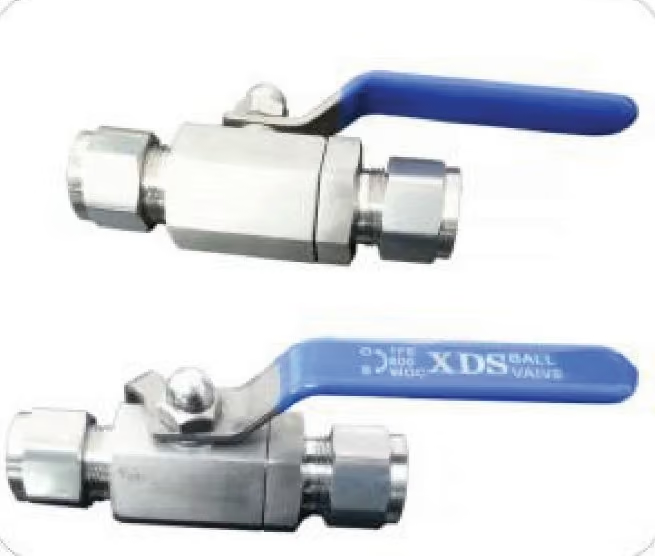
FerruleX builds stainless valves with trim stated part-by-part — start from the needle valve and ball valve categories or the high-pressure female globe valve line, and send the service, class and temperature with the size list. Request a factory quote.
FAQ
Can I order a 316 body with a 17-4 stem? Yes, and it is a common combination: the body handles the pressure boundary and corrosion duty in 316, while the stem takes the 17-4 strength advantage at the bending load. Mixed trim is normal engineering — just write each part’s material on the RFQ rather than one grade for all.
Is 17-4 PH stainless steel? Yes — it is a precipitation-hardening, martensitic stainless steel, UNS S17400 (Grade 630), with roughly 15–17.5% chromium and 3–5% copper. It gains its high strength — about 1380 MPa tensile in the H900 aged condition — from that precipitation aging, not cold work. Its corrosion resistance is near 304’s. It is not austenitic like 304 or 316.
Is a 420 ball better than a 316 ball? Only in the duty that rewards hardness. At about 50 HRC, 420 resists wear and scoring better than 316, which suits clean, non-chloride media with high cycling. In chloride-bearing or corrosive service, 316’s molybdenum-bearing austenitic structure is the better choice despite being softer. Match the ball to the media, not to a hardness number.
What temperature can a PTFE-seated valve take? Class-typically about 200 °C for the seat itself; filled PTFE spans roughly 180–230 °C by fill, and PEEK extends to about 250 °C and above. Check the packing separately — PTFE packing and a PTFE seat share a polymer but not a rating, and hot service usually moves the packing to graphite.
Does 316 trim qualify a valve for seawater? No — a grade alone never qualifies a valve. 316’s PREN of about 24–25 is borderline for seawater, especially in crevices, and the pressure class and seat material impose their own limits. For marine or high-chloride duty, state the actual service on the RFQ and have the body, trim and seat qualified together.