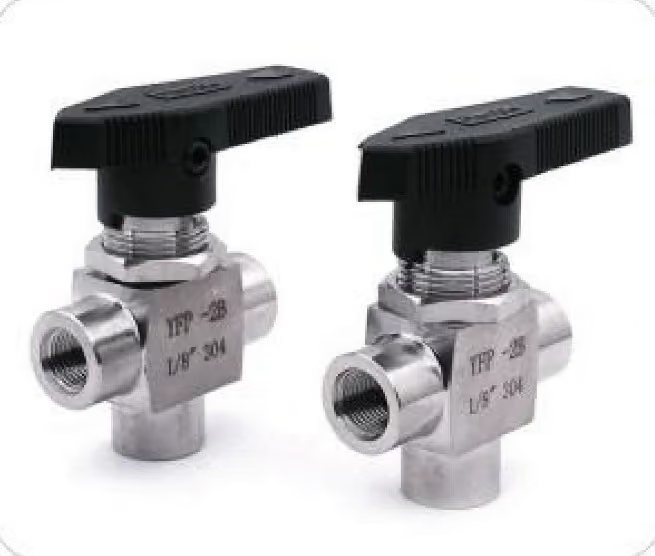
Cv is the valve flow coefficient: the number of US gallons per minute of 60 °F water that flows through the fully open valve with a 1 psi pressure drop across it. A valve with a Cv of 2 passes 2 GPM of water at that 1 psi drop; a Cv of 10 passes 10. The number lets buyers compare the flow capacity of different valves on one common scale, and it is the single most quoted flow number on an instrument valve datasheet. Here is what it tells you and how to use it without getting burned.
Key takeaways
- Cv is defined at the fully open position: GPM of 60 °F water per 1 psi drop — for water, flow scales as Q = Cv × √ΔP, so doubling the pressure drop does not double the flow.
- Higher Cv means more flow capacity at the same pressure drop; two valves with the same end size and orifice can still carry different Cv values because internal geometry sets the number.
- Makers publish Cv per model and size, sometimes at partial openings for needle and characterized ball valves — those partial-opening values are not linear with stroke.
- Cv is a comparison and sizing number, not a pressure rating: it says nothing about whether the valve body holds your line pressure — that is the class rating, covered in ball valve ratings explained.
What the number actually means
The definition is a test condition, not a guess: fully open valve, water at 60 °F, 1 psi differential, measure the flow. Because the relationship between flow and pressure drop goes with the square root, a valve with Cv = 4 passes 4 GPM at 1 psi drop but about 5.7 GPM at 2 psi — useful when you estimate what a line will actually deliver. For liquids other than water the specific gravity enters the calculation; gases need their own corrected formulas. For an instrument buyer the practical reading is simpler: at the same supply pressure and the same allowed pressure drop, the valve with the higher Cv delivers more flow to the actuator, the analyzer or the downstream leg.
That is why Cv matters so much on small valves. A compact ball valve and a needle valve of identical tube end size can differ in Cv by an order of magnitude: the ball opens a full-bore path, the needle throttles through a fine annulus. Choosing between them is exactly the shutoff-versus-throttling trade covered in needle valve vs ball valve. The same end size, the same pressure class, completely different flow capacity — Cv is the number that says so.
Cv, orifice, and how to read maker tables
Orifice diameter and Cv move together but are not the same thing. A larger orifice generally means a higher Cv, yet internal restrictions — seat geometry, stem, port shape — mean the same nominal orifice can carry different Cv values between makers. This is why reputable catalogs print Cv alongside port orifice for each size, and why a serious valve table reads model by model rather than giving one number per thread size. For needle valves and characterized balls, expect the table to carry Cv at several opening positions, because capacity versus travel is deliberately shaped and is not a straight line.
Read those tables at the opening you will actually run. A needle valve bought for fine metering spends its life at partial stroke; its fully open Cv is a ceiling, not the working number. Conversely, a ball valve doing isolation duty runs at fully open, where its Cv table value applies directly.
Where buyers misuse Cv
Three mistakes repeat. Oversizing: picking the largest Cv available “for margin” leaves the valve throttling near closed, where control is coarse and seats wear — better to size for the operating point with sensible margin. Confusing Cv with pressure rating: a high Cv valve is not a high-pressure valve; class and Cv are independent columns on the datasheet, and the class side is its own discipline. Comparing across valve types: a globe-pattern valve and a ball valve with identical Cv behave differently at partial open; the number compares capacity, not character. For metering duty where flow character matters, the valve-family discussion in high-pressure needle valves covers what the bonnet and stem geometry change.
One honest note about our own catalog: FerruleX quotes Cv per order rather than publishing a fixed table on every SKU page. Cv varies with exact port geometry and size within a family, and a per-order confirmation keeps the datasheet tied to the valve you actually receive. Ask for the Cv with the size list on the RFQ and we state it on the quotation for the exact model and size.
State the flow duty with the valve request — medium, flow rate, allowed pressure drop, and opening position — and we size and quote the right family. Start from the ball valve category for shutoff candidates and needle valves for metering duty. Request a factory quote.
FAQ
What does Cv stand for on a valve? Cv is the valve flow coefficient: the US gallons per minute of 60 °F water that flows through the fully open valve with a 1 psi pressure drop across it. A Cv of 5 passes 5 GPM of water at that test condition.
Is a higher Cv always better? No — higher Cv means more flow capacity at the same pressure drop, which is only better if the line needs that flow. An oversized high-Cv valve throttles near closed and controls poorly; size Cv for the operating point with reasonable margin.
What is the difference between Cv and orifice size? Orifice size is one driver of Cv, but Cv also depends on internal geometry — seat, stem, port shape. Two valves with the same orifice can carry different Cv values, which is why makers publish Cv measured per model, not calculated from diameter alone.
Does Cv change as the valve opens? Yes for throttling valves. Needle and characterized ball valves have Cv tables at several opening positions because flow versus travel is shaped, not linear. A full-open Cv is a ceiling; choose from the table at the opening you will actually run.
Is Cv the same as the pressure rating? No. Cv measures flow capacity; the pressure rating (class, CWP) is the pressure the body and joints hold. They are independent datasheet columns — a high-Cv valve can be a low-pressure valve and vice versa.


