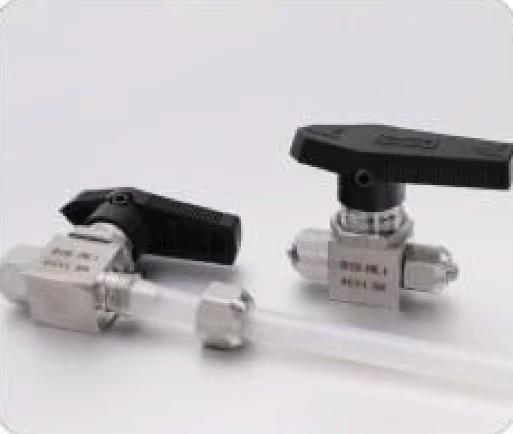
Needle valve vs globe valve is less a rivalry than a family distinction: a needle valve is the instrument-grade member of the globe family. Both move a closing element toward a seat with a linear stem; the needle refines that mechanism with a slender tapered point and fine stem threads for repeatable low-flow control, while the globe valve is the broader class — disc or plug trim across a wider range of flows for general throttling and shutoff. If you are choosing between them, you are really asking how much control precision the line needs.
Key takeaways
- Both are globe-pattern linear-stem valves: the needle is defined by its tapered needle point and fine threads, the globe by a broader disc-or-plug trim class — terminology varies by maker.
- Needle valves win where flow is small and adjustment must be fine and repeatable: gauge and transmitter lines, sample points, purge and pilot duty.
- Globe valves win where a process line needs throttling or shutoff across a wider flow range, or where specialized trim provides the control character.
- Flow direction on a needle valve is maker- and seat-design-dependent — flow under the seat and over the seat are both real designs, so follow the arrow or the model documentation, covered alongside the mechanics in how does a needle valve work.
The family resemblance, and the split
The shared anatomy explains the confusion. Both valve types run a stem through a bonnet to a seat: turn the handwheel, the closing element advances, flow throttles. The globe valve takes that mechanism to process lines — a disc or plug, sized for the line, moving against a matched seat, good for throttling and shutoff across a wide flow span, with contoured or needle-like trim available when a process needs better control character. The needle valve takes the same mechanism in the opposite direction: a long, slender needle tapering to a fine point, engaging a small seat through fine-pitch threads, so one turn moves the point a little and the flow changes a little. Needles exist for the lines where “a little” is the whole job. The bonnet and stem choices that shape both families are covered in high-pressure needle valves: integral vs union bonnet.
Side by side
| Factor | Needle valve | Globe valve |
|---|---|---|
| Trim | Long tapered needle into a small seat | Broader disc or plug; contoured or needle-like trim in control variants |
| Control precision | Fine, gradual adjustment over many turns; repeatable low-flow setting | General throttling and shutoff; resolution depends on trim and design |
| Typical flow | Small: instruments, gauges, samples, purge, pilot | Wider range: process-line throttling and shutoff |
| Sizes and classes | Instrument small-bore; the 6000 psig CWP class is common across maker series | Line sizes through process piping; class per the piping spec |
| Instrument-line fit | The default for metering points and gauge isolation | Used where a line must throttle, not just meter |
Choosing for the line
Match the valve to the control the line actually needs. A gauge take-off, a transmitter calibration point, a sample line, a purge leg — small flows where the set point must hold — are needle territory, which is why the instrument manifold and gauge-valve world runs on them. A process branch that must throttle bypass flow or regulate a utility line is globe territory, or ball territory where the duty is shutoff rather than control — the isolation side of that decision is needle valve vs ball valve. A needle forced onto a throttling process line chokes it; a globe dropped onto a metering point cannot hold a fine set; either mismatch shows up as drift, wear, or a panel that never quite reads right.
One duty note that surprises buyers: neither valve is the right answer for fast, repeatable shutoff of a full-bore line — that is ball and gate work. Both needle and globe trade flow capacity for control.
Flow direction, stated honestly
Needle valves often have a preferred flow direction, and it is not universal. The seat and plug design decides whether flow should come under the seat or over it — both arrangements exist across makers — and the right answer comes from the valve’s flow arrow, nameplate, or model documentation, not from a rule of thumb. Some valves carry no permanent arrow and specify direction by model. If the drawing leaves it open, state the line direction on the RFQ and we confirm it against the valve. The through-line mechanics of what the flow actually does inside the valve are covered in how does a needle valve work.
FerruleX quotes the needle side of this family across straight, angle and male-female patterns — start from the needle valve category — and the globe side from the high-pressure female globe valve line. Send the service, flow range and direction with the size list. Request a factory quote.
FAQ
What is the difference between a needle valve and a globe valve? A needle valve is a specialized, instrument-grade globe-pattern valve: both use a linear stem, but the needle carries a slender tapered point and fine threads for fine low-flow control, while a globe valve uses broader disc or plug trim for general throttling and shutoff across a wider flow range.
Is a needle valve a type of globe valve? Yes — it is commonly described as a small, specialized globe-pattern valve, since both move a closing element toward a seat with linear stem motion. The needle’s tapered point and fine stem are what set it apart for metering duty.
Which is better for throttling, a needle or a globe valve? For small flows that must be set finely and held, the needle valve. For process lines throttling a wider flow range, the globe valve, or specialized control trim where the process demands it. Neither replaces a control valve for continuous automatic regulation.
Does a needle valve have a flow direction? Often yes, but it is maker- and seat-design-dependent: flow under the seat and flow over the seat are both real designs. Follow the valve’s flow arrow, nameplate, or model documentation — where none exists, state the line direction on the RFQ and have it confirmed.
Can a globe valve replace a needle valve on an instrument line? Usually not well. A globe’s trim is sized for line flow, not for setting a fraction of a turn’s worth of flow; on a metering point it hunts and drifts where a needle holds. Use the globe where the line needs throttling, the needle where it needs precision.
Related: reading valve symbols on a P&ID.


