Valve symbols on a P&ID are the first thing a buyer should read — and the first thing they should distrust. Read them because a symbol scan turns a wall of piping into a quotable valve list in an afternoon. Distrust them because a symbol names the valve family and nothing else: it says “ball valve,” never “1/2 in, Class 800, threaded, PTFE seat.” The class, end connections, seat and trim come from the line list, piping class and valve schedule — you add them yourself before the RFQ makes sense. This walkthrough covers the forms, a worked line, and the exact handoff from symbol to RFQ line.
Key takeaways
- The bowtie — two triangles tip to tip — is the generic valve body. Internal marks distinguish the family: a circle for ball, a center line for globe, a flap against a seat line for check, a fine needle mark for needle.
- Standards exist — ANSI/ISA-5.1 in the US, ISO 10628 internationally — but owner variants are common. The legend sheet on the drawing beats any published chart, including ours.
- A symbol never encodes pressure class, end connections, seat material or trim. Those live in the piping class and valve schedule; without them a “quote” is a guess.
- The procurement workflow is: symbol list → add size from the line number, class from the piping class, ends/seat/trim from the valve schedule → one RFQ row per valve with quantity.
The basic forms
Start with the bowtie. Two triangles meeting tip to tip is the conventional general valve body — by itself it means “a valve goes here,” family unspecified. What sits inside the bowtie (or replaces half of it) names the family:
- Ball — bowtie with a circle at the center. The circle is the ball seen end-on, the open bore through it reading as quarter-turn shutoff.
- Globe — bowtie with a straight line through the body’s center axis, marking the linear-stem globe form built for throttling.
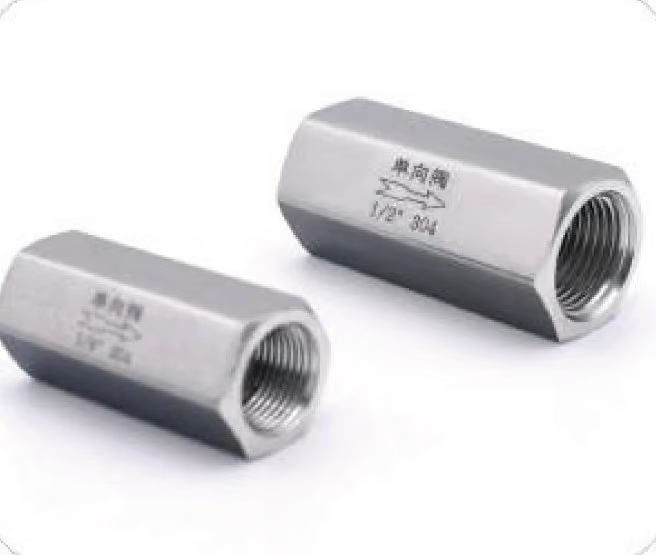
- Check — a single triangle with a short flap line resting against a seat line, replacing one bowtie half. It reads as one-way flow: the permitted direction is where the triangle points, and you confirm actual flow direction from the line’s flow arrow, not the symbol alone.
- Needle — bowtie with the center stem line and a fine needle mark from the stem side: the globe family’s fine-metering member, the valve at gauge taps and sample points.
Two honest caveats. First, published variants are real: some references draw a globe valve as a filled circle rather than a line, and some needle symbols carry only a tag letter to distinguish them from globes. Second, owners modify freely. Learn the forms above, then read the drawing’s legend sheet — on its own drawing set, the legend overrides every published chart, including our valve symbols chart.
A worked example
Take one small line: a dosing pump discharging through a regulating loop into a day tank. Walking the line left to right, the symbols read:
- Bowtie with a circle at the pump nozzle — a ball valve, pump isolation. The symbol says nothing else, so the RFQ row needs: size (from the line number), pressure class (from the piping class — a 1/2 in instrument line might be Class 800 threaded or flanged), end connections, and seat material — PTFE for the usual water-chemical duty.
- Single triangle with flap against a seat line, pointing away from the pump — a check valve holding against backflow from the tank side. Add to the RFQ: size, class, ends, plus the one spec a symbol never shows — cracking pressure, from the datasheet.
- Bowtie with center line and fine needle mark at the gauge tap — a needle valve metering the gauge connection. Add: size, class, ends, and the trim question — stem and seat material — because a needle valve’s whole job happens at the trim. That selection logic is covered in valve trim materials: 316 vs 17-4 PH vs 410/420.
- Bowtie with a circle at the tank entry — a second ball valve for positive shutoff during maintenance, specified as the first.
Four symbols, four RFQ rows — each row carrying four or five specs the drawing never printed.
What the symbol never tells you
This is the section that saves you money. A P&ID valve symbol does not encode:
- Pressure class. Rating comes from the piping class or line list, not the drawing symbol.
- End connections. Threaded, socket weld, flanged, tube-end — same symbol, four different valves, four different prices.
- Seat material. PTFE, filled PTFE, PEEK — the temperature and pressure ceiling of the soft parts, invisible on the symbol.
- Body and trim material. The symbol says “valve”; the schedule says WCB, CF8M or 316 with a 17-4 PH stem. Trim selection is its own decision, per the valve trim guide.
Even valve size is not in the symbol — it rides in the line number. Treat the P&ID as the valve census and the valve schedule as the specification; together they are quotable.
From symbol list to RFQ list
The practical handoff, in order:
- Sweep the P&ID and list every valve symbol with its tag or line number — one row per symbol occurrence, keeping duplicates as quantities.
- Pull size and class from the line list for each row.
- Pull ends, body and seat from the piping class or valve schedule. Where the schedule is silent, mark the row “to be confirmed” — don’t let the factory guess.
- Split rows by valve family for the quote request: ball rows to the ball valves category, needle rows to needle valves, check rows to check valves. Where a needle versus globe question is open on a throttling line, settle it before quoting — the two valves price and perform differently, per needle valve vs globe valve.
- Attach the drawing’s legend page (or a marked-up P&ID excerpt) to the RFQ so the symbol readings are auditable.
FerruleX quotes stainless valves from marked-up P&IDs — send the symbol list with the additions above and the quote comes back matching the drawing. Request a factory quote.
FAQ
Are P&ID valve symbols standardized? Yes — and no. ANSI/ISA-5.1 (“Instrumentation Symbols and Identification”; the 2024 revision adds “and Control”) governs in the US, and ISO 10628 covers flow diagrams for process plants internationally. But owners, engineering firms and CAD libraries maintain variants — which is why every drawing set carries a legend sheet, and on that set the legend wins.
What does a bowtie with a circle mean? A ball valve: the circle is the ball seen end-on inside the generic bowtie body. If the circle is filled solid, many references read that as a globe valve instead — a live example of why the drawing’s legend sheet, not the chart, decides.
Does the valve symbol show size and pressure class? No. Size rides in the line number, and pressure class lives in the piping class or valve schedule. The symbol itself names only the valve family — everything that makes it quotable has to be added from the other documents.
How do I know which way a check valve is installed? The symbol’s triangle points in the permitted flow direction, but confirm against the line’s flow arrows before you write the RFQ — a check valve counted against actual flow direction is the cheapest insurance on the line.
Can I order valves straight from the P&ID? Only the type. Without class, ends, seat and trim from the schedule, a quote is a guess at best and a mis-supply at worst. Adding the piping-class data to your symbol list is what turns a drawing into a purchase order.


