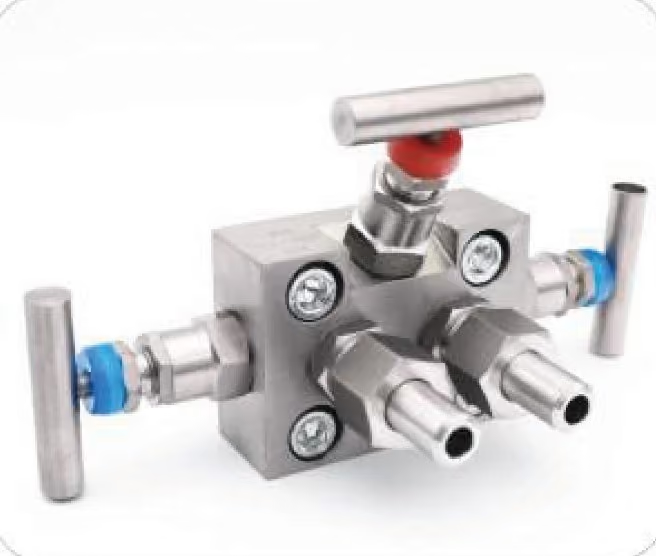
Instrument manifolds are the small steel block between your process and your instrument, and they deserve their own line on the RFQ. The valve count is not a style preference — each added valve buys a function: isolate, equalize, vent, calibrate. Pick the block by what your instrument needs to do in service, and the manifold style follows. Pick wrong and you either cannot zero the transmitter without a shutdown, or you paid for five valves to do a two-valve job. The same one-piece-body logic that shrinks leak paths here is what the discrete needle valve does at the single-point level in how a needle valve works — the manifold is that idea, multiplied and bolted together.
Key takeaways
- Valve count maps to function: 2-valve = gauge isolation plus vent; 3-valve = differential transmitter isolation plus equalizing; 5-valve = all of that plus vent ports for calibration without shutdown — one family covering the whole valve manifold range.
- The equalizing valve is the safety device of a 3-valve manifold: it protects the differential cell from one-sided overpressure during operation.
- Operating sequence matters more than the block: close one block, open the equalizer, then close the other — never trap the cell single-sided.
- Manifolds replace threaded valve assemblies: one forged body means far fewer leak paths and faster hook-up.
- Direct-mount transmitter manifolds bolt to the IEC 61518 flange; remote-mount gauge manifolds use threaded ports, typically 1/2 NPT.
2-valve: gauge isolation
The 2-valve manifold is one block valve plus one vent (bleed) valve, made for static pressure instruments — a pressure gauge, a pressure switch, a gauge-pressure transmitter. The block valve isolates the instrument from the process; the vent bleeds trapped pressure to atmosphere so the gauge can be removed or calibrated. That is the whole job, and for a simple gauge it is all the job you need. Mounting is direct — the manifold bolts to the instrument or tees into the line — and 2-valve blocks are the cheapest way to give a gauge a serviceable isolation point. Our 2-valve manifold line covers the direct-mount pattern.
3-valve: differential transmitter
A differential pressure transmitter has two process ports — high and low — and a measurement cell that compares them. The 3-valve manifold gives each port its own block valve and adds a center equalizing valve between them. The equalizer is not a convenience: it is what lets you zero the transmitter and what saves the cell during commissioning.
The operating principle that matters: never let the cell see pressure on only one side. References differ on the exact close-first order (HP first or LP first), and both are defensible — the invariant is that the equalizer is open while the second block closes, so the cell is never fighting a one-sided differential. The standard zero-check sequence: close one block valve, open the equalizer (the reading decays to zero), close the equalizer, and reopen the block valve. Bringing the manifold into service runs the mirror image: open the equalizer first, crack open one block slowly, close the equalizer, then open the second block. The valve family inside is needle or ball — the needle-versus-globe selection logic from how a needle valve works applies at manifold scale. See the 3-valve manifold product line.
5-valve: calibration without shutdown
The 5-valve manifold takes the 3-valve layout and adds two vent/test valves, one on each side of the equalizer. Those test ports are the payoff: with both block valves closed, the equalizer open and the test port opened, you can connect a calibration hand pump or reference instrument to the transmitter — verify, trim or calibrate while the process keeps running, then return to service without breaking a single process connection. For loops where a shutdown costs production, that is the entire reason the 5-valve block exists. One sequence warning from the instrumentation references: when equalizing a 5-valve manifold, open the equalizer on the live side deliberately and deliberately — opening the wrong side first can over-pressure the transmitter, which is the opposite of protection. The 5-valve manifold line is built around this calibration-duty pattern.
Gauge root valves
Below the manifold, at the process tap itself, sits the gauge root valve — the primary isolation point between the line and everything above it: manifold, snubber, gauge. Root valves are most often built as rising-stem metal-seated needle valves, straight or angle pattern, in the high-pressure classes, so the whole instrument string can be serviced without depressurizing the process. Our gauge root valve is the single-valve version of the same isolation logic for simple gauge installations.
RFQ lines
manifold style— 2/3/5-valve, or single gauge root valve.mounting— direct-mount (IEC 61518 flange for transmitters) or remote threaded, typically 1/2 NPT process and instrument ports.valve type inside— needle or ball; the needle valves category covers the trims.pressure class and material— with certificate type where the project requires it.
FAQ
Can I use a 3-valve manifold on a gauge?
Physically, often yes — remote-mount 3-valve blocks are cataloged for differential pressure gauges — but for a single-port pressure gauge it wastes the hardware: half the ports have nothing to connect to. A 2-valve block or a single gauge root valve does the same job for less money and less dead volume. Spend the 3-valve budget where a differential measurement actually exists.
Why does manifold valve count matter?
Each valve is a function, not a decoration. Two valves isolate and vent. Three add the equalizer that protects a differential cell and enables zero-checks. Five add test ports that let you calibrate without a process shutdown. The count tells you what maintenance the loop can survive without stopping production.
What is the equalizing valve for on a 3-valve manifold?
It connects the high and low sides of a differential transmitter. During commissioning and zeroing it lets pressure balance across the cell so the instrument reads true zero; during operation it must stay closed (open it and the measurement collapses to zero). Its second job is protection — it keeps the cell from seeing one-sided pressure when blocks are opened or closed.
Do manifolds really reduce leaks?
Yes, structurally. A threaded assembly of discrete valves has a joint at every connection; a manifold replaces that stack with one forged body and internal passages. Manufacturer literature counts fewer connections and fewer leak paths among the manifold’s main selling points, and hook-up time drops with them.
What connections do I specify on a manifold RFQ?
Process and instrument ports by thread and size — 1/2 NPT is the common remote-mount pattern; direct-mount transmitter blocks use the IEC 61518 flange instead of a threaded instrument port. Add the vent/test port size, pressure class, body material and the internal valve type, and the manifold is quotable.
Related: for air-supply distribution blocks rather than instrument manifolds, see stainless pneumatic manifolds.


