Every hot pipeline is a loaded spring. Steel grows as it heats — predictably, irreversibly, and with forces that will buckle pipe, crack equipment flanges or tear anchors loose if the movement is given nowhere to go. A stainless steel expansion joint is the engineered way to give it somewhere to go.
Key takeaways
- Steel pipe grows on a fixed schedule: carbon steel roughly 1.2 mm per meter per 100 °C of temperature rise, and austenitic stainless (304/316) about 40% more — around 1.6–1.7 mm per meter per 100 °C — so a 50 m hot run can grow close to 100 mm.
- Restrained growth does not disappear; it converts to enormous compressive stress that buckles pipe, distorts equipment nozzles and breaks anchors — the failure looks structural but the cause is thermal.
- Layout flexibility (loops and offsets) absorbs movement on long runs; metal bellows expansion joints absorb it where space is short; and either way, anchors and guides must be positioned so the movement actually reaches the flexible element.
The arithmetic of growth
Thermal expansion is a simple calculation: growth equals the material’s expansion coefficient times the run length times the temperature change. The material coefficients are what catch stainless buyers:
| Material | Expansion coefficient | Growth per meter per 100 °C |
|---|---|---|
| Carbon steel | ≈ 12 µm/m·°C | ≈ 1.2 mm |
| Stainless 304 | ≈ 17 µm/m·°C | ≈ 1.7 mm |
| Stainless 316 | ≈ 16 µm/m·°C | ≈ 1.6 mm |
Austenitic stainless expands roughly 40% more than carbon steel for the same temperature change — worth remembering when carbon-steel plant standards are applied to stainless lines. Multiply the per-meter figure by your run: a 50 m carbon-steel header rising 160 °C from ambient grows on the order of 100 mm; the same run in 304 grows more. That movement happens on every start-up and every shutdown, forever.
What happens without compensation
A straight run between two fixed points cannot grow — so it builds compressive stress instead. The pipe bows sideways (buckling), equipment nozzles and valve bodies take the load they were never designed for, flange bolts fatigue, and pipe supports tear. The visible failure is usually a cracked nozzle or a bent line, but the cause is unrelieved thermal stress. Designers have three standard ways to relieve it: build flexibility into the routing, add a bellows expansion joint, or — for axial movement on straight runs — use a slip-type joint. Doing nothing is not a design; it is a delayed failure.
Loops vs joints: where each fits
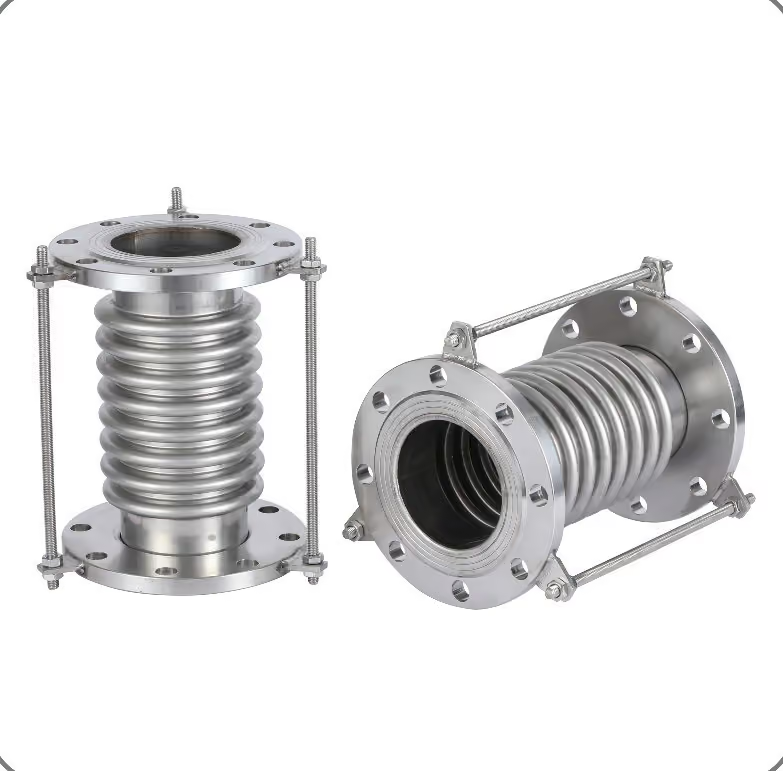
An expansion loop is simply extra pipe arranged in a U or Z shape: the legs flex like a spring as the run grows. Loops cost nothing in special hardware and last the life of the pipe — but they consume space, add pressure drop and hold more inventory of fluid. A metal bellows expansion joint absorbs the same movement in centimeters of face-to-face length: a thin-walled corrugated bellows element, usually with flanged or welded ends, flexes axially, laterally or angularly depending on its arrangement. Bellows suit crowded skids, equipment connections and anywhere a loop will not fit. Where large axial movement must be taken on a long straight run, slip joints telescope — at the price of a packing seal that needs maintenance. The honest rule: loops where you have the space, bellows where you do not, slip joints where a designer calls for them.
Anchors and guides: the part everyone forgets
A flexible element only works if the pipe is forced to move through it. Main anchors divide the line into sections so each joint sees only its own growth; guides keep the pipe straight on either side so it does not bow and steal the joint’s movement. A bellows joint installed without proper anchoring simply transfers the stress into itself and fails early — most expansion-joint warranty claims trace to installation, not manufacture. This is also why a joint belongs in the specification early: anchors and guides are pipework, decided at layout stage, not accessories bolted on later.
Where stainless bellows earn their place
Corrosive or hot service where carbon steel loops would need coating and maintenance; sanitary and process lines in 304/316; equipment isolation on pumps and turbines where vibration joins thermal movement. For short flexible jumpers and moderate movement — under roughly a hundred millimetres — a corrugated hose assembly is often the simpler answer; a purpose-built expansion joint is for sustained, larger, cyclic movement.
FerruleX supplies flanged stainless expansion joints and corrugated hose assemblies built to order. Send the run length, service temperature, pressure class, movement direction and end connections, and we quote the right flexible element — or tell you honestly when a pipe loop is the better answer.
FAQ
How much does steel pipe actually expand? Carbon steel grows roughly 1.2 mm per meter per 100 °C of temperature rise; austenitic stainless (304/316) runs about 40% higher, around 1.6–1.7 mm per meter per 100 °C. A 50 m hot header can therefore grow close to 100 mm — the calculation is coefficient times length times temperature change.
Is a hose the same as an expansion joint? No. A corrugated hose with braid is a flexible jumper for short lengths and moderate movement. A bellows expansion joint is a purpose-built flexing element for sustained, larger, cyclic movement, sized by movement and cycle life rather than by pressure alone.
Can I just add more pipe supports instead? More supports make it worse, not better: they restrain the pipe more rigidly, transferring more stress into the line and the equipment. Movement must be absorbed by flexibility — a loop, a bellows or a slip joint — with anchors and guides arranged to deliver the movement to it.
Which expansion joint type should I choose? Loops where space allows and pressure drop is acceptable; metal bellows where space is short or movement is large and cyclic; slip joints for long axial runs where a designer has accounted for the packing maintenance. Stainless bellows in 304/316 suit corrosive, hot and sanitary service.
Why did my expansion joint fail early? Usually installation, not manufacture: missing or misplaced main anchors and guides let the pipe bow and work the bellows beyond its rated movement, or the joint was absorbing the growth of far more pipe than it was sized for. Verify the anchor and guide layout before blaming the joint.
Related: axial, lateral and angular movement types explained.