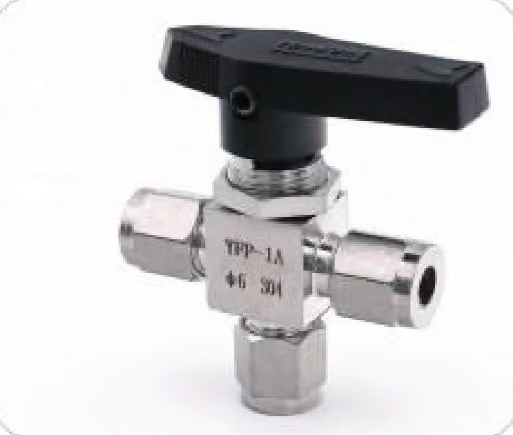
A 3-way stainless steel ball valve replaces two 2-way valves and a tee on lines that need to mix, divert or switch between two destinations. One quarter-turn of the handle changes the flow path — but only if the ball’s port pattern matches the job. L-port and T-port bores do different work, and choosing wrong is the classic 3-way mistake.
Key takeaways
- An L-port 3-way ball valve diverts or switches flow between two adjacent ports and never connects all three, while a T-port ball can connect all three ports at once for mixing or splitting.
- If two destinations must never mix, a T-port valve is the wrong pattern regardless of price, because its mid position leaves the side ports in communication.
- 3-way ball valves are usually reduced bore, briefly connect adjacent paths during the handle turn, and should never throttle flow — a partially open ball valve cavitates and eats its seats.
How a 3-way ball valve works
The body has three ports, usually arranged as one bottom (or side) port and two others at 90° or 180°. Inside, a ball with a shaped bore rotates in seats. A quarter turn moves the bore from one passage to the next; a half turn (180°) returns to the original path with a different intermediate position in between. Seals at each port keep the unselected paths isolated. Like 2-way valves, 3-way bodies come in 1-, 2- and 3-piece construction, and the same pressure-class logic applies — check the rating article if you are unsure whether a standard class covers your line.
L-port: the diverter
An L-port ball has a 90° channel drilled through it, connecting two adjacent ports at a time. In a three-position handle:
- Position 1: bottom port flows to left
- Position 2 (90°): bottom port flows to right
- Position 3 (180°): left flows to right, bottom closed
L-port is for diverting or switching: send the incoming stream to tank A or tank B, switch a pump between duty and standby, or bypass a filter. It never connects all three ports at once, so the two destinations stay isolated. The common stainless pattern is the bottom inlet with side outlets — our 3-way compression ball valve and female 3-way ball valve follow this layout.
T-port: the mixer
A T-port ball has a channel that can connect all three ports simultaneously. In its mid position, flow enters the stem port and splits to both sides — or conversely, two streams merge into one. That makes T-port the choice for:
- Mixing: blending two feed lines into a common outlet in one valve
- Splitting: distributing one stream to two branches proportionally (though not precisely — a ball valve is not a metering device)
- Straight-through with bypass: some T-port orientations also give a straight path plus a side take-off
Because all three ports can communicate, a T-port valve cannot isolate the two side ports from each other. If your two destinations must never mix, T-port is the wrong pattern regardless of price.
Side by side
| Factor | L-port | T-port |
|---|---|---|
| Channel | 90° bend | T, all three connectable |
| Core job | Divert / switch | Mix / split |
| All ports open | Never | At mid position |
| Side-port isolation | Yes | No |
| Typical use | Tank selection, bypass | Blending, common outlet, sampling |
Flow paths and handle stops
3-way valves come with different handle stop arrangements — some give two positions (90°), some three (with 180°). The stops matter as much as the port: a two-position L-port valve will not give you the left-to-right crossover position. Also note that during the quarter turn between positions, flow momentarily connects adjacent paths; 3-way ball valves are not bubble-tight switching devices for services where cross-contamination during transition is unacceptable. For critical isolation, add a dedicated shutoff valve per line.
Specifying on an RFQ
Port pattern is the first line item — L or T — followed by port orientation (which port is inlet), body construction, size, pressure class, seat material and handle stops. Stainless bodies run SS304 for general duty and SS316/316L where chlorides or washdown are present; seats are PTFE or filled PTFE for heat. If the valve sits on an instrument panel with compression tubing, say so — tube-end 3-way valves differ from threaded process versions. Browse the ball valve category for the stocked 3-way range and send the flow diagram with the RFQ if the pattern is unusual.
FAQ
Can I use an L-port valve for mixing? Only crudely, in the crossover position where left connects to right with the bottom closed. Proper mixing needs the T-port mid position where all three connect.
What happens to flow during the handle turn? There is a brief transition where adjacent ports connect through the ball’s channel. On clean fluids this is harmless; on incompatible fluids that must never touch, use separate 2-way valves instead.
Are 3-way valves reduced bore? Usually yes — compact 3-way bodies are commonly reduced bore. If you need full flow through all three legs, specify full port on the RFQ and expect a larger, costlier body.
Which port is the inlet? Any of the three can be, but the seat loading and flow-induced torque differ when you feed from the stem side. Manufacturers rate the valve for any orientation; feeding the bottom port is the standard arrangement.
Can a 3-way valve throttle flow? It will, but it should not. A partially open ball valve eats the seat edge unevenly and cavitates. Install it fully open or fully closed, or use a needle valve for metering duty.


