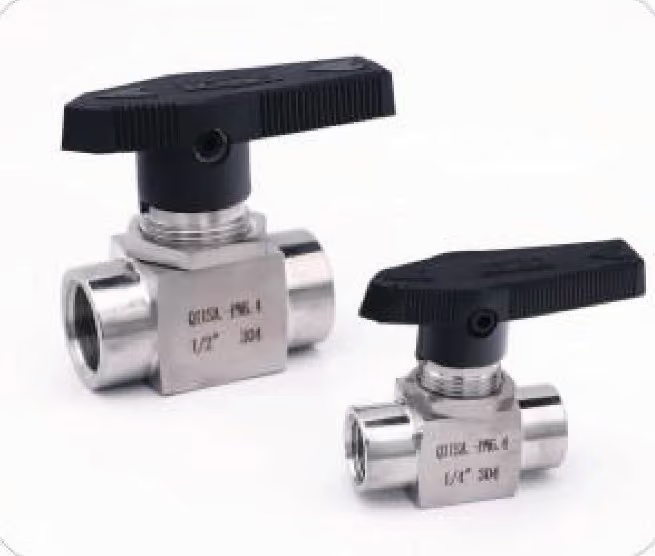
A stainless steel ball valve is never just a ball in a body — the body itself decides what the valve costs, how long it runs and whether a failed seat means a repair or a replacement. 1-piece, 2-piece and 3-piece designs are the three constructions you will quote, and the difference is where the body splits.
Key takeaways
- Body construction decides whether a worn seat means a repair or a replacement: a 1-piece ball valve cannot be rebuilt at all, a 2-piece valve can be opened for seat inspection, and a 3-piece valve swings out of the line without cutting pipe.
- 1000 WOG is the standard class for stainless 2-piece threaded ball valves, 2000–3000 PSI classes come with reinforced bodies and metal or filled PTFE seats, and a 1000 WOG valve at 200 °C may carry only half its cold rating.
- A 3-piece valve costs 30–50% more upfront and is worth it only where inline rebuilds or cleanability matter — on a threaded utility line serviced by replacement, the extra cost buys nothing.
The three constructions
1-piece (unibody): the body is a single casting or forging with no separable joint. The ball and seals are trapped inside, so the valve is compact, cheap and leak-proof by construction — but when a seat wears, the whole valve is scrap. Common on mini valves, utility shutoff and OEM skids where the valve costs less than the labor to open it.
2-piece: two body halves, one housing the ball and one the end connection, joined by threads or bolts. The valve can be opened for seat inspection, the end is replaceable, and it covers the bulk of industrial process duty. Most threaded stainless ball valves — like our female threaded ball valve — are 2-piece.
3-piece: body split into two end caps plus a center section, bolted together. Pull the center bolts and the valve swings out of the line without cutting pipe — the reason 3-piece designs dominate where downtime is expensive or hygiene matters.
Side by side
| Factor | 1-piece | 2-piece | 3-piece |
|---|---|---|---|
| Body joints | None | One | Two bolted |
| Inline repair | Not possible | Possible, awkward | Yes — swings out |
| Cost | Lowest | Mid | Highest |
| Dead space / CIP | Higher | Moderate | Low (sanitary options) |
| Typical duty | Utility, OEM, mini | General process | Food, pharma, high-cycle |
| End styles | Fixed (weld, thread) | Thread, weld, flange | Clamp, weld, thread |
How construction affects the seal
Every body joint is a potential leak path, but it is also a maintenance feature. A 1-piece valve has zero body joints to fail — its weakness is economic, not hydraulic. On 2-piece valves the body joint sees full line pressure, so thread sealant quality and bolt torque matter on reassembly. On 3-piece valves the center section carries the seats and seals; rebuild kits swap the wetted parts while the end caps stay welded or clamped in the line.
Pressure and temperature
Body construction is not the rating — material, wall thickness and seat design set that. As a working envelope for stainless 2-piece threaded valves: 1000 WOG (water, oil, gas) is the standard class, 2000–3000 PSI comes with reinforced bodies and metal or filled PTFE seats, and high-pressure designs go beyond that with special stems and blowout-proof construction. See our breakdown of ball valve pressure ratings for what WOG actually certifies. Temperature derates the pressure: a 1000 WOG valve at 200 °C may carry half its cold rating.
When to pick each
- OEM panel, gauge isolation, drain point, cost-driven utility line: 1-piece or compact mini designs. Our investment cast ball valve fits budget utility shutoff.
- General plant utility, compressor lines, process shutoff on threaded pipe: 2-piece. It is the default for a reason — repairable, stocked everywhere, priced sensibly.
- Food, beverage, pharma, high-cycle actuation, or lines you cannot drain: 3-piece. Paying 30–50% more upfront beats cutting out a welded valve at 2 a.m.
Spec checklist for the RFQ
Whatever the construction, put these on the factory RFQ: end connection and size, body material (SS304 general, SS316/316L for chlorides), seat material (PTFE standard, filled PTFE or PEEK for heat/abrasion), ball port (full or reduced — see full port vs reduced port), pressure class, and handle type. Our ball valve category lists the stocked range; send the spec sheet and we match the construction.
FAQ
Can I rebuild a 1-piece ball valve? No. The body is one piece, so seats and seals are not replaceable. When it weeps, replace the whole valve — which is why 1-piece valves are priced for exactly that.
Is a 3-piece valve always better than 2-piece? Not for a threaded utility line that gets serviced by replacement anyway. The 3-piece advantage is inline rebuild and cleanability; if you will never open the valve, the extra cost buys nothing.
Why are 3-piece valves preferred in sanitary plants? The center section can be removed for cleaning and the design takes tri-clamp ends with minimal dead space. That matters for CIP/SIP cycles — see tri-clamp fittings.
Do body joints leak more over time? A properly torqued body joint is as tight as the pipe flanges around it. Leaks usually trace to seats or stem packing — the parts that actually move and wear.
What is a “full bore” 3-piece valve? Full bore means the ball opening equals the pipe ID, so flow is unrestricted and a pig can pass. Check full port vs reduced port before you assume.
Related: stainless vs brass ball valves.


