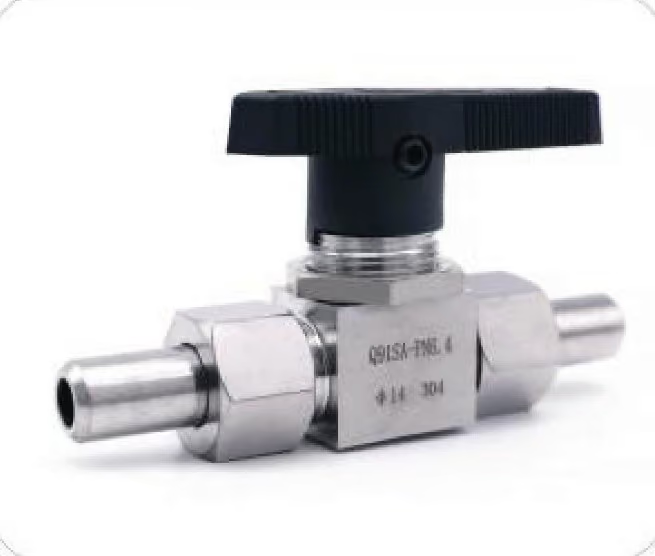
A stainless steel ball valve full port design has a ball opening the same size as the pipe bore; a reduced port (reduced bore) valve narrows the flow path through the ball. Everything else — body, seats, handle — can be identical, and the bore alone changes price, pressure drop and what you can push through the line.
Key takeaways
- A full port 1-inch stainless ball valve flows at Cv ~40 versus Cv ~15–25 for a reduced port valve of the same size — the bore alone changes price, pressure drop and what you can push through the line.
- Reduced port is the right call for most utility isolation, tank drains and branch shutoff; full port is mandatory on pump suction lines, pigged or probed lines, and sanitary transfer.
- A 1-inch reduced port valve and a 1-inch full port valve share end connections but not hydraulics, so swapping one for the other on a balanced loop quietly redistributes flow — quote Cv on the RFQ, not just nominal size.
What the port actually is
The port is the drilled hole through the ball. In a full port (full bore) 1” valve, that hole is 1”. In a standard reduced port valve it is typically one pipe size smaller — a 1” valve with a ~3/4” bore — though ratios vary by maker. Because the ball is smaller and lighter, reduced port valves cost less, weigh less and torque lower. A side benefit: for the same body size, the reduced ball allows a thicker body wall, which is one reason high-pressure compact valves are often reduced bore.
Flow: the numbers that matter
A full port valve adds almost no restriction — its flow coefficient (Cv) approaches that of straight pipe. A reduced port valve acts like a short, abrupt contraction and expansion. In a 1” water line at 3 m/s, the reduced port might add the equivalent of several metres of pipe in pressure drop. That is negligible on a drain valve and meaningful on a pumped recirculation loop running near its curve.
Rule of thumb: if the valve is throttling flow continuously, neither type is right — use a control valve or needle valve. Ball valves are for shutoff, and the port question is about what happens when they are fully open.
Side by side
| Factor | Full port | Reduced port |
|---|---|---|
| Bore vs pipe | Equal | Smaller (often one size down) |
| Pressure drop | Minimal | Noticeable at high flow |
| Cv (1” SS valve) | ~40 | ~15–25 |
| Pigging / swabbing | Passes pigs and probes | Blocks them |
| Slurries / solids | Resists clogging | Can trap at the bore |
| Cost & weight | Higher, heavier ball | Cheaper, lighter |
| Typical use | Manifolds, pump suction, CIP | Utilities, drain, isolation |
When reduced port is the right call
Most of the time, honestly. Utility isolation, tank drains, sample points and branch shutoff valves see intermittent flow at modest velocity, and a reduced port valve performs identically for less money. The smaller bore also survives cavitation-prone spots slightly better because of the thicker body around it. Our female threaded ball valve line ships both bores for exactly this reason — ask which bore the stocked size carries when you RFQ.
When you must go full port
- Pump suction lines: added restriction at the suction raises NPSH requirements and can invite cavitation. Go full bore.
- Pigged or probed lines: inspection pigs, foam swabs and sampling probes need pipe-size passage. Reduced bore stops them cold.
- High-velocity transfer or recirculation: compute the pressure drop at design flow; if the valve’s Cv costs you more than a few percent of pump head, go full port.
- Sanitary transfer: full bore with tri-clamp ends avoids product hold-up at the bore step. See tri-clamp fittings for the clamp side.
One trap: “same size” valves that are not
A 1” reduced port valve and a 1” full port valve share end connections but not hydraulics. Swapping one for the other on a balanced loop quietly changes flow distribution across branches. If your line schedule calls out Cv values, quote the valve’s Cv on the RFQ, not just the nominal size — the ball valve category lists stocked bores per size.
FAQ
Does port size affect pressure rating? No directly — rating comes from body and seat design. But reduced bore valves often rate slightly higher in compact bodies because of the thicker wall, and full port high-pressure valves get large and expensive fast.
Can a pig pass through a full port ball valve? Yes, that is the point of full bore. The ball must be fully open; a partially open full port valve is still a blockage and will destroy the pig.
Is Cv the same as port diameter? No. Cv is the measured flow capacity (US gpm of water at 1 PSI drop). Port diameter drives Cv, but body geometry matters too — compare Cv on the datasheet, not bore on a drawing.
Which bore do compression-end ball valves usually have? Compact compression valves are typically reduced bore for the same cost and wall-thickness reasons. If you need full flow at compression ends, say so on the RFQ — it changes the body casting.
Reduced port for slurry service: acceptable? Avoid it. The bore step is a trap for settled solids and a wear point for abrasive flow. Full bore, hard-faced seats, or a different valve style entirely.


