A “1.5 inch” tri-clamp fitting measures almost 2 inches across its flange — because tri-clamp sizes are named by tube outside diameter, not by the face the clamp actually grips. That single fact causes most ordering mistakes on sanitary lines, and it is why measuring the wrong dimension sends you home with the wrong clamp.
Key takeaways
- Tri-clamp sizes are named by tube outside diameter, not by the flange the clamp grips — a “1.5 inch” tri-clamp fitting measures 1.984” (50.4 mm) across its flange.
- Clamp sizes share ferrules: ½-inch and ¾-inch tube both use the ¾-inch clamp, and 1-inch and 1.5-inch tube both use the 1.5-inch clamp, so flange OD alone cannot tell the tube sizes apart.
- A single-hinge 1.5-inch tri-clamp is typically listed around 500 psi at 70 °F but only roughly 250 psi at 250 °F — and the real rating always belongs to the lowest-rated component of the whole stack.
What a tri-clamp joint is
Three parts make the connection: two identical ferrules (a short tube stub with a raised flange), a gasket that sits between the ferrule faces in the bore, and a clamp that pulls the flanges together around it. No threads, no weld at the joint — which is exactly why food, beverage, dairy, brewery and bioprocess lines use it. A trained operator breaks the joint down for CIP or SIP cleaning in seconds, and a made-up connection leaves no crevices where product can lodge.
The design dates to the Alfa Laval Tri-Clover trademark; “tri-clamp” became the generic term after Ladish popularized the clamp style. Today both names cover the same sanitary clamp connection, built to 3-A sanitary standards in 304 or 316L stainless.
The size chart
| Clamp size | Tube OD | Flange OD | Tube ID |
|---|---|---|---|
| ¾” | ½” / ¾” | 0.984” (25 mm) | — |
| 1.5” | 1” / 1.5” | 1.984” (50.4 mm) | — |
| 2” | 2” | 2.516” (64 mm) | — |
| 2.5” | 2.5” | 3.047” (77 mm) | — |
| 3” | 3” | 3.579” (91 mm) | — |
| 4” | 4” | 4.682” (119 mm) | — |
Two traps hide in this table. First, the flange runs roughly ½” larger than the tube OD — so a 1.5” fitting needs a 1.5” clamp, not a 2”. Second, sizes share ferrules: ½” and ¾” tube both use the ¾” clamp; 1” and 1.5” tube both use the 1.5” clamp. Two different tubes, one flange dimension.
How to measure an existing fitting
- Set calipers across the outside edge of the ferrule flange — the raised rim the clamp captures. Do not measure tube OD, flange thickness or the gasket.
- Compare with the chart: ~0.984” means a ¾” clamp size; ~1.984” means 1.5” clamp size; ~2.516” means 2”.
- Hit a shared-flange pair (1.984”)? Measure the tube OD to split 1” (25.4 mm) from 1.5” (38.1 mm), or read the bore.
If you are ordering adapters into a mixed inch/metric system, verify both sides’ standards before assembly — DIN 32676 metric ferrules do not interchange with inch tri-clamp even when the flange looks close.
Clamps and pressure ratings
| Clamp type | Construction | Typical use |
|---|---|---|
| Single hinge (2-segment) | Hinged, quick-open | Standard sanitary duty |
| Double hinge | Hinged, higher load | Frequent opening, larger sizes |
| High-pressure (bolted) | Two segments + bolts, no hinge | Permanent or higher-pressure lines |
Indicative ratings for single-hinge clamps: a 1.5” clamp is typically listed around 500 psi at 70 °F, falling to roughly 250 psi at 250 °F; a 2” clamp around 450 psi, and larger sizes drop from there. Bolted high-pressure clamps roughly triple the smaller sizes’ ratings. Treat these as orientation, not guarantees — the actual rating depends on the whole stack: clamp design, gasket material and condition, ferrules, temperature and assembly torque. Never exceed the lowest-rated component.
Gasket selection
The gasket fits between the ferrule faces, centered in the bore, and is sized by clamp/flange size. Match the elastomer to the media:
- Buna-N (NBR): water, mild products, low cost
- EPDM: steam, hot CIP, acids — avoid oils
- PTFE: aggressive chemicals, high temperature, low extractables
- Viton (FKM): oils, solvents, high temperature
Two gasket rules prevent most sanitary failures: use the larger gasket when joining different tube sizes that share a flange (1.5” gasket for a 1”–1.5” joint), because a gasket that is too small leaves unsanitary gaps at the bore; and for tubes 2” and larger, use a proper concentric reducer rather than clamping two different bores together directly — the abrupt bore step behaves like a dead leg in the flow path.
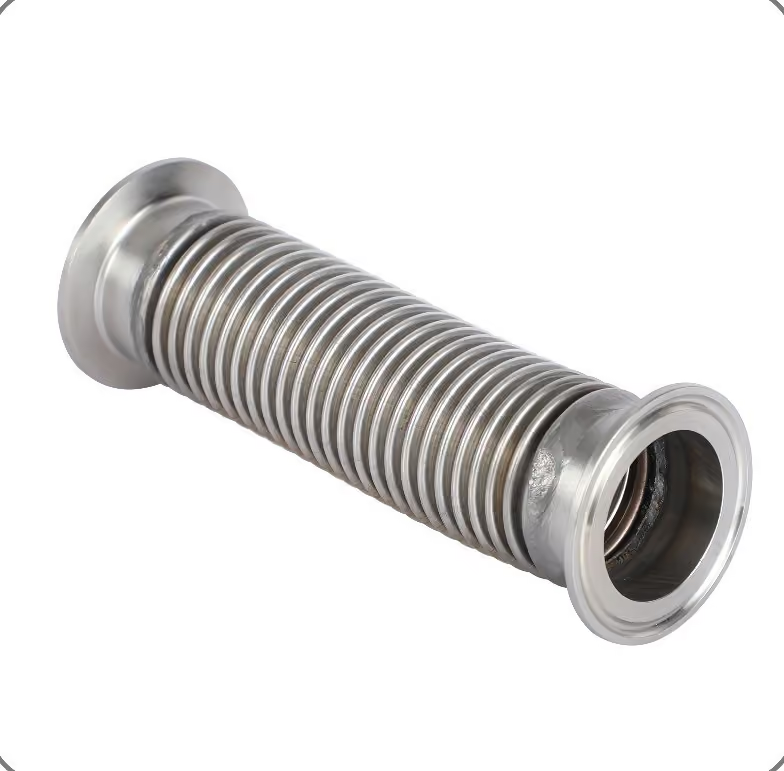
FerruleX builds tri-clamp ends into stainless corrugated hose assemblies and stocks sanitary styles across the corrugated hose and cast fittings ranges — send your ferrule size with the RFQ and we match it, including 316L bodies and food-grade surface finishes where the process demands them.
FAQ
Is tri-clamp the same as tri-clover? Tri-clover was the original Alfa Laval brand name; tri-clamp became the generic term. Dimensions follow the same sanitary standards either way.
How do I tell a 1-inch from a 1.5-inch tri-clamp? Both share the 1.984” flange. Measure the tube OD — 25.4 mm is 1”, 38.1 mm is 1.5”.
What size clamp and gasket do I need? Match both to the clamp size that fits your flange OD (¾ / 1.5 / 2 / 3…), not to the tube OD — and choose gasket material for your media and cleaning temperature.
Are tri-clamp fittings high-pressure rated? They are sanitary connections, not high-pressure joints. Ratings depend on the whole stack — clamp style, gasket, ferrules, temperature — so confirm with the maker for your conditions.
Can I join two different tube sizes directly? Small shared-flange pairs (½”/¾”, 1”/1.5”) can clamp directly with the larger gasket. From 2” up, use a reducer fitting to keep the bore clean and the flow predictable.