Pipe schedule numbers confuse buyers because they look like measurements and act like codes. Schedule 40 and Schedule 80 on the same pipe size share one outside diameter and differ only in wall — the number is a wall-thickness series, not a millimeter count, not a pressure rating, and the same NPS name is not a measurement either. Once the three ideas separate, the whole chart reads cleanly: the OD is fixed, the schedule moves the wall, and everything downstream — bore, pressure, threading — follows the wall.
Key takeaways
- Schedule is a wall-thickness series designation: same NPS, same OD, higher schedule = thicker wall, smaller bore.
- NPS is a name, not a measurement — NPS 1/2 pipe is 0.840 in OD whatever the schedule.
- In the small-bore range, Schedule 40 matches the STD wall and Schedule 80 matches XS (XS equivalence holds through NPS 8).
- Schedule is not a pressure class: the same schedule rates differently with material, diameter and code.
- Stainless pipe uses the S-suffix schedules (5S/10S/40S/80S); thread cutting needs enough wall under the thread — thin schedules cannot hold it.
What the number means
A pipe schedule is a standardized series index for wall thickness. ASME B36.10 defines the series: pick an NPS and the OD is fixed — NPS 1/2 is 0.840 in (21.3 mm) whether the wall is 0.109 or 0.147 — and the schedule selects the wall. Our printable pipe schedule chart covers the small-bore range in the values procurement actually quotes:
| NPS | Actual OD (in) | OD (mm) | Sch 10 wall (in) | Sch 40 wall (in) | Sch 80 wall (in) |
|---|---|---|---|---|---|
| 1/8 | 0.405 | 10.29 | 0.049 | 0.068 | 0.095 |
| 1/4 | 0.540 | 13.72 | 0.065 | 0.088 | 0.119 |
| 3/8 | 0.675 | 17.15 | 0.065 | 0.091 | 0.126 |
| 1/2 | 0.840 | 21.34 | 0.083 | 0.109 | 0.147 |
| 3/4 | 1.050 | 26.67 | 0.083 | 0.113 | 0.154 |
| 1 | 1.315 | 33.40 | 0.109 | 0.133 | 0.179 |
| 1-1/4 | 1.660 | 42.16 | 0.109 | 0.140 | 0.191 |
| 1-1/2 | 1.900 | 48.26 | 0.109 | 0.145 | 0.200 |
| 2 | 2.375 | 60.33 | 0.109 | 0.154 | 0.218 |
Full printable version: pipe schedule chart
In this small-bore range, Schedule 40 is the STD (standard) wall and Schedule 80 is the XS (extra-strong) wall — the XS equivalence holds through NPS 8, then diverges at NPS 10, where XS is 0.500 in and Schedule 80 is 0.594 in. Values above are the published B36.10 nominal figures, reproduced from the chart without recomputation. The deeper size-logic difference — pipe ordered by NPS and schedule versus tube ordered by OD and wall — is covered in pipe vs tube.
OD stays, wall changes
The fixed OD is a compatibility rule, not a curiosity: pipe sizes were locked generations ago so that fittings, flanges and threads would interchange regardless of wall. That is why the NPS name stopped meaning any measured diameter below NPS 14 — the mirror image of the tube world’s dash system, where the number does measure something (dash size chart) — and why a Schedule 80 pipe threads into the same fitting as Schedule 40 of the same NPS. What changes with the wall is the bore — a Schedule 80 1 in pipe carries noticeably less flow area than its Schedule 40 sibling — plus the strength figures and, below, the threading limits.
Pressure and threads
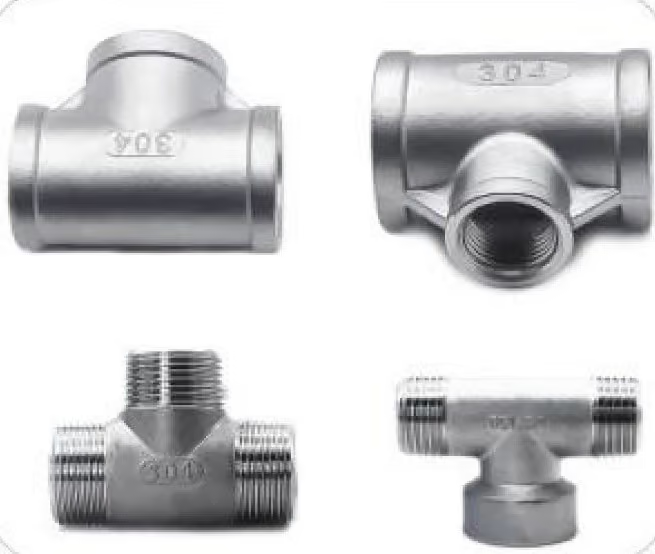
Schedule is not a pressure class. The same Schedule 80 wall rates very differently in carbon steel versus stainless, at different diameters and temperatures, under different design codes — pressure rating is a calculation from material allowables, diameter and temperature, not a lookup from the schedule index. Thicker wall does buy pressure margin; it just does not certify it. On threading, the rule is wall under the thread: the NPT form cuts to a depth of about 0.8 times the thread pitch, and the wall must survive that cut with margin. Thin schedules — 5S, 10S, and some 40 in small sizes — cannot hold full-depth threads at all; that is why threaded stainless work runs 40S and 80S. And the thread form itself is fixed: a threaded Schedule 40 and Schedule 80 pipe of the same NPS take the same fitting and seal the same way — the heavier wall leaves more material beneath the same thread, resisting deformation and mechanical damage, not a different thread. Identification before assembly follows the bench test.
Stainless practice
Stainless pipe follows ASME B36.19 and its own schedule family with an S suffix: 5S, 10S, 40S, 80S. The S distinguishes the stainless series from the carbon schedules — and the walls are not uniformly thinner, whatever the shorthand says. Through about NPS 10, the 40S and 80S walls are identical to their carbon 40 and 80 counterparts; the series diverges at larger sizes, and it is the 5S and 10S walls that are thinner than anything B36.10 offers. For the small-bore instrument and process range in the chart above, 40S behaves as 40. When the RFQ says “stainless pipe, 1 in, Schedule 40,” the honest write is 1 in NPS, 40S, with the standard named.
RFQ lines
NPS + schedule— e.g.,1/2 NPS Sch 40S— never the bare name.standard— ASME B36.10 or B36.19 as applicable.end prep— threaded, beveled for weld, or plain.material and test requirements— grade, certificate type, any hydro or NDT.
FAQ
Is Schedule 80 always stronger?
Thicker wall always adds pressure margin, but “stronger” needs a reference: pressure rating depends on material, diameter, temperature and design code, and schedule alone certifies none of it. Schedule 80 in one material can out-rate Schedule 160 in another at some sizes. Treat schedule as wall, not as class.
Why does the OD stay the same when the wall changes?
Compatibility. Pipe OD was standardized generations ago so fittings, flanges and threads would interchange across walls — a Schedule 80 pipe threads into the same fitting as Schedule 40 of the same NPS. Only the bore moves with the wall. The NPS name stopped tracking any measured diameter below NPS 14.
What does the S in Schedule 40S mean?
The stainless series of ASME B36.19: S-suffix schedules (5S, 10S, 40S, 80S) belong to stainless pipe and are distinguished from the carbon-steel schedules of B36.10. In the small-bore range through about NPS 10 the 40S and 80S walls match their carbon namesakes; the divergence, and the thinner 5S/10S walls, live at larger sizes.
Can I thread Schedule 10 stainless pipe?
Generally no. The NPT thread form cuts to roughly 0.8 times the pitch, and a Schedule 10 wall — thinner than anything in the carbon schedules — cannot hold the full-depth thread with margin. Threaded stainless work runs 40S and 80S for exactly that reason; below them, switch to welded or compression ends.
Is Schedule 40 the same as STD?
Through NPS 10, yes — STD is the standard wall and equals Schedule 40 in that range. XS equals Schedule 80 through NPS 8 and diverges at NPS 10, where XS is 0.500 in and Schedule 80 is 0.594 in. Above those sizes the legacy names and the schedule numbers go their separate ways, and the wall table is the only safe read.