Identify NPT vs BSP threads at the bench, before the RFQ goes out — not after the parts arrive. The two families look alike, share fractional size names, and in the 1/2 and 3/4 inch sizes even share the same 14 threads per inch, which is why “it screwed in” proves nothing. A caliper, a thread pitch gauge and five minutes settle it definitively. Here is the procedure and the lookup table.
Key takeaways
- Measure two things — TPI with a pitch gauge, major OD with calipers — then check the table: 1/4 and 3/8 inch split on TPI (NPT 18 vs BSP 19), but 1/2 and 3/4 inch tie at 14 TPI and only the thread form separates them.
- The form check decides tied sizes: NPT (ASME B1.20.1) has 60° flanks with flat crest and root; BSP — parallel BSPP or tapered BSPT — has a 55° Whitworth form with rounded crest and root.
- Taper separates the BSP variants: BSPP (ISO 228-1, “G”) is parallel and seals on a face washer or O-ring; BSPT (ISO 7-1, “R”) tapers 1:16 like NPT and seals on the thread.
- NPT and BSP are not interchangeable: the tapers match on paper, the flank angles do not meet in the metal — no sealant bridges that, only an adapter converts it.
The 5-minute bench test
- Clean the thread. Wipe off oil and lint; a chipped or painted crest distorts every measurement that follows.
- Gauge the TPI. Lay thread pitch gauge leaves across the flanks until one seats without daylight. Count threads per inch, not the leaf number.
- Measure the major OD. With calipers across the crests, measure the male thread’s largest diameter — on a tapered male take the reading at the base end, on the largest full thread, because the table values sit there: a 1/2 NPT male reads 0.840 in (21.34 mm) at the base and about 0.80 in near the tip.
- Look up OD + TPI together. Neither number alone identifies a thread — more than one size shares a TPI, and the OD differences between families run a few tenths of a millimetre. Use the table below.
- Confirm form and taper. Form: NPT crests look cut flat; BSP crests look rolled round. Taper: run the calipers along the shank — NPT and BSPT visibly shrink toward the end, BSPP stays constant and usually carries a sealing face or washer seat.
- Write it on the RFQ. “1/2 NPT male”, “G1/2 male”, “R1/2 male” — the standard plus the size is the whole message.
The OD + TPI lookup table
Core asset — the published gauge values, cell by cell:
| Nominal size | NPT (TPI / OD) | BSPP G (TPI / OD) | BSPT R (TPI / OD) |
|---|---|---|---|
| 1/4 inch | 18 / 13.72 mm (0.540”) | 19 / 13.16 mm | 19 / 13.16 mm |
| 3/8 inch | 18 / 17.15 mm (0.675”) | 19 / 16.66 mm | 19 / 16.66 mm |
| 1/2 inch | 14 / 21.34 mm (0.840”) | 14 / 20.96 mm | 14 / 20.96 mm |
| 3/4 inch | 14 / 26.67 mm (1.050”) | 14 / 26.44 mm | 14 / 26.44 mm |
| 1 inch | 11.5 / 33.40 mm (1.315”) | 11 / 33.25 mm | 11 / 33.25 mm |
Values are the published dimensions from our printable NPT thread chart and BSPP thread chart sheets — NPT per ASME B1.20.1, G per ISO 228-1, with BSPT sharing TPI and gauge-plane diameters with the same nominal BSPP size per ISO 7-1. Because tapered threads change diameter along their length, expect a reading within a few tenths of a millimetre of the table value, not on it.
The 14-TPI trap
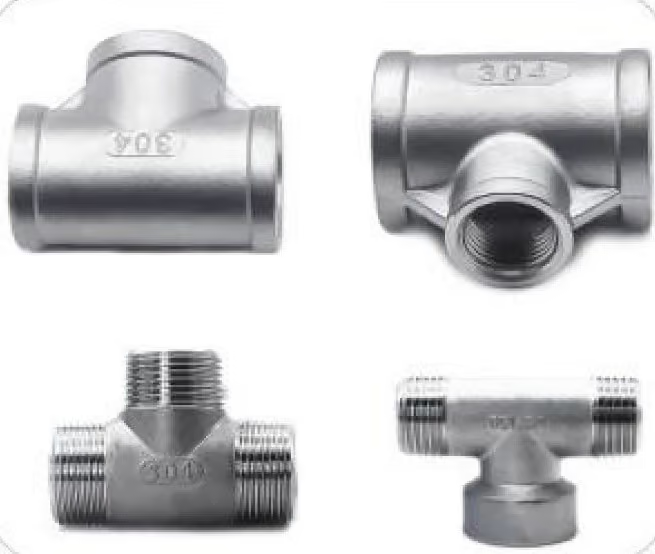
At 1/2 and 3/4 inch, NPT and BSP both run 14 TPI, and the ODs sit about 0.2–0.4 mm apart — inside caliper slop on a worn or coated thread. TPI alone cannot distinguish these sizes, so the form check leads. Hold the thread to the light and look at the crest profile: NPT’s 60° Sellers form presents flat-topped crests and flat roots, while the BSP 55° Whitworth form presents rounded crests and roots. A 55° pitch-gauge leaf that seats on a BSP thread will rock or show daylight on an NPT flank. That one observation is the definitive answer where the numbers tie — and it matters, because the two threads are not interchangeable even though both taper 1:16 on diameter. The sealing philosophies behind each family are compared in NPT vs G (BSP) threads on stainless fittings.
What the taper tells you
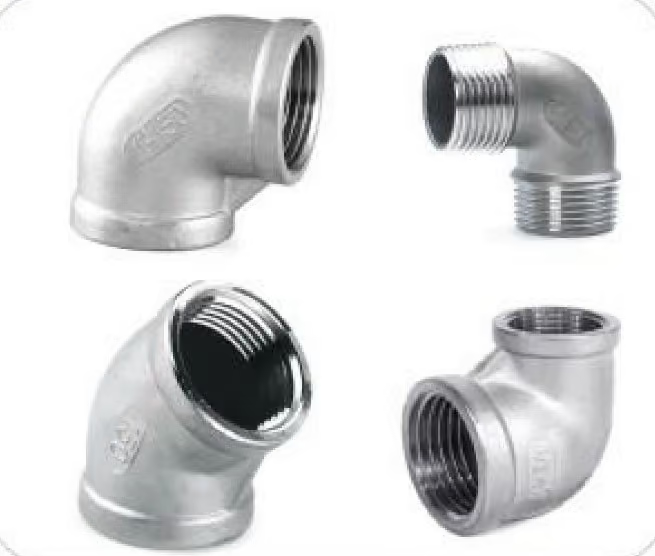
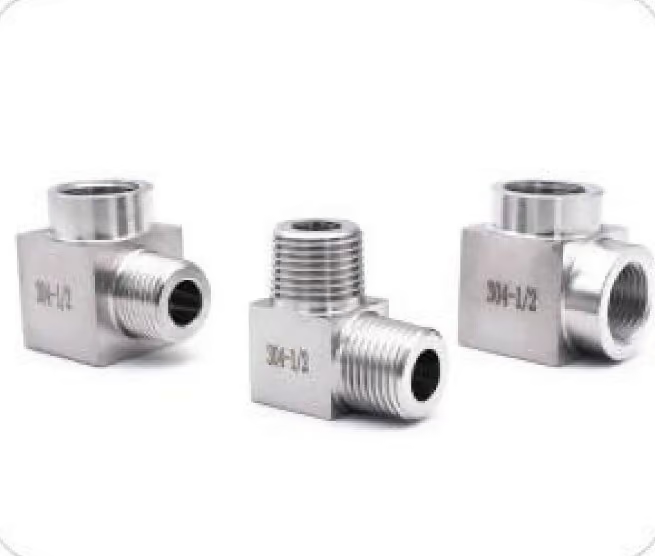
NPT is always tapered. BSPT is tapered at the same 1:16 rate. BSPP is parallel — its diameter is constant along the thread, and it never seals on the thread: the seal is a bonded washer, O-ring or face gasket, so a BSPP female usually shows a machined face or a recessed washer seat inside. If the male thread diameter is constant, the answer is BSPP and the RFQ line is “G” — then specify the seal arrangement. If it tapers, you have NPT or BSPT and the form check above picks between them. For tube-side sizes on the same panel, the metric-versus-fractional question is separate: see metric vs fractional tube sizes.
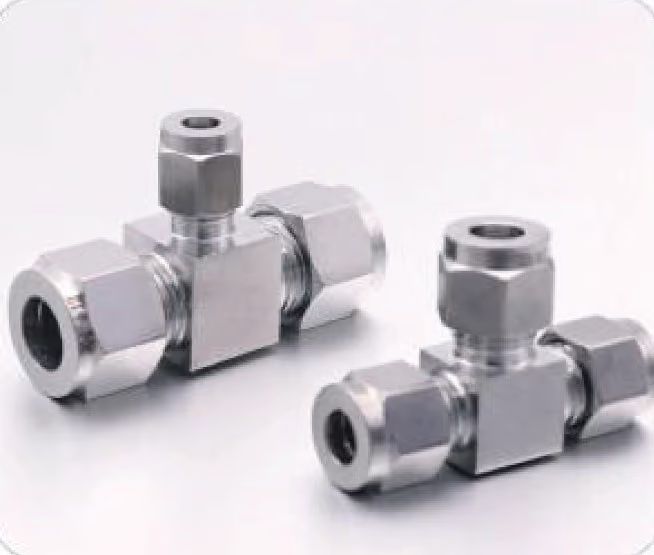
FerruleX machines NPT, BSPP (G) and BSPT (R) ends across the compression fittings range and threaded valve lines, with each end named on the quote. Request a factory quote with the thread written exactly as the bench test read it — standard, size, male or female.
FAQ
Are NPT and BSP threads interchangeable? No. Both tapered families run the same 1:16 taper on diameter, but NPT’s 60° flat-crested form and BSP’s 55° rounded Whitworth form contact at the crests rather than the flanks. The joint may feel tight and will gall on assembly, then leak under pressure, temperature or vibration. Use an adapter made for exactly the two standards involved.
Can I use thread sealant to make NPT and BSP fit? No. Sealant fills the spiral leak path between matching tapered threads — it cannot fill a form mismatch. The 60°-against-55° flanks make metal contact at points instead of faces, and no thickness of tape or compound creates a sealing surface that is not there. Forcing the pair with extra tape usually galls the stainless threads first.
When the threads do match, the same sealant question returns at the fitting’s other end: a compression adapter with an NPT or BSPT tail needs tape or dope on the taper — kept off the first thread or two — and none whatsoever on the ferrule side, where sealant prevents the bite. The end-by-end rules live in pipe dope vs Teflon tape on compression fittings.
Do NPT and BSPT have the same taper? Yes — both taper 1:16 on diameter, 3/4 inch per foot. That is exactly why the taper check alone cannot separate them: use the form check (flat 60° NPT crests vs rounded 55° BSPT crests) once the calipers show a taper.
Can TPI alone identify a pipe thread? No. More than one size shares a TPI within a family, and across families 1/2 and 3/4 inch tie at 14 TPI. Even where TPI differs, the margin is a single thread per inch at 1/4–3/8 inch (18 vs 19) and half a thread at 1 inch (11.5 vs 11). Always pair the TPI count with the OD measurement and confirm with the form.
How do I identify a female thread? Gauge the TPI inside the port with the pitch gauge leaves, check for taper with a known male fitting or plug gauge, and look for the BSPP signature: a machined face or recessed bonded-washer seat. Where the port is ambiguous, send FerruleX a photo or the mating part with the RFQ and we confirm the standard before quoting.
Why does my fitting point the wrong way once it’s tight? Because a tapered thread tightens to a position, not to a torque: once wrench-tight, the fitting’s orientation is fixed, and backing it off to clock the outlet unwinds the very interference that seals the joint. Plan orientation before assembly. Dry-run the fitting to see where it lands, and work from hand-tight engagement — the dimensional allowances in ASME B1.20.1 work out to roughly three wrench turns past hand-tight for 1/8–2 in. NPT, though makers’ assembly instructions often specify fewer. Where clocking is critical by design, a straight-thread O-ring fitting is the joint that tolerates re-orientation. If the assembly must be welded, remove valves or plastic-bodied components first, and trial-fit the position before the final weld.