A dash size is a shorthand number that says how big a hydraulic tube or hose end is, in sixteenths of an inch: the dash number divided by 16 gives the size. It is the sizing language of SAE and JIC fittings and adapters, and once you can read it, a spec line like “6-6 STR JIC” tells you both ends at a glance. Here is the chart and the mistakes that still trip buyers.
Key takeaways
- Dash size = the fitting or tube size in 16ths of an inch: -4 is 4/16 (1/4 inch, 6.35 mm), -6 is 6/16 (3/8 inch), -8 is 1/2 inch, and -32 is 2 inches (50.8 mm).
- On SAE/JIC tube fittings the dash number corresponds to the tube outside diameter; on hose ends it commonly denotes the hose inside diameter.
- Dash notation belongs to the SAE/JIC world — it is not an NPT pipe size. A -4 NPT port does not have a 1/4 inch thread; pipe threads are identified from an NPT thread chart.
- Read a spec line end by end: “6-6” means 3/8 inch (dash -6) on both ends of the adapter or hose assembly.
The dash size chart
| Dash | Fractional inch | mm | Typical use |
|---|---|---|---|
| -4 | 1/4 inch | 6.35 | Small instrument and pilot lines |
| -6 | 3/8 inch | 9.53 | The workhorse instrument tube size |
| -8 | 1/2 inch | 12.70 | Instrument and hydraulic mains on skids |
| -10 | 5/8 inch | 15.88 | Medium hydraulic lines |
| -12 | 3/4 inch | 19.05 | Process and hydraulic distribution |
| -14 | 7/8 inch | 22.23 | Less common; larger instrument runs |
| -16 | 1 inch | 25.40 | Hydraulic supply and return lines |
| -20 | 1-1/4 inch | 31.75 | Larger hydraulic and process runs |
| -24 | 1-1/2 inch | 38.10 | Manifold and station feeds |
| -28 | 1-3/4 inch | 44.45 | Rare; special machinery runs |
| -32 | 2 inch | 50.80 | Large-bore hose and tube headers |
The arithmetic is the whole trick: divide the dash number by 16. That is why -12 (12/16) is 3/4 inch and -16 is a full inch, and why the jump from -16 to -32 doubles the size. Millimeter users can read the same chart straight across — the mm column is just the verified inch value converted, which is also the cleanest way to talk to a metric-drawing shop about a fractional-drawing line, and the reverse conversion discipline is covered in metric vs fractional tube sizes. A printable version of this chart lives on our dash size chart sheet.
How to read a dash spec line
Adapter and hose drawings stack the dash numbers end to end. A “6-6 straight adapter” is 3/8 inch on both ends; a “6-8” steps from 3/8 inch to 1/2 inch. A “-6 JIC” call-out names the end geometry too: 3/8 inch tube-size fitting with a 37° flare seat. The number describes the fitting’s size in the SAE/JIC system — a -6 fitting is made for 3/8 inch tube OD — and matching the tube to the number, not to a thread measurement, is what keeps the joint honest. When the second end is a pipe thread, the drawing says so explicitly, and that is where dash notation ends and pipe-thread charts begin.
The three mistakes to avoid
Mistake one: reading dash as NPT. An NPT port marked “-4” does not carry a 1/4 inch thread; NPT nominal sizes follow the pipe standard, and the thread’s actual dimensions come from the NPT chart, not from dividing by 16. Mixing the two systems is the most common reason an adapter arrives one size off — the identification method is covered in NPT vs G (BSP) threads. Mistake two: assuming dash equals the measured fitting. The number is a nominal code for the tube or hose it serves; the fitting’s own hex and thread are sized by the standard governing the end form. Mistake three: ordering by dash alone on a mixed drawing. Dash sizes are fractional-inch language; a metric drawing expresses the same tube as 6, 8, 10 or 12 mm, and the RFQ needs both systems stated when the panel mixes them.
Stating dash sizes on an RFQ
Give the factory what the drawing gives you: end form, dash size and, where a pipe thread is involved, the thread call-out. “6-6 straight adapter, both ends -6 JIC, 316 stainless” is a complete line; “8-4 reducer, -8 JIC to -4 NPT male” is complete in the same way. If the tube itself is metric, add the metric OD alongside the dash so there is no ambiguity about which system the panel uses.
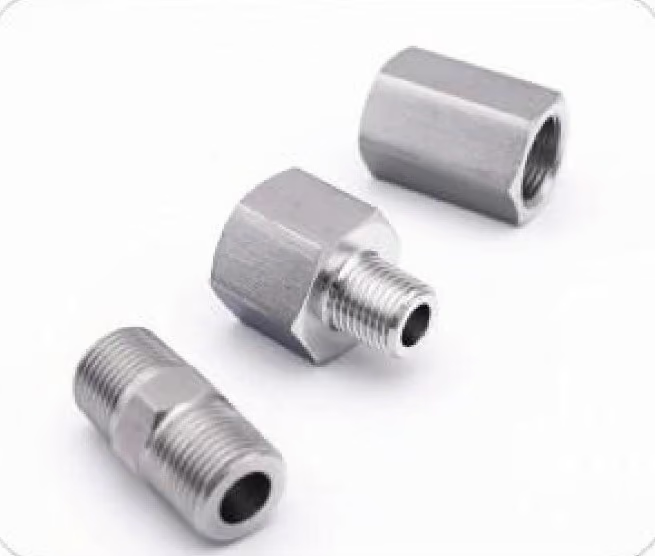
FerruleX supplies the stainless adapters that live at the dash-to-thread boundary of these drawings — see the adapters and weld category for straight, elbow and reducing adapters, and the products hub for the fitting families they connect. Send the spec line as drawn and we match both ends. Request a factory quote.
FAQ
What does a dash number mean on a hydraulic fitting? It is the fitting’s size in sixteenths of an inch. Divide the number by 16: -4 is 1/4 inch, -6 is 3/8 inch, -8 is 1/2 inch, continuing up to -32 at 2 inches. On tube fittings it corresponds to tube OD; on hose ends it commonly denotes hose ID.
Is a dash size the same as an NPT size? No. Dash sizing belongs to SAE/JIC tube and hose fittings; NPT is a pipe thread standard with its own size table. A fitting marked -4 on an NPT port does not have a 1/4 inch thread — identify NPT threads from a thread chart.
What size is a -6 fitting? 3/8 inch. The dash number over 16 gives 6/16 = 3/8 inch, which is 9.53 mm. A “-6 JIC” fitting is made for 3/8 inch tube OD with a 37° flare seat.
What is the biggest common dash size? -32, or 2 inches (50.8 mm), is the top of the standard dash chart and appears on large-bore hose and tube headers. The everyday instrument range is -4 through -12.
How do I convert a dash size to millimeters? Divide the dash number by 16 to get inches, then multiply by 25.4. A -12 is 12/16 inch = 3/4 inch = 19.05 mm. For tube, the metric near-misses (6 mm versus 1/4 inch and so on) are not interchangeable — state the system on the RFQ.