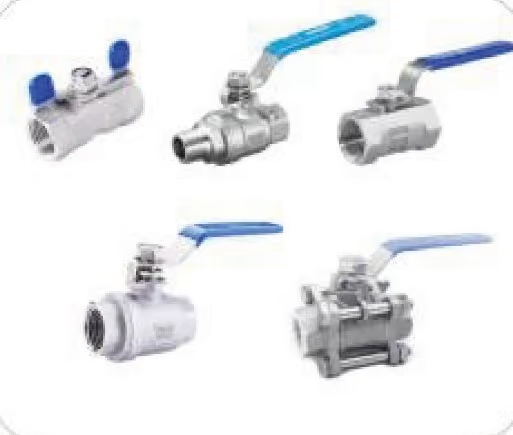
Stainless steel ball valve vs brass is not a quality contest — it is a duty contest. Brass wins a large share of water and air service honestly, and stainless wins every corrosive, hot or regulated duty just as honestly. The expensive mistake is not choosing either; it is choosing brass for water that turns out to be aggressive.
Key takeaways
- The deciding failure mode is dezincification: common free-machining brass carries ~35% zinc, and in warm, stagnant or chloride-bearing water the zinc leaches out, leaving a porous copper shell that fails without warning — stainless contains no zinc and is immune.
- The envelopes differ by construction: typical brass ball valves run 600 WOG class to roughly 160–185 °C, while stainless runs 1000 WOG and beyond to about 220 °C+ — though in both families the seat material, not the body, often sets the real ceiling.
- Cost is real but so is scope: brass valves commonly run two to three times cheaper, which is money well saved on benign water and air — and money wasted on chlorides, seawater, chemicals, food contact or any line where a failed valve costs production.
Side by side
| Aspect | Stainless (304/316) | Brass (C36000 class) |
|---|---|---|
| Chlorides / seawater | Excellent in 316 (Mo-bearing); 304 limited | Poor — dezincification risk |
| Dezincification | Immune — no zinc | Susceptible above ~15% Zn; severe near 35% |
| Temperature | To ~220 °C and beyond by seat | To ~160–185 °C; derates steeply with heat |
| Pressure class | 1000 WOG standard; HP classes above | 600 WOG typical |
| Media | Chemicals, food, pharma, marine, most fluids | Potable water, air, oils, fuels — benign media |
| Potable compliance | Naturally lead-free | Must be certified lead-free (e.g. NSF 61/372) |
| Weight / machining | Heavier, harder to machine | Lighter, machines fast |
| Cost | Two to three times the brass valve | The budget option |
Where brass wins honestly
Clean, low-chloride potable water, compressed air, hydraulics and heating circuits within its rating. Brass machines faster and cheaper, threads easily, and decades of plumbing history say it lasts 20-plus years in benign water. If the media is neutral, the temperature moderate and the pressure inside the 600 WOG class, brass is the economical answer — stainless adds purchase cost without adding service life. One condition: the water must actually be benign. Warm, soft, low-alkalinity or chloride-bearing water — hot-water recirculation lines are the classic casualty — turns the same valve into a dezincification case, and potable duty demands certified lead-free brass regardless.
Where stainless is the only honest answer
Chlorides and seawater: dezincification eats ordinary brass, and even the stainless choice must be 316 in real chloride service — 304 is not a substitute, the molybdenum is what buys the pitting margin (the grade logic from SS304 vs SS316 applies to valve bodies exactly as to fittings). Temperature above the brass ceiling, where brass strength falls off steeply — and check the seat rating separately, because PTFE limits both materials. Chemical, food, dairy and pharma media, where cleanability and media compatibility rule brass out. Marine splash and washdown. And anywhere a failed valve stops production: the two-to-three-times purchase premium is cheap insurance against unplanned isolation.
The middle path: DZR brass
Where the water is aggressive but stainless is not justified — aggressive municipal supplies are the textbook case — dezincification-resistant brass caps zinc below roughly 15% and adds inhibitors, and low-zinc bronzes such as C83600 sit below the susceptibility threshold. DZR runs 10–20% over standard brass and is mandated by plumbing codes in affected regions. It is the right answer for potable water that would eat C36000 but does not need stainless economics — a niche, but a real one.
FerruleX manufactures stainless ball valves in SS304 / SS316 / SS316L — ball valve category, female threaded and investment cast bodies — and our compression fitting line carries the same material-matching logic: brass ferrules on copper tube, stainless on stainless, per tube compatibility. Send the media, water chemistry where relevant, pressure class and temperature, and we quote the material the duty deserves. Request a factory quote.
FAQ
Why do brass ball valves fail in some water systems? Dezincification: common brass is ~35% zinc, and in warm, stagnant, soft or chloride-bearing water the zinc leaches selectively, leaving a porous copper skeleton with no strength. Hot-water recirculation lines are the classic failure location. Susceptibility starts around 15% zinc content.
Is a stainless steel ball valve always better than brass? No — better only where the duty demands it: chlorides, seawater, chemicals, food and pharma, high temperature, or regulated potable duty. For benign water and air inside the brass rating, brass performs identically for two to three times less money. Match material to duty.
What temperature can brass and stainless ball valves take? Typical brass valves in the 600 WOG class run to about 160–185 °C, derating steeply as temperature rises; typical stainless valves reach roughly 220 °C and beyond. In both families the seat material — usually PTFE — often sets the practical ceiling before the body does, so check the P-T curve.
Can I use brass valves on seawater? Not ordinary brass — dezincification will consume it. Seawater and brackish service belong on 316 stainless, or on dezincification-resistant alloys and low-zinc bronzes where economics demand. That is a materials decision worth making before the purchase order, not after the first failure.
What about potable water specifically? Benign chemistry: certified lead-free brass is the economical standard. Aggressive chemistry (warm, soft, low-alkalinity, high chloride): DZR brass or low-zinc bronze, code-mandated in many regions. Stainless is the premium answer and the compliance-safe one for regulated or high-purity potable duty.


