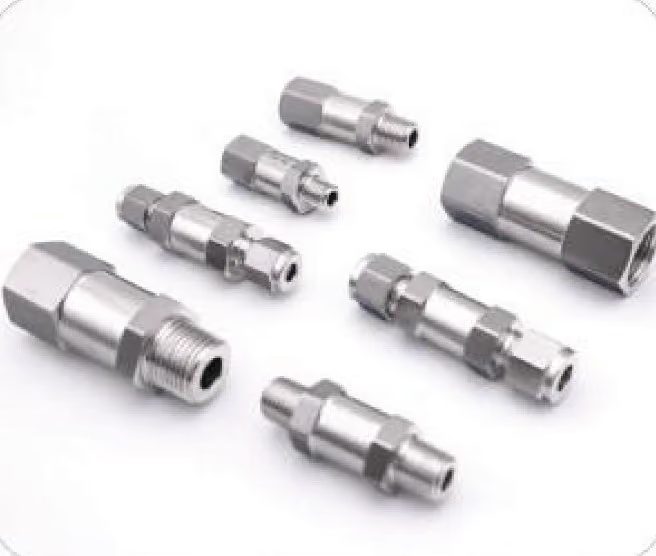
Orifice union fittings hide a precision instrument inside the most boring fitting on the rack: a union body with a drilled disc inside it. The disc carries a hole measured in thousandths of an inch, and that hole does real work — throttling flow to protect a transmitter, damping a twitchy impulse line, setting a bleed rate. Because the restriction lives inside a union, it assembles like any other joint and swaps like any other spare. Because the hole is precision-drilled rather than field-made, it actually does what the drawing says.
Key takeaways
- An orifice union is a union fitting with a precision-drilled orifice plate captured in the joint — the disc sits between the union tailpiece and thread piece.
- Published precision bores run from about .004 in to .125 in, held to ±.0005 in — tolerances a drill press cannot repeat.
- Jobs: limiting flow to instruments, damping pulsation in impulse lines, setting drain and bleed rates, and metering duty on measurement taps.
- Smaller bore means more restriction — lower Cv, higher pressure drop, slower response; size the hole for the job, not the smallest available.
- Do not drill your own: flow through a plain drilled hole can vary as much as 30% hole-to-hole, and edge condition alone changes the coefficient.
What an orifice union is
Take a standard union — tailpiece, thread piece, nut — and capture a thin orifice plate in the joint between them. The plate is 316 stainless in standard builds, bored to spec or supplied blank, and the union seals around it exactly as it would around a gasket joint. The result is a restriction that installs and services with ordinary fitting tools: no spool piece, no flanged orifice run, no special wrench. Maker catalogs describe the same construction across the category — a single-piece plate that fits directly in the union seat, eliminating the separate gasket. For custom bore-and-body combinations, the custom fittings range is the quoting route.
Where they go
Three instrument-loop jobs dominate. First, transmitter protection: a differential or gauge device has a maximum working flow through its sensing path, and a restriction upstream caps what the process can push through it — the same protection logic that puts a gauge snubber on a Bourdon tube, applied to flow. Second, impulse-line damping: pulsating flows make transmitters chatter, and a restriction in the impulse line averages the pressure seen at the device — one of the standard damping measures alongside routing covered in instrument impulse lines. Third, rate setting: bleed lines, seal pots and sampling points that must dribble at a controlled, repeatable rate get there with a fixed bore instead of a hand-valve babysitter. Measurement duty exists too — a known bore is a known restriction — but that is metering-orifice territory with its own standards and straight-length requirements; the instrument-line union is about control, not custody transfer.
Sizing
Sizing language is Cv, the flow coefficient covered in what is Cv — smaller bore, lower Cv, more restriction for the same pressure drop. The working trade-offs: more restriction damps harder and slows the response; too much restriction leaves the instrument blind to real change. Catalog ranges give the palette — precision bores from about .004 in up to .125 in, each with a published Cv band — so the RFQ line is simply the job: “cap flow at X under Y conditions,” or “damp a compressor-driven impulse line,” and the bore follows from the maker’s tables. Where the duty might change, specify a replaceable-disc union and the bore becomes a spare part instead of a re-order.
One comparison buyers benefit from: the orifice union is the fixed restriction, the set-and-forget member of the family. Where the line needs an adjustable restriction — a damping setting the commissioning engineer tunes by hand — a needle valve does that job, at the price of a stem seal and a setting that can drift. The union trades adjustability for zero maintenance and nothing to loosen: no stem, no packing, no adjustment to walk. Specifying the fixed bore is how you buy certainty; specify the needle valve only when the certainty is expected to change.
RFQ lines
bore— drilled diameter in inches, or “bored to spec” with the flow/pressure conditions.tube or pipe ends— both sides: OD and wall for tube, NPS and schedule for pipe.body and plate material— 316 is the standard plate; body to match the line.service— protection, damping, or rate-setting, with the fluid and its viscosity.replaceable disc— yes or no.
FAQ
Can I drill my own orifice?
You can, but the hole will not be the size you think. Maker data shows flow through plain drilled holes varying as much as 30% between holes with identical measured diameter — burrs, edge radius and roundness all move the effective coefficient, and flow-measurement standards require edge sharpness measured in ten-thousandths of the bore. A ±.0005 in factory bore with a verified coefficient is the point of the part; a drill press buys you an unknown.
What bore sizes are available?
Precision orifice inserts are published from about .004 in to .125 in in diameter, with ±.0005 in tolerance as a catalog standard, and makers will bore outside the table on request. Below .004 in the territory is specialized micro-drilling; above .125 in you are usually into full orifice-plate rather than union territory.
How does the orifice size relate to flow?
Through the Cv relation — the same sizing basis as valves. A smaller bore passes less flow for a given pressure drop, so the restriction rises and the response downstream slows. Pick the bore from the flow and pressure conditions, not by habit: the smallest hole is rarely the right hole.
What is the difference between an orifice union and a snubber?
They share the physics — a small restriction throttling change — but the packaging and duty differ. A snubber is a damping element installed ahead of a pressure gauge. An orifice union is a line fitting carrying a fixed, precision bore that sets the flow in the line itself. One protects an instrument from pulsation; the other makes the line do what the drawing says.
When do I need a replaceable disc?
When the duty might change — new pump, different fluid, revised flow — or when the line cannot afford the downtime of a fittings order. The replaceable-disc union turns the bore into a stocked spare: pull the nut, swap the disc, remake the joint. For fixed, known duties the bored-in-place disc is cheaper and one less leak interface.


