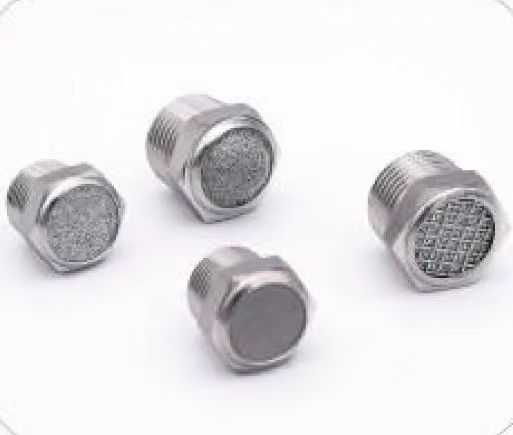
Gauge snubbers are the cheapest insurance in the instrument rack: a small threaded restriction that sits between the process and a pressure gauge and stops the pointer from being hammered to death. The failure they prevent is not exotic — reciprocating pumps, compressors and fast valve actuation produce pressure pulsation that fatigues the gauge element, and vibration plus water-hammer spikes finish the job. A snubber that costs less than the gauge’s shipping crate can double the gauge’s life. The part is trivial; choosing it is not.
Key takeaways
- Pulsation and vibration are leading gauge killers — pointer flutter is the symptom, fatigue of the sensing element is the bill.
- A snubber is a restriction the process fluid must squeeze through: it passes steady pressure and averages out rapid change; it does not change the process pressure.
- Three working types: fixed drilled orifice, porous sintered disc, and piston (self-cleaning, sometimes adjustable with a needle).
- Sizing follows the fluid: finer restriction for gases, coarser for viscous liquids — and over-damping hides real pressure changes.
- A snubber is not an isolation valve: the loop needs both, snubber for damping plus a gauge root valve for service.
What kills gauges
Pressure gauge failure reports read the same way everywhere: excessive pulsation and vibration at the top. High-frequency vibration grinds the movement’s gear teeth (black powder inside the case is the telltale); low-frequency pulsation flexes the Bourdon tube thousands of cycles per shift; water-hammer spikes from fast valve closure or pump switching dent pointers, deform tubes and can rupture the element outright. Overpressure events degrade accuracy even when they do not break anything. The gauge’s own data sheets concede the pattern — most field failures trace to dynamic abuse, not to defective instruments. The loop-level defenses are covered in instrument manifolds and the check-valve selection logic in types of stainless check valves; the snubber is the point defense for the gauge itself.
How a snubber works
A snubber inserts a deliberate restriction — a small orifice the process fluid must pass through — between the process and the gauge. Rapid pressure change is throttled by that orifice, so spikes and pulsation are averaged before they reach the element; steady pressure, which has all the time in the world, equalizes across it. The snubber does not alter process pressure — it changes only how fast pressure is allowed to arrive. Three constructions do the job:
- Fixed drilled orifice — a disc with a precision hole; simplest and cheapest; the hole can clog in dirty service.
- Porous sintered disc — the media percolates through a porous element that averages pulsation across its whole surface; tolerant of moderate dirt.
- Piston — a floating piston seats against the orifice on sudden pressure rise and meters the flow; self-cleaning, and makers ship swappable pistons in several orifice sizes so the damping can be tuned without replacing the part. Adjustable versions add a needle for on-site tuning.
Typical construction is 316 stainless in 1/4 or 1/2 NPT, with common sizes in the 6,000 psi class — bigger ratings exist, but for most instrument panels that is the working range. The part list is short by design: body, seal, restriction. That is what makes the snubber a fleet item — stock one per gauge size class and the next pulsation problem is an afternoon fix, not a purchase order.
Sizing the orifice
The trade is response versus damping, and the fluid picks the starting point. The smaller the orifice, the harder the damping and the slower the reading — and maker guidance selects the grade by viscosity: finer restriction for gases and steam, coarser for water and light oil, coarser still for viscous liquids, because viscous fluid resists the orifice on its own. Adjustable and multi-piston snubbers exist precisely because the right hole is hard to predict from the desk: install, watch the needle, and tune until the pointer is steady yet still follows real process change. Two warnings from the references: over-restricting delays the reading enough to mislead operators during fast transients, and a snubber damps — it does not protect against true overpressure, which is a range-selection or relief-device problem.
Snubber vs gauge valve
Different jobs, both required. The gauge root valve isolates the gauge for maintenance — it is either open or closed, and the process flows through it freely. The snubber is a permanent restriction the process flows through continuously; it can never isolate, and tightening a needle snubber to shutoff is not a service valve. Standard hook-up runs process tapping, root valve, snubber, gauge — isolation above, damping below, each doing the one thing the other cannot.
RFQ lines
thread— 1/4 NPT or 1/2 NPT, matching the gauge port.type— fixed orifice, porous disc, piston, or adjustable.media and viscosity— gas, water, oil at stated viscosity; the maker picks the grade from this.pressure class— 6,000 psi covers most panels.pulsation source— pump or compressor duty tells the factory how hard the damping needs to work.
FAQ
Does a snubber affect accuracy?
At steady state, no — equilibrium pressure equalizes across the restriction, so the gauge reads true. What the snubber adds is response lag: real process changes take longer to show. Over-restricted, the delay becomes long enough to mislead during fast transients, which is why sizing and tuning matter more than the part’s price.
What is the difference between a snubber and a gauge valve?
A gauge valve isolates — open or closed, full flow, zero damping — for maintenance and calibration. A snubber damps — a restriction the process flows through continuously, averaging pulsation, with no shutoff ability. The loop needs both: valve above for service, snubber below for protection.
Which snubber type should I choose?
Fixed drilled orifice for clean, predictable service where cost rules. Porous disc for moderate dirt and simple averaging. Piston for dirty or variable service — self-cleaning, with swappable orifices; pick the adjustable needle version when the pulsation character is unknown until start-up.
Can a snubber fix water hammer?
No. A snubber averages the high-frequency ripple a pump or compressor produces, and it blunts small spikes — but a true water-hammer transient is a system event. Fix hammer at its source: closure rates, surge suppression, and correctly ranged instruments. The snubber protects the gauge from the ripple, not the piping from the surge.
How do I size the orifice for my service?
Give the maker the media and its viscosity, plus the pulsation source. Catalog practice matches element grade to fluid — finer for gases and steam, coarser for liquids, coarsest for viscous service — and piston or adjustable types let the installer tune on-site. State the response you need (“pointer steady but still follows normal process swings”) and let the grade follow.


