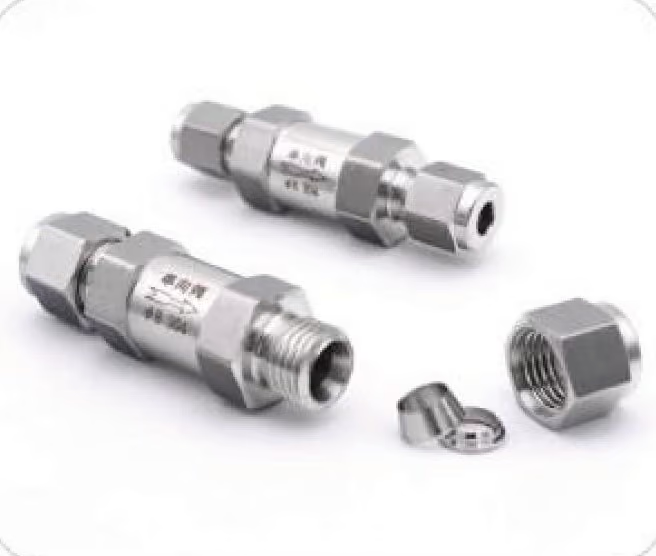
Pick a stainless steel check valve by its closing mechanism and you have picked 90% of its behavior: how much pressure it needs to open, how fast it closes, whether it cares which way is up, and how much room it needs in the line. The three families — spring/piston, swing and dual-plate — differ on exactly those axes, and each has a duty it owns.
Key takeaways
- A check valve opens only when upstream pressure beats its cracking pressure — commonly a fraction of a psi on gravity swing types, 0.5–5 psi across typical industrial designs, and higher on stiff spring loads — so the available pressure differential, not the catalog default, must drive selection.
- Swing checks flow with the lowest pressure drop but close slowly by gravity and can water-hammer; spring/piston and dual-plate designs close in milliseconds by spring force, killing slam at the cost of a little head loss.
- Orientation rules separate the families: swing checks need horizontal runs or vertical-up flow, while spring-loaded designs work in any position — and cracking pressure, orientation and class belong on the RFQ together.
Spring / piston check valves: the instrument-panel default
A guided poppet or piston works against a spring in a short, compact body. Forward pressure lifts the poppet when it beats the spring preload — the cracking pressure — and the spring drives the poppet back the instant flow decays, closing before reverse flow establishes. The consequences: silent operation, any-orientation mounting, and a cracking pressure set by the spring itself. Typical industrial designs crack in the 0.5–5 psi band, with standard spring loads at the low end and heavy loads higher; in small instrument sizes, cracking pressures are also expressed in fractions of a bar, roughly 0.1–0.5 bar for spring-loaded patterns. Because the closure is fast and orientation-free, spring checks own the small-bore territory: instrument air, sampling, dosing pump discharge, CIP circuits — anywhere a compact valve must close quietly and reliably. FerruleX’s stainless instrument range — compression check valves and threaded patterns — lives in this family.
Swing check valves: the low-drop workhorse
A hinged disc swings fully open on forward flow, lying nearly parallel to the stream — the lowest pressure drop of any common check type, with a full-bore passage that tolerates dirty and viscous fluids. The same geometry is the weakness: closure is by gravity alone, the disc has real mass and a long travel, and on a fast flow reversal — a tripping pump, a slamming valve — the disc arrives late and hammers. Swing checks also demand respect for gravity: horizontal runs, or vertical pipes with upward flow, so the disc can fall closed. They shine on large-bore, low-velocity water and utility mains where reversal is slow; on pump discharge with quick reversals they are the classic source of water hammer. Stainless swing checks for process and utility lines are quoted per line size — see the swing check valve page.
Dual-plate (split-disc) check valves: compact and fast
Take the swing concept, split the disc across its diameter and hinge the two half-plates on a central pin, and hold them shut with torsion springs. Each plate carries a fraction of a swing disc’s mass over a fraction of the travel, so the springs close the valve in milliseconds — before reversal completes — in a thin wafer body that fits between flanges and weighs a fraction of an equivalent swing check. Pressure drop sits between swing and piston types, and the spring preload sets a modest cracking pressure, commonly in the same sub-psi to few-psi neighborhood as other spring-assisted designs. Dual-plates suit space- and weight-limited stations: pump discharge manifolds, skid packages, flanged process lines where a swing check’s face-to-face will not fit. FerruleX’s split-body check valves bring the same fast-closure idea to threaded instrument sizes, and the flanged-line configuration is quoted per line size on the dual-plate check valve page.
The selection table
| Factor | Spring / piston | Swing | Dual-plate |
|---|---|---|---|
| Cracking pressure | ~0.5–5 psi typical; spring-set | Lowest — gravity-dependent | Low–moderate; torsion springs |
| Closure speed | Fast (spring) | Slow (gravity) — can slam | Very fast (light plates) |
| Pressure drop | Highest of the three | Lowest | Low–moderate |
| Orientation | Any | Horizontal / vertical-up | Any |
| Envelope | Compact, threaded or tube ends | Long face-to-face, large bore | Thin wafer between flanges |
| Failure to fear | Spring fatigue, wrong cracking | Slam / water hammer | Springs in corrosive service |
For the check-versus-isolation layout and the mounting rules in brief, the companion post check valve vs ball valve covers the pairing logic.
How to choose
- Instrument or small-bore line, any orientation, quiet duty: spring/piston — state the cracking pressure your differential can afford.
- Large-bore water or utility main, slow reversals, lowest head loss: swing — mind the orientation rule.
- Pump discharge, space or weight limited, hammer-sensitive: dual-plate.
- Any of them on a low-differential line: verify the cracking pressure first — a valve that barely opens is a valve that chatters, erodes and dies early.
FerruleX stocks stainless check valves across these patterns — start from the check valve category, the compression check valve and split-body check valve styles for instrument work — and send the line size, pressure class, orientation, media and available differential. The valve symbols chart shows how each type appears on a P&ID. Request a factory quote.
FAQ
Which check valve type has the lowest pressure drop? Swing checks, by design: the disc lies nearly parallel to the stream at full flow. Dual-plates come close with much faster closure; spring/piston types trade the most head loss for silence and orientation freedom.
What cracking pressure should I ask for? One your system can comfortably supply: typical industrial check valves crack between 0.5 and 5 psi depending on type and spring, with gravity swing types at the bottom and heavy spring loads at the top. On low-head or gravity-fed lines, an over-sprung valve blocks or chatters — put the available differential on the RFQ.
Can I mount a check valve vertically? Spring-loaded piston and dual-plate valves: yes, in any orientation. Swing checks: only where gravity closes the disc — horizontal runs or vertical pipes with upward flow. A swing check in vertical-down flow stays open forever.
Why does my pump discharge line hammer at shutdown? A slow-closing check — almost always a swing type on a fast-reversing line. The disc arrives after reversal and slams. Switching to a spring-loaded or dual-plate design closes the element before reversal completes and eliminates the hammer.
Do dual-plate check valves wear out faster? Not inherently — their torsion springs and light plates are long-lived in clean service. In corrosive media the springs are the watch item, and in viscous or solids-bearing lines the hinge area wants consideration. Match the material and pattern to the media and the duty is routine.


