KF vacuum fittings — also called NW or ISO-KF — are the quick-flange standard for vacuum lines up to DN50, and their sizing is one of the friendlier systems in piping: the number after KF is the nominal bore in millimeters. A KF25 flange is built around a 25 mm bore. Everything else about the joint follows from how the flange seals.
Key takeaways
- KF (Klein Flansche, ISO 2861 / DIN 28403) is a sexless quick flange: two identical flanges, a centering ring that both aligns them and carries an O-ring, and a single claw clamp — no bolts, no grooves, assembly in seconds.
- Standard sizes KF16/25/40/50 name the nominal bore in millimeters, with flange outside diameters of 30 / 40 / 55 / 75 mm respectively; the system reaches roughly 10⁻⁷–10⁻⁸ mbar with elastomer seals, after which ISO-K/ISO-F (larger lines) and CF metal gaskets (ultra-high vacuum) take over.
- The O-ring material sets the service envelope — FKM (Viton) is the common default for the 0–180 °C range — while the flange body in SS304/316 suits high vacuum and aluminum versions save cost on rough-vacuum plumbing.
How a KF joint works
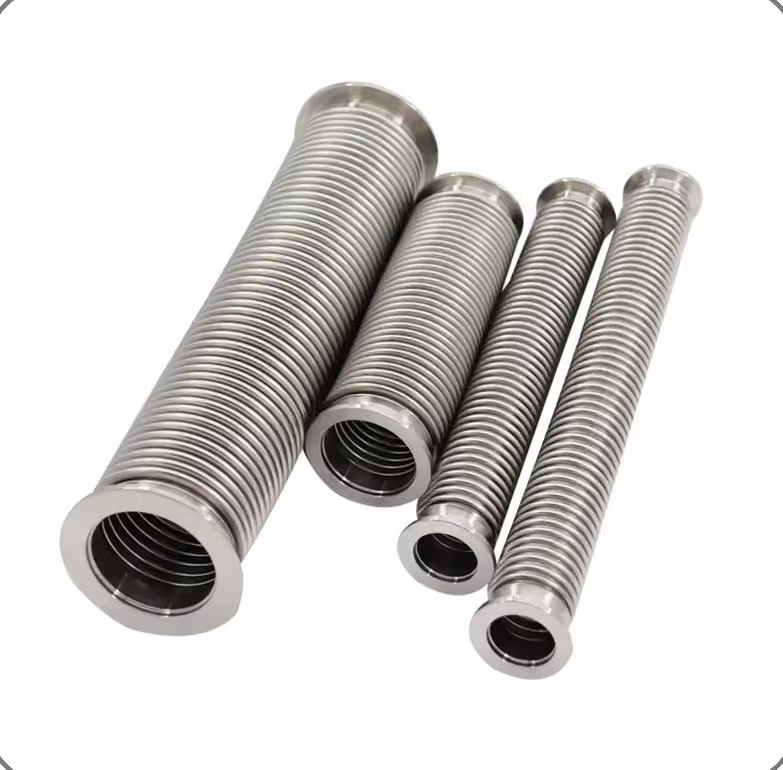
Two flanges, both identical — “sexless” in the standard’s language — butt against each other with no groove cut into either face. Between them sits a centering ring: a metal ring whose bore aligns the flanges and whose outer channel holds an elastomer O-ring, the actual vacuum seal. A hinged claw or single-pin clamp wraps the flanged periphery and pulls the stack together. Assembly is seconds: seat the ring, swing the clamp, done. Disassembly is equally fast, which is why KF owns vacuum lines that are rebuilt as often as they are run — pump connections, forelines, chambers, gauges and the flexible jumps between them. FerruleX’s KF vacuum corrugated hose assemblies carry the same quick-flange ends on a flexible core.
The KF size chart
| KF size | Nominal bore (tube ID) | Flange OD | Typical use |
|---|---|---|---|
| KF10 | 10 mm | 30 mm | Gauge ports, small forelines (shares clamp with KF16) |
| KF16 | 16 mm | 30 mm | Instrument connections, small pump ports |
| KF25 | 25 mm | 40 mm | The general workhorse — pump forelines, chamber ports |
| KF40 | 40 mm | 55 mm | Larger forelines, process chambers |
| KF50 | 50 mm | 75 mm | Biggest KF size — high-flow roughing lines |
Less common sizes KF20 and KF32 exist; above KF50 the standard steps to ISO-K/ISO-F. Note that the KF number is the bore, not the flange diameter — the clamp and centering ring must match the flange OD, which the chart fixes for each size.
Materials and vacuum range
Flange bodies run in SS304 or SS316 for corrosion resistance and lower outgassing, with aluminum fittings popular for cost on rough-vacuum plumbing where the pressure rating note favors stainless for the deeper decades. With elastomer O-rings the system serves rough and high vacuum down to roughly 10⁻⁷–10⁻⁸ mbar depending on construction — beyond that, ultra-high vacuum needs metal seals: CF flanges with copper gaskets on small lines. The O-ring material is the service envelope: FKM (Viton) is the common default, rated about 0 to 180 °C in operation with short excursions higher; choose the elastomer for your bakeout and media, because an O-ring baked past its rating outgasses and leaks precisely where the pump works hardest.
When KF ends and the bigger standards begin
KF covers lines up to DN50. Above that, ISO-K and ISO-F flanges take over — DN63 through DN630, joined by claw clamps (ISO-K) or bolted hole patterns (ISO-F) — for large process chambers and long vacuum lines. For UHV on small bores, CF flanges with metal gaskets replace KF entirely. The selection logic is a ladder: KF for quick assembly to 10⁻⁸, ISO for size, CF for ultimate vacuum. FerruleX’s vacuum-side assemblies pair KF quick-flange ends with corrugated hose, and the corrugated hose category covers the flexible element underneath — the construction and braid logic is the same metal-hose engineering covered in corrugated vs braided stainless hose.
How to order
Send the KF size (matching your port or tube bore), the tube or port being connected, the vacuum level and any bakeout temperature, and the media. We weld or fit the transitions, supply the centering rings and clamps with the assembly, and quote the lot as one line item. Request a factory quote.
FAQ
What does KF stand for, and is it the same as NW? KF is from the German Klein Flansche — “small flange.” NW (Normen Weite, nominal width) is the same ISO 2861 / DIN 28403 system under its European name; KF and NW fittings of the same number are dimensionally the same system.
What do the KF numbers mean? The nominal bore in millimeters — the largest tube inside diameter the flange is built around. KF16 ≈ 16 mm bore, KF25 ≈ 25 mm, and so on. The flange outside diameter is separate: 30 / 40 / 55 / 75 mm for KF16/25/40/50.
How deep a vacuum can KF fittings hold? With elastomer O-rings, KF serves rough and high vacuum to roughly 10⁻⁷–10⁻⁸ mbar depending on construction and materials. Ultra-high vacuum beyond that needs metal-sealed CF flanges; large lines need ISO-K/ISO-F.
KF16 and KF10 use the same clamp? Yes — KF10 and KF16 share the same 30 mm flange OD and the same clamp and centering-ring family, differing only in bore. Check the ring bore when ordering.
When do I move from KF to ISO or CF? KF to DN50 and quick assembly; ISO-K/ISO-F for DN63 and above; CF metal gaskets for UHV on small lines. If the line is large, permanent, or pumping below 10⁻⁸, KF is no longer the answer.
Can I use ordinary compression fittings in vacuum service? In rough vacuum, often yes; in high vacuum, no — and there is no single crossover number to quote, because vacuum capability depends on the specific fitting design, tube condition, assembly quality and the leak-rate criterion you must hold. Fitting makers publish model-specific vacuum ratings, and those ratings are quoted at room temperature: at elevated temperature, elastomer seals and residual gas loads shift performance, so a rating stated at 72 °F does not carry to a hot line. The boundary is really hardware-driven: once you are pumping into high vacuum, KF, ISO and CF hardware exists precisely for that duty, and a ferrule joint on a long tube run becomes the questionable link. For a roughing or foreline line at millitorr-scale vacuum, a correctly assembled compression joint is normal practice.
Do KF fittings need gasket grease? Practice splits, and honestly so. The O-ring seals by elastic compression between clean flange faces, and a smooth, properly clamped ring holds vacuum with nothing on it — one school greases nothing at all. The case for a thin film: it fills microscopic surface roughness, lets the ring slide and square up under the claw clamp at lower contact force, and eases joints that come apart constantly. The case against: grease is an outgassing and contamination source — it migrates, collects dust, and a residual-gas analyzer will find it. The discipline if you do grease: vacuum-rated grease only, wiped to a film almost dry to the touch, never applied with a bare fingertip. Up the vacuum ladder, the CF metal-gasket end runs its copper gasket dry.