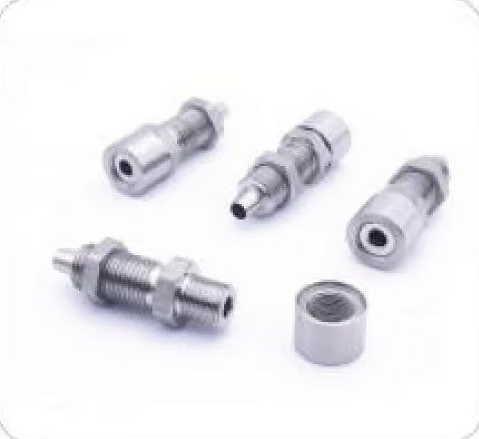
Inline filters are the unglamorous guardians of the instrument loop: a small body with a porous element that stands between the process and the transmitter you just paid for, catching the debris that destroys seats, plugs sensing ports and turns calibration day into a fishing expedition. The filter costs a rounding error against the instrument. The particles it stops are the leading cause of early instrument failure — and the worst of them arrive in the first weeks of a new system’s life.
Key takeaways
- New systems are the dirtiest: weld slag, mill scale, rust, chips and sealant residue circulate at start-up and damage valve seats and trim within weeks of operation.
- Element choice is the spec: sintered stainless for fine, cleanable duty; wire mesh at mid ranges; coarse strainers for bulk protection — published ratings run from about 1 µm to 100+ µm in steps that vary by maker.
- Place filters where they protect the instrument: upstream of valves and regulators, at take-off points, ahead of analyzers.
- Rising differential pressure is the element’s service meter — clean elements drop little; a climbing ΔP says the element is loading.
- Sintered elements are cleanable by backflushing, but in small inline bodies replacement is usually the honest economics.
What lives in a line
Commissioning debris is the documented enemy. New piping hides weld slag, mill scale, rust, sand and leftover construction debris; start up without removing it and the literature’s warning is that it damages valve seats and trim during start-up — the failure mode is not gradual. Maintenance events re-inject the problem: every opened fitting admits chips and scale, and a shred of PTFE tape broken off inside a port becomes a lodged contaminant. Instrument makers describe the consequences in their troubleshooting notes: debris blocks pressure ports, wedges between plug and seat, cuts seating surfaces and produces inaccurate readings or outright failure. The cheap, effective defense is a barrier at the take-off — one inline filter per instrument leg, cheaper by orders of magnitude than the transmitter behind it. For loops that also fight pulsation, the gauge snubber and orifice union complete the protection set.
Filter element choices
Three element families cover the duty ladder. Sintered stainless elements hold the fine end — published ratings from sub-micron through about 100 µm depending on maker, with 5 and 10 µm the common instrument grades. Woven wire mesh spans the mid-range as a cleanable, robust screen. Coarse strainer elements — perforated or heavy mesh — guard against bulk debris where fine filtration would plug too fast. Makers do not share one universal rating ladder: one major catalog’s sintered set runs 1, 5, 10, 50, 100 µm with wire-cloth options at 250 and 450, while another’s sintered range steps 0.5 to 90 µm and its strainers run 40 to 440. So the RFQ line is the job — “protect a transmitter sensing port” versus “strain bulk debris from a sample” — and the maker maps it to the nearest catalog grade. Body material is 316 stainless in standard instrument builds, in 1/8 to 1 in threaded forms, with published pressure classes from 3,000 psig at the common end to 6,000 psig in high-pressure series.
Where to install
Placement follows the threat. Filter at the take-off when the leg leaves the process, because that is where the debris enters. Filter upstream of regulators and control valves — seat damage from particles is their classic failure, and several maker installation guides put the filter explicitly ahead of the regulator for that reason. Filter ahead of the analyzer sensor in sampling service, where a coalescing or particulate stage is standard practice. Order within the protection chain is engineering logic rather than a codified rule: debris destroys porous snubber elements and clogs fixed orifices, so the filter belongs upstream of both — put the barrier where it keeps the finer restrictions alive. Manifold-based hook-ups fold the filter into the block hardware, per the instrument manifold layout.
ΔP and maintenance
A clean element barely notices the flow; a loading element starts charging rent. Differential pressure is the service meter: baseline it clean, watch it climb, and replace at the maker’s recommended maximum — the filter references are consistent that rising ΔP is the element-change signal and that time-based replacement is the blunt alternative. Sintered elements are technically cleanable — backflushing, solvent or ultrasonic treatment all appear in maker procedures — but in small inline bodies the element costs less than the labor to clean it, so replacement is the honest default. Non-cyclable plants should treat elements as scheduled spares: one box per rating, swapped on ΔP or inspection.
RFQ lines
element grade— the protection job, e.g.,10 µm for transmitter port protection, or the maker’s grade letter.body material and class—316, 6000 psigor the plant standard.ends— NPT/BSP thread or tube fitting, both sides.service— what flows and how dirty it starts: the maker sizes the grade from this.
FAQ
Can I clean and reuse a sintered element?
Yes, technically — backflushing, solvent washing and ultrasonic cleaning are all published procedures, and the element survives many cycles. The economics usually say otherwise: a small inline element costs less than the labor and solvent to restore it, so plants stock replacements and swap on differential pressure. Clean-in-place makes sense only where the element is large, expensive or hazardous to handle.
What micron rating do I need for a pressure transmitter?
Match the rating to the smallest passage it protects — transmitter sensing ports and valve trim gaps are the fine end, so single-digit micron sintered elements are the common answer there. For bulk protection upstream of a regulator seat, mid-range mesh does the job. When unsure, state the instrument model on the RFQ and let the maker map the grade.
Where does the filter go relative to the snubber?
Upstream. The filter keeps debris out; the snubber and any fixed orifice are the fine restrictions that debris would destroy. That order is engineering logic — no standard codifies it — but the failure mechanics argue it clearly: a clogged snubber lies about the pressure, a clogged filter announces itself with differential pressure.
How do I know when to change the element?
Differential pressure tells you: a clean element drops little, a loading element climbs. Baseline the ΔP at installation, monitor, and change at the maker’s recommended maximum. Where no gauge exists, cycle time and response drift are the proxies — and a stretched maintenance calendar is the blunt fallback.
Is a filter enough to protect the whole loop?
The filter is the barrier against particles; it is not the barrier against pulsation or overpressure. A complete instrument protection set pairs the filter with a snubber where the process pulses, an orifice where flow must be capped, and a manifold for isolation — four cheap parts standing in front of one expensive instrument.


