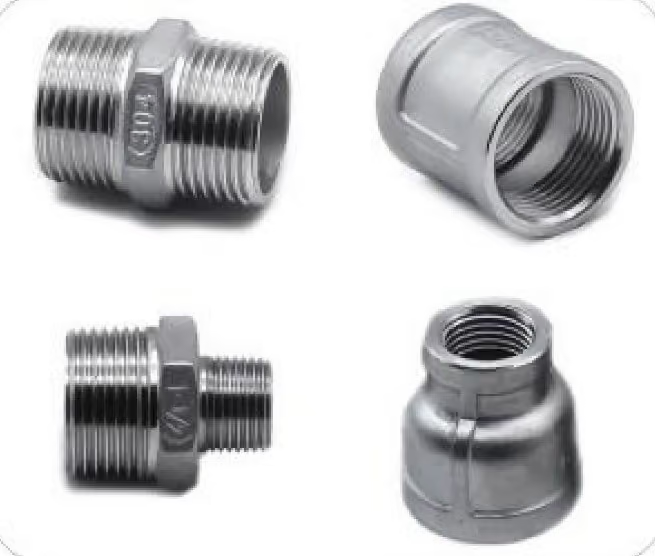
Cylinder connectors are the last fitting before the motion, and they take abuse the rest of the panel never sees: vibration at the rod end, flexing tube, hands-on maintenance and the wrong-thread emergency. Pick the connector for the port and the motion — not for what fits the tube in your hand — and the cylinder leg becomes a service item instead of a leak log. Pick wrong and the classic failure is the one nobody budgets: a fitting that slowly walks loose under vibration, or a cross-threaded port that looks fine until pressure finds it.
Key takeaways
- Port threads follow the cylinder’s design geography: M5 metric fine on compact metric cylinders, G threads on larger European/Asian designs, NPT on North American ones — small US cylinders may use 10-32 UNF.
- Parallel G ports seal at the face on an O-ring or bonded washer; tapered NPT and R threads seal on the flank with sealant. The thread’s job and the seal’s job are separate.
- NPT fittings do not belong in BSPP ports: 55° against 60° starts by hand, binds, and leaks or cracks the casting under pressure.
- Push-in connectors tolerate vibration and motion better than rigid threaded joints and are the automation default; for severe continuous vibration with rigid tube, compression is the stronger spec.
- The tube is the wear item at the cylinder — flex fatigue lives at the bend nearest the moving anchor, not at the fitting.
What the port sees
Read the port before you order the fitting. Compact metric cylinders thread their ports M5 (with M3 and M7 appearing on miniatures), and larger metric-design cylinders run G threads — parallel BSPP in ISO 228-1 sizes from 1/8 up. North American cylinders run NPT, and the smallest US bores often use 10-32 UNF rather than metric. None of this is trivia: the port’s thread decides the connector’s thread, and guessing converts a five-minute swap into an adapter hunt. Sealing follows the same geography. A parallel G port seals at the face — an O-ring in the port face or a bonded washer under the shoulder, with the thread doing nothing but clamping. A tapered R or NPT port seals on the wedged flanks with sealant. The full sealing logic is its own post — BSP thread seal: why BSPP needs a washer and BSPT does not — but at the cylinder the rule is immediate: identify the port thread, then match the connector’s thread and its sealing style. Our cylinder connector line covers the common port patterns.
Quick-plug vs compression vs threaded
Three connection families divide the duty. Push-in quick-plug fittings assemble in seconds, release by collar, and re-route without cutting — built for speed and repeatability. Compression fittings grip metal tube with a ferrule and hold harder against pull and vibration, at the cost of slower remake and consumable ferrules. Threaded joints are the semi-permanent end of the scale: sealant, torque discipline, and a joint you do not plan to open often. Leak behavior differs predictably: push-in leaks when tube is scratched, oval or under-inserted; threaded leaks when under-torqued or cross-threaded; compression leaks when under- or over-tightened. The honest summary from the comparisons: none is universally better, and the choice is tube, duty and service frequency — which is the same conclusion the push-to-connect on stainless limits post reaches for the panel side.
Vibration at the cylinder
The rod end is the worst seat in the house for a rigid joint. Vibration works threaded fittings micro-slip by micro-slip until the seal walks; the comparisons rate rigid threaded connections for static or low-movement duty and put the spring-collet, O-ring-sealed push-in family comfortably ahead for moving connections. Automation end-of-arm tooling and cylinder ports are exactly that duty, which is why push-in is the default there. One honest boundary: where vibration is severe and continuous and the tube is rigid, ferrule-type compression rates higher than push-in — the metal bite holds where an elastomer seal chatters. And whichever family you pick, support the tube so the fitting only seals: a connector asked to be a mechanical anchor fails early, whatever its brand. The flexible side of the run matters too — PU tube absorbs vibration while nylon transmits it, and fatigue shows at the bend nearest the moving anchor, not at the fitting, per the tube-maker guidance. The push-to-connect range covers the flexible-run side of this joint.
RFQ lines
port thread— M5, G1/8, 1/8 NPT: from the cylinder datasheet, not the tube.tube— size and material (PU or nylon), because the collet and the bend life both depend on it.connection family— push-in, compression or threaded, with the remake frequency expected.duty— static panel or moving actuator: the words that choose the family and the support hardware.
FAQ
Can I use NPT fittings on a BSPP cylinder port?
No — and the failure is predictable. NPT is a 60° tapered form; BSPP is a 55° parallel form. The threads start by hand, then bind or strip, and under pressure the joint leaks or cracks the casting while you over-tighten it chasing the seal. Even taper-on-taper (NPT into BSPT) mismatches flank angle. Use the port’s thread, or a purpose-made adapter — never force the near-miss.
What thread is on my cylinder port?
Read the datasheet first; measure second. Metric compact cylinders thread M5, larger metric designs run G (parallel BSP). North American cylinders run NPT, and the smallest US bores often use 10-32 UNF. A thread pitch gauge and the caliper routine from identify NPT vs BSP threads settle it at the bench in five minutes.
Push-in or compression at the cylinder?
Push-in for moving and frequently serviced connections — the release-collar remake and the elastomer seal tolerate the vibration and motion at the rod end. Compression for rigid tube in severe continuous vibration, where the metal bite outlasts the seal. Threaded for the joints that should never need to move. Match the family to the motion, not the habit.
Why does my cylinder fitting keep leaking after rework?
Two usual suspects. The tube end: a scratched or ovalled tube will weep past any push-in seal — trim the tube square and re-insert to the stop. Or the wrong-direction history: a fitting previously forced across mismatched threads carries damaged crests that never seal again. Trim, re-insert, and if the fitting has seen a cross-threaded past, replace it — seals have memory for damage.
What actually wears out at the cylinder port?
The tube, not the fitting. Flex fatigue concentrates at the bend nearest the moving anchor, and abrasion and aging follow the motion. Maintenance guidance is inspection-led: check the tube runs, trim or replace the tube, reuse the fitting. The fitting is retained hardware; the tube is the consumable.


