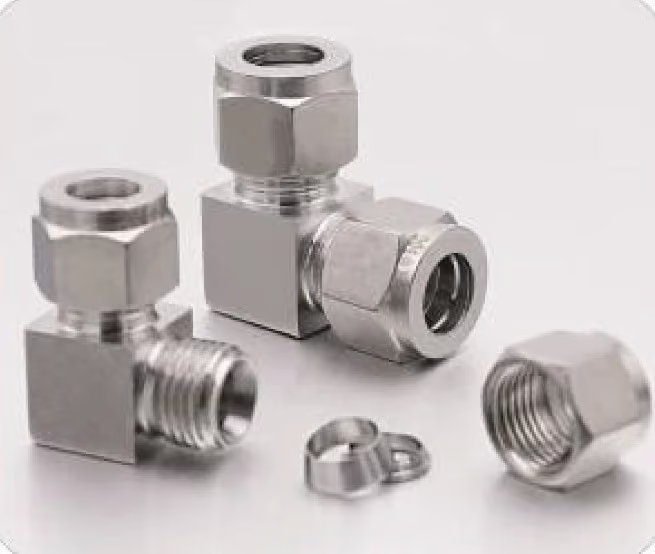
A compression fitting leak is rarely a mystery once you read the symptom: each failure pattern points to its cause the way a footprint points to a shoe. This hub collects the cause families — installation, tube, components, service — into one diagnosis table, with the fix that actually holds.
Key takeaways
- Most compression leaks trace to four causes: tube not bottomed to the shoulder, wrong ferrule order or orientation, makeup outside the 1-1/4 to 1-1/2 turns prescription, or ferrules that are reused, mixed-brand or mismatched to the tube.
- The symptom narrows the cause fast: weeps at pressure mean an incomplete bite, pull-out means no grip, leaks after remake almost always mean reused ferrules, and leaks only when hot point to temperature cycling or wrong material.
- The universal remake rule: new ferrules, tube cut back to undamaged metal, clean assembly, correct turns — skip any one and the leak returns.
The diagnosis table
| Symptom | Likely cause | Fix |
|---|---|---|
| Weeps immediately at pressure | Under-tightened, or tube not seated to shoulder | Tighten in small increments; re-seat tube fully |
| Weeps on gas, holds on liquid | Incomplete ferrule bite on hard tube | Annealed tube; new ferrule set |
| Tube pulls out under load | Ferrule never swaged (hard tube / wrong size) | Correct tube hardness and OD; new ferrules |
| Leaks after a remake | Reused ferrules on old bite marks | New ferrules; cut tube to fresh section |
| Leaks only when hot | Temperature cycling loosening makeup, or wrong material | Re-make at temperature cycle; verify material for service |
| Leak at body-to-fitting joint | Wrong ferrule order or orientation | Rebuild: front (conical) ferrule faces body |
| Leak plus visible scoring | Mixed ferrule brands or debris in the set | One matched brand set; clean assembly |
| Crushed or oval tube end | Overtightening, or tube not cut square | Cut back to round section; remake to the turns prescription |
The cause families
Installation errors cover most first-time leaks. Short insertion — the tube never reaching the body shoulder — puts the bite in the wrong place on the tube. Wrong ferrule order reverses the seal geometry: on a double-ferrule fitting the conical front ferrule faces the body, and a reversed set assembles without ever sealing. Makeup outside the prescription fails in both directions: under-tightened leaves the bite incomplete, over-tightened crushes the ferrule past its sealing geometry. The prescription for common stainless double-ferrule sizes is finger-tight plus 1-1/4 to 1-1/2 turns — the full procedure is in how to install compression fittings.
Tube problems defeat good technique. Hard tube — not annealed — refuses the swage, and the ferrule skates instead of biting; gas service exposes it first. Oval or out-of-round tube, or one scratched at the sealing zone, leaks at the imperfection. Wrong OD for the fitting — the 6 mm versus 1/4 inch trap — under-bites by a tenth of a millimeter. Tube compatibility rules across copper and plastics are in stainless on copper or plastic tubing.
Component mistakes recycle the leak. Ferrules deform permanently on first makeup, so a remade joint with old ferrules seals on damaged geometry — replace the rings every time, and cut the tube back past the old bite marks. Mixed brands break the matched geometry-hardness set: front ferrule, back ferrule, nut and body are engineered together, and mixed sets seal on line contact. The component-level rules live in what is a ferrule fitting.
Service conditions finish the list. Temperature cycling works the nut loose over months — hot leaks that vanish when cold are its signature; re-make and, if the cycle is severe, verify the material suits the temperature. Media aggressiveness eats the wrong alloy; chlorides pit 304 and find any marginal seal.
One more installation-side cause deserves its own line because it is invisible on the failed joint: sealant in the wrong place. Dope or Teflon tape on the tube end or the ferrules stops the bite from forming, and the joint passes a bench test then weeps weeks later — while the same adapter’s NPT or BSPT tail needs that sealant to seal at all. The positional rule — which end gets it, which end must stay clean — is the subject of pipe dope vs Teflon tape on compression fittings.
Cut back or replace?
The decision is mechanical. If the tube section under the ferrule is scored, oval or work-hardened — cut back to fresh metal and remake with new ferrules; the fitting body and nut survive many cycles. If the body seat is damaged, the tube is undersized for the duty, or the same joint has leaked twice after correct remakes — replace the fitting, and question the tube hardness or system pressure before the third attempt.
FerruleX supplies replacement ferrules and the full compression fitting range in SS304 / SS316 / SS316L. Send the symptom, the tube spec and a photo if you have one — we identify the cause with the RFQ, not after the second leak. Request a factory quote.
FAQ
Why does my compression fitting leak after I tightened it hard? Probably over-tightened: the ferrule crushed past its sealing geometry, or the tube was never bottomed so the bite landed wrong. More torque will not fix either — remake with new ferrules on a fresh tube section, to the turns prescription.
Can I reuse compression ferrules? No. Ferrules take permanent set on first makeup. Reused rings seal on old bite geometry and leak — especially on gas. New ferrules at every remake is the rule, not a preference.
The joint only leaks when the line is hot — why? Temperature cycling relaxes the makeup, and hot service exposes marginal bites. Re-make at operating temperature if the cycle is severe, and verify the material suits the heat — a PTFE-seated or 304-based assembly in the wrong range needs upgrading, not re-tightening.
How do I know whether to cut back or replace the fitting? Cut back when the damage is limited to the tube end and bite zone. Replace when the body seat is damaged, the tube is chronically undersized or over-hard, or the joint has failed twice after correct remakes — the third failure is the fitting telling you the system, not the assembly, is wrong.
Why does my remade joint leak in the same spot? Reused ferrules or an uncut tube. The old ferrule set holds its first bite geometry forever, and the old tube section carries the same marks. New ferrules plus a fresh tube section fixes the repeating leak in one pass.
How do I take a compression fitting apart — and can I re-use anything? Back the tube nut off with a wrench and the tube withdraws from the body — but the ferrule almost never comes with it. The ring is swaged onto the tube on first makeup and stays there, which sets the reuse rules: the body and nut survive many cycles, the ferrule and its bite section of tube do not. To rebuild on the same body, fit a fresh tube section with new ferrules. If the old tube end is scrap, cut the tube behind the ferrule rather than hammering or prying the ring off — forcing it off dents and scores the tube, which is why purpose-made sleeve pullers exist. The remake rules in “Cut back or replace?” above cover what happens next.


