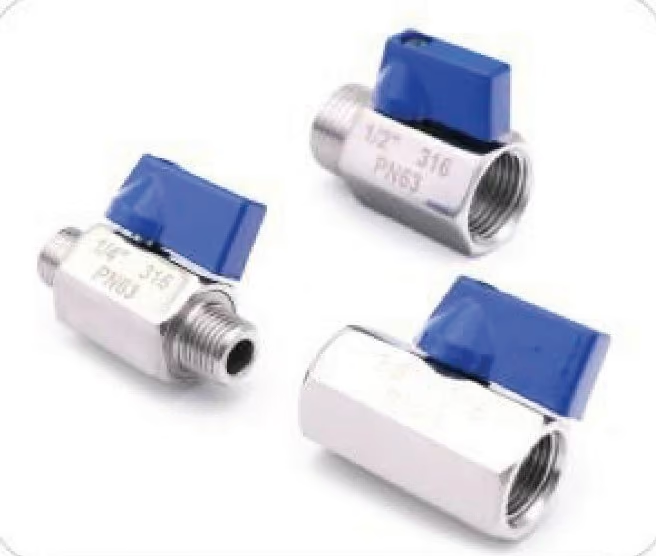
Ball valve Cv values are the most misused three letters in a valve spec. Cv is a size — the flow in US gallons per minute of 60 °F water that drops one psi across the valve — and like any size it can be wrong in both directions. Too small starves the line; too big, the subject here, quietly destroys the valve and the process it was bought to protect. The failure does not look like a failure: the valve passes the hydro test, opens and closes smoothly, and erodes itself to a leak in two seasons of throttling near its seat.
Key takeaways
- Oversizing is the industry’s own number-one control valve problem — a survey of 500+ practitioners across 200 plants put it at the top of the failure list.
- An oversized valve spends its life near-closed: a small opening jets media across the seat at high velocity and erodes the sealing surfaces — the too-big failure mode nobody predicts.
- Near the seat, small stem movements swing large flow changes: the loop hunts, control is coarse, and a 1% position error can become a greater-than-3% process swing.
- Size to a band, not a point: good practice puts maximum flow around 60–80% open and keeps minimum flow above roughly 20% — the 20–80% envelope is the commonly quoted outer limit.
- Isolation valves are not throttling valves: a ball or gate valve held partially open erodes its seat; if you need control, use a valve designed for it.
Cv in one paragraph
Cv quantifies how much flow a valve passes for a given pressure drop — higher Cv, more flow at the same opening, all else equal. The definition, the formula and the worked examples are in what is Cv; nothing here recomputes it. What matters for sizing is what Cv means on the line: the valve’s travel from closed to open maps flow from zero to the full-Cv figure along the valve’s characteristic curve, and where your operating points land on that curve decides whether you own a control valve or an erosion machine.
The too-big failure modes
Near-seat erosion. A valve sized for three times the actual flow runs at a small fraction of open. The media accelerates through the narrow gap at the seat and impinges on the sealing surfaces; valve-maker engineering references describe the result — wear cuts into the seat contour, the flow characteristic changes, the leak class degrades. Cavitation and flashing in liquid service crater the trim further. The valve does not fail closed; it fails leaky, quietly.
Control quality collapse. Near the seat the characteristic curve is steep: a 1% change in stem position produces an outsized change in flow — one reference puts a healthy sensitivity threshold at “a 1% controller-output change should move the process less than 3%.” In a worked comparison, a properly sized 3-inch valve held flow within about ±8 gpm while an oversized 6-inch valve of the same quality managed only ±20 gpm — same actuator, same positioner, worse control. The loop oscillates, operators distrust it, and someone adds more safety factor.
Hammer on closure. Fast closure of a large-bore valve converts the line’s kinetic energy into a pressure surge — water hammer scales with how quickly the flow stops, and large valves need longer closure times for exactly that reason. The fix is operational (close slowly, extend stroke times on big lines) but the root cause is still the oversized valve putting more flow through the joint than the process needs.
Rule-of-thumb sizing band
The published band practice: size so the valve operates around 60–80% open at maximum required flow, and not much below 20% open at minimum required flow. The 20–80% figure is the commonly quoted outer envelope; the tighter guidance is that the best control sits at 60–80% open at max flow. Two derived rules help at the desk. First, rangeability — the ratio of maximum to minimum controllable flow — runs about 30:1 to 50:1 for equal-percentage trim, which means a valve oversized by 3x has already spent its useful travel; references note an oversized control valve’s effective turndown collapsing toward 3:1. Second, resist line-size matching: properly sized full-ball valves usually run one to two sizes smaller than the pipe, and survey evidence says “a little bigger to be safe” is how most oversizing happens.
Ball vs needle for control
If the duty is truly control — modulating flow, not passing it — the right tool is usually not a ball valve at all. Needle valves meter finely at small openings because that is their design point; a ball valve held at 15% open is a dam, not a regulator, and the seat erosion above is the bill. The needle-versus-ball division of labor is covered in needle valve vs ball valve, the needle’s internal mechanics in how a needle valve works, and the right-hand end of the catalog is the needle valves range. Ball valves stay for shutoff — from the ball valves category, sized honestly.
RFQ lines
flow rate range— minimum, normal, maximum, with units.pressure drop availableacross the valve at those flows.media and temperature— density, viscosity, cavitation risk for liquids.control or isolation— one word that changes the valve family.desired characteristicif modulating — equal-percentage for most process control.
FAQ
Why is an oversized valve worse than an undersized one? An undersized valve starves the line — visible, and corrected. An oversized one appears to work while throttling near its seat, where it erodes the sealing surfaces, hunts the loop and hammers the line on closure. The damage is gradual and shows up as leakage and instability, which is why it goes uncorrected longer.
What Cv should I choose for my line? Not the biggest available. Compute the flow and pressure drop at minimum, normal and maximum duty — the method and worked numbers are in what is Cv — then pick the valve whose travel lands maximum flow around 60–80% open and minimum flow above about 20%. If the computed Cv sits far below the line-size valve’s rating, the valve is usually a size or two smaller than the pipe.
Can I throttle with a ball valve? Only ball valves designed for it — characterized V-port or segmented designs. A standard full-port ball held partially open concentrates flow at the seat, erodes the PTFE and metal, and gives poor control besides. For throttling duty, specify a control-type ball or, for fine metering, a needle valve.
What is valve rangeability and why does oversizing burn it? Rangeability is the ratio of maximum to minimum controllable flow — typically 30:1 to 50:1 on equal-percentage trim. An oversized valve spends its travel near the bottom of the curve, where controllable range compresses dramatically; references put an oversized valve’s effective turndown as low as 3:1. You paid for 40:1 and got 3:1.
Why do people keep oversizing valves? Habit plus safety factors: matching valve size to pipe size is the most common path, compounded by “add a margin” at every step of the spec chain. Industry surveys name oversizing the number-one control valve problem. The correction is procedural — size from flow and pressure drop, not from the pipe flange.


