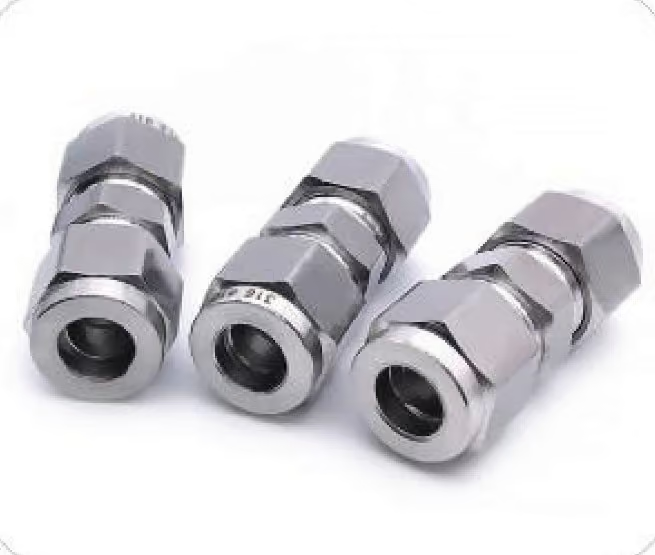
Ask “which connection?” on a sanitary line and you are really asking how often the joint must come apart, how clean it must stay, and how much pressure it must hold. Tri clamp vs flange vs threaded is not a contest with one winner — each method owns a different stretch of the trade-off space.
Key takeaways
- Tri-clamp dominates sanitary process lines because two ferrules, a gasket and a clamp break down in seconds with no tools — but every clamped joint needs a gasket and periodic inspection, and ratings depend on the whole clamp-gasket-ferrule stack.
- Threaded connections are the cheapest and most compact, but thread crevices and sealant make them an audit risk on product contact — they belong on utilities upstream of the process boundary.
- Flanged joints carry the pressure and size range and suit permanent heavy-duty runs, but they are heavy, not crevice-free, and slow to open; weld ends beat everything for permanent product lines.
Connection method comparison
| Method | Strengths | Weaknesses | Best for |
|---|---|---|---|
| Tri-clamp | Tool-free teardown in seconds; crevice-free bore; CIP-friendly | Needs gaskets and clamps; rating set by the whole stack | Product lines opened for cleaning/inspection |
| Threaded | Cheapest; compact; no gaskets | Thread crevices; sealant contamination risk; slow to open per joint | Utilities, instruments, non-product service |
| Flanged | High pressure/size range; robust; standards-based | Heavy; gasket crevice; many bolts to open | Permanent process and utility headers |
| Weld end | No joint at all; smoothest bore; zero crevices | Not demountable; needs a welder | Permanent product runs |
Tri-clamp: the sanitary default
Two identical ferrules, a gasket captured between their faces in the bore, and a clamp that pulls the flanges together — the joint breaks down with thumbscrews in seconds, which is why food, beverage, dairy and bioprocess lines standardized on it decades ago. No threads, no weld at the joint, no crevices if the ferrules are true. The price of that convenience is a stack: the working rating belongs to the clamp, gasket and ferrule combination together, and every gasket is a wear item on a cleaning schedule. Sizing follows tube OD, not the flange face — the measuring rules are in what are tri-clamp fittings, and mixing metric DIN 32676 ferrules with inch tri-clamp on the same line is a classic import mistake. For clamp-end flexible jumps, FerruleX builds tri-clamp corrugated hose assemblies.
Threaded: cheap, compact — and off the product line
NPT and G threaded joints win on cost and envelope, and they assemble with a wrench anywhere. They lose on hygiene: the thread itself is a spiral crevice, sealant or tape is a contamination question on product contact, and opening a threaded joint means breaking and remaking every turn. Upstream of the process boundary — plant air, cooling water, CIP supply, instrumentation — none of that matters and threaded fittings are the right economy. On product contact, they fail audits. Keep the boundary discipline from your spec sheet and threaded service stays where it belongs.
Flanged: pressure, size and permanence
Flanged pairs with a gasket carry the largest sizes and pressure classes, bolt to standards every contractor knows, and tolerate misalignment and external loads better than any clamp. They are also heavy, slow to open bolt-by-bolt, and every flange gasket is a controlled crevice that must be specified for the media — which is exactly why sanitary product lines avoid them while utility headers and tank nozzles keep them. Where a flanged line is permanent and product-wetted, many plants weld instead: a welded joint has no gasket, no crevice and no bolts, at the cost of never coming apart again. FerruleX’s weld-end valves and weld connectors cover that end of the map.
How to choose
- Product line opened weekly for cleaning or inspection: tri-clamp.
- Product line never opened: weld end, with tri-clamp at equipment connections for maintenance access.
- Utilities and instrument take-offs: threaded, kept upstream of the product boundary.
- Large-bore headers, tanks, high-pressure or external loads: flanged, gasket selected for the media.
FerruleX supplies sanitary-pattern clamp-end assemblies, threaded fittings and weld-end valves across SS304 / SS316 / SS316L. Send the line sizes, media, pressure class and how often each joint must open — we will quote the connection method that fits the duty, not a catalog default. Request a factory quote.
FAQ
Is tri-clamp rated for high pressure? Tri-clamp is a sanitary connection, not a high-pressure joint. Ratings belong to the whole stack — clamp style, gasket material and condition, ferrules, temperature — so confirm with the maker for your conditions rather than assuming from the tube size.
Why not use threaded fittings on a product line? The thread is a spiral crevice that holds product past the CIP cycle, and tape or sealant is a contamination question. Auditors write both as findings. Threaded fittings belong on utilities; product contact gets clamp or weld.
When do flanges beat tri-clamp? Large sizes, higher pressure classes, tank and equipment nozzles, and lines with external loads or misalignment. Flanges cost more envelope and opening time, and their gaskets are controlled crevices — on hygienic product lines that usually disqualifies them.
Can I mix tri-clamp and weld ends on one line? Yes — it is the standard sanitary layout: welded tube runs for permanence, tri-clamp joints at equipment and valve connections where maintenance needs access. Each weld-end spool is fabricated to length, so send measured dimensions or a drawing with the RFQ.
What gasket goes with each connection? Clamped joints: EPDM for steam and hot CIP, PTFE for aggressive chemistry, FKM for oils — matched to media and cleaning temperature. Flanges: sheet gasket material selected the same way. Weld ends need none, which is half their appeal.
Related: when a sanitary ball valve is actually sanitary. For flanged small valves in CL150 territory — class marking, facings and bolt-hole questions — see the flanged small valves guide.


