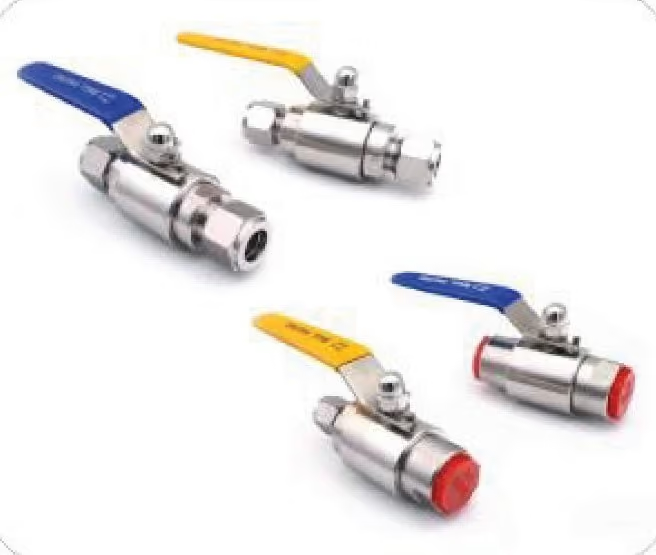
Flanged connections on small valves are what maintenance departments order after they have cut out one threaded valve too many. Threads are wonderful until the day a valve must leave the line: no axial room to unwind, sealant welded by time, and the union you should have fitted is nowhere in the spool. A flange is the anti-that: four bolts, the valve lifts out, the line barely notices. On small-bore valves the flange also carries a vocabulary — Class, PN, RF, FF — that mixes poorly with thread thinking, and the mixing is where RFQs go sideways.
Key takeaways
- Flanges buy break-in maintenance: the valve unbolts and slides out without cutting pipe — the reason flanged ends exist at mid sizes.
- Class 150 sits at roughly 19.6 bar at ambient; its dimensional EN 1092-1 equivalent is PN 20, while PN 16 is the pressure-nearest common valve rating — the two cross-walks are different claims.
- Class 150 and PN 16 bolt circles differ in most sizes; direct inter-bolting is not endorsed, some sizes field-mate, and dual-drilled conversion flanges are the clean bridge.
- RF (raised face) seats a ring gasket at high stress; FF (flat face) spreads load full-face and exists for brittle flanges like cast iron.
- Stainless practice: flange matches line material, and zinc-plated bolts against stainless flanges are a galvanic cell the moment moisture arrives.
Why flanged: break-in maintenance
The case for flanges is the outage it prevents. A threaded valve in a run cannot be unscrewed in place — threads unwind in one direction, and the pipe on both sides refuses to move — so removal means cutting, and cutting means re-welding or re-threading both ends of a spool. The flange comparison literature states the contrast plainly: unbolt, slide out, bolt in the new valve, done in minutes with standard tools. That is the entire economics: flanged ends cost more per valve and repay it the first time maintenance does not need a hot-work permit. On small bore the pattern holds — flanged-end ball and gate valves run commonly from DN15 to DN50 and beyond, and the flanged members of our plug range, the flanged hex socket plug and flanged hex head plug, carry the same face logic at the port-closure end.
The flanged catalog lists both mechanisms at those sizes, and the flange answers nothing about which one to pick: a gate valve seals by wedging a gate across the bore and must never be throttled, while a ball valve turns a quarter turn against seats — the isolation-duty trade-off between them, including how each fails as it ages, is covered in gate valve vs ball valve.
Class and PN demystified
Class and PN are two rating systems that converge without matching. The published cross-walk: Class 150 pairs dimensionally with PN 20, Class 300 with PN 50 — ISO 7005 flanges are designed to be interchangeable with ASME B16.5 drillings at those pairs, deemed to comply without being identical. On pressure capacity, Class 150 carries about 19.6 bar at ambient against PN 16’s 16 bar — which is why “Class 150 ≈ PN 16” circulates: PN 16 is the pressure-nearest common valve rating, while PN 20 is the dimensional flange equivalent. Keep the two claims separate and the RFQ stays clean: name the flange standard and class, or the EN standard and PN, and let the other system ride the cross-walk table. The vocabulary groundwork is laid in the RFQ glossary, and the pressure-side semantics in proof pressure vs burst pressure.
Face types: RF/FF
The face decides how the gasket works. A raised face concentrates bolt load on a small annulus, seating a ring or spiral-wound gasket at high sealing stress with modest torque — the default for steel flanges. A flat face spreads the load across the whole surface with a full-face gasket whose bolt holes align with the pattern — and it exists for one reason: brittle flanges. Bolt a cast-iron FF flange against a steel RF flange and the raised nose carries the reaction as a bending moment on a material with no ductility, and the casting cracks; the rule the references state as not negotiable is that grey cast iron demands flat-face to flat-face. Pair like with like, and RF-to-RF remains the stainless default.
Stainless practice
Two practices keep stainless flanged joints honest. Material: the flange matches the line — standards practice for stainless piping specifies flanges and fittings of the same material and grade as the pipe they attach to, so 316 line, 316 flange, and the bolting question answers itself. Bolting: zinc-plated or plain carbon-steel bolts against stainless flanges are a galvanic couple waiting for an electrolyte, and humid air qualifies — the references put zinc ten positions below stainless on the series and the zinc sacrificial, which reads as corroding fasteners and seized joints. Stainless bolting against stainless flanges, or a coating decision made with the dissimilar-metal rules from galvanic corrosion in mixed fittings in hand.
RFQ lines
DN or NPS + rating— e.g.,DN25, PN16or1 in, Class 150, one system per flange.facing— RF or FF, and the gasket standard if it matters.material— flange grade to match the line.bolting— stainless, or the coating and isolation plan.
FAQ
Can I mate a Class 150 flange with a PN 16 flange?
Carefully, and usually not directly. The ratings are near-neighbors — about 19.6 bar against 16 at ambient — but the bolt circles differ in most sizes, and the stronger engineering references say direct inter-bolting fails on drilling mismatch; a few sizes happen to field-mate. The endorsed bridge is a dual-drilled conversion flange built for both patterns, with the gasket standard and facing checked alongside. Where the drawing allows, staying inside one flange system is cheaper than any conversion.
What is the difference between Class 150 and PN 16?
Two different claims wearing similar numbers. Class 150 is an ASME pressure-temperature rating class — about 19.6 bar at ambient for common material groups, falling with temperature. PN 16 is a European nominal-pressure rating of 16 bar at the 20 °C reference. The dimensional EN equivalent of a Class 150 flange is PN 20, not PN 16; PN 16 is simply the nearest common valve rating in the European ladder. State the system you are buying in and the cross-walk handles the rest.
RF or FF face — which do I need?
RF for steel and stainless: the raised face seats a ring gasket at high stress and is the industrial default. FF exists for brittle flanges — grey cast iron above all — where the full-face gasket spreads bolt load and avoids the bending moment that cracks a casting. Match the face to the mating flange, and never set a raised face against a flat face.
What size do flanged small valves start at?
Commonly DN15, running through DN50 and beyond — flanged-end ball and gate valves are cataloged from half-inch nominal in both ASME and EN systems, with DN8 and DN10 flanges reserved for special instrument and regulator patterns. If a small valve must leave the line for service, the flanged end pays for itself at the first removal.
Can I use galvanized bolts on stainless flanges?
Only in genuinely dry service. Zinc sits far below stainless on the galvanic series, so the zinc-coated fastener becomes the sacrificial anode the moment an electrolyte appears — and humid air is electrolyte enough outdoors or in washdown plants. Stainless bolting against stainless flanges is the default; where mixed bolting is unavoidable, decide it with the galvanic-isolation rules, not with what is in the hardware bin.


