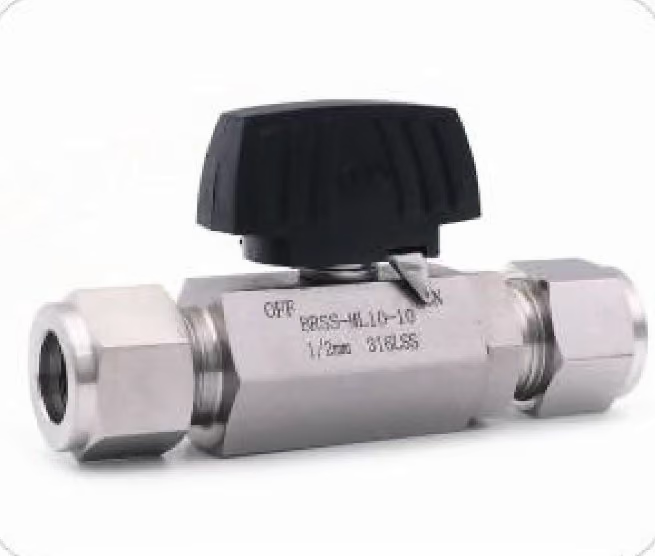
Proof pressure, burst pressure and working pressure are three different numbers on a valve or fitting datasheet, and mixing them up is how lines get over-rated and valves get mis-specified. Working pressure is what the component may see in service; proof pressure is a temporary test pressure used to demonstrate integrity; burst pressure is where a destructive test actually fails the part. Here is what each is for, what the common test conventions are, and how the CWP and WOG labels fit in.
Key takeaways
- Working pressure is the maximum service pressure at stated conditions — the only number you design to; proof and burst are not operating headroom.
- Proof pressure is a temporary, non-destructive verification test: many valve standards call for a shell test at 1.5× the rated pressure, but the multiple is standard-specific, not universal.
- Burst pressure comes from destructive testing on samples; it defines the failure boundary and a safety margin, never a target.
- CWP (cold working pressure) and WOG (water-oil-gas) are both ambient-temperature body ratings in psi — CWP is the clearer modern marking, and the full rating-system picture lives in ball valve ratings explained.
The three pressures, side by side
| Pressure | What it is | What it is for | Can you operate there? |
|---|---|---|---|
| Working (rated, CWP) | Maximum pressure permitted in service under stated conditions — temperature, material, fluid | The design number; sizing and selection | Yes — this is the operating limit |
| Proof (test) | Temporary pressure applied to demonstrate integrity — shell and seat tests | Factory verification; finds leaks and weak joints without destroying the part | No — passing a proof test does not rate the part at the test pressure |
| Burst | Pressure at which the component fails in a destructive test | Qualification and safety-margin data | Never — it is the failure boundary |
The working number is the only one that belongs in a system calculation. Proof and burst describe how the maker proves the part: the shell test pressurizes the body and joints to demonstrate leak-tightness, and the seat test checks shutoff, and a destructive burst test on samples establishes where failure actually occurs. Required margins vary by product standard — hydraulic hose standards, for example, set their own proof and burst multiples — so read the governing standard for the product rather than assuming one universal ratio.
The 1.5× convention, stated honestly
A common shell-test convention in valve standards is proof testing at 1.5× the rated pressure: API 6D, for instance, sets a minimum shell-test pressure at 1.5× the applicable rating, and makers describe shell tests at 1.5× CWP. State it as what it is — a common convention of several standards, not a definition of proof pressure, because other product families carry their own multiples. The practical reading for a buyer: when a datasheet says “shell tested,” the test pressure and basis are worth asking for, and a valve that passed a 1.5× shell test is rated for its working pressure — not for 1.5× working.
CWP vs WOG
Both are body ratings in psi at ambient temperature, and both appear constantly on instrument and commodity valves. CWP — cold working pressure — is the maximum non-shock working pressure across a stated cold-temperature range, commonly −20 °F to 100 °F; it is the clearer, preferred marking. WOG — water, oil, gas — is the older ambient-temperature marking, and the letters name a service family rather than granting approval for every oil or combustible gas duty. They are not automatically interchangeable: check the temperature-pressure limits and any service approvals for the actual fluid. The deeper dive into rating systems — WOG classes, PSI classes, and temperature derating — is its own guide: ball valve ratings explained.
What to state on the RFQ
Three lines keep pressure specs clean. First, the working pressure and temperature per line — the number the valve must hold in service, not the test figure. Second, any test or certification requirement — shell test, seat test, hydrostatic documentation — named explicitly, since these are ordered extras, not assumptions. Third, the rating terminology your spec uses — CWP, WOG or a class designation — so the quote comes back in your language. Where the duty involves isolating a pressurized line for maintenance, the double-block thinking in double block and bleed valves explained covers the isolation side.
FerruleX quotes the class with the valve and confirms any test documentation on the RFQ — state working pressure, temperature and test needs with the size list. Request a factory quote.
FAQ
What is the difference between working pressure and burst pressure? Working pressure is the maximum the component may see in service; burst pressure is where a destructive test fails it. The gap between them is a safety margin for spikes, fatigue and variation — design to working, never toward burst.
Is proof pressure always 1.5× working pressure? No — 1.5× is a common shell-test convention in several valve standards, but the multiple is standard- and product-specific. Other families set their own proof and burst figures. Treat 1.5× as a convention to confirm, not a rule.
Does passing a proof test mean the valve is rated higher? No. A shell test at 1.5× rated pressure demonstrates integrity; the valve remains rated at its working pressure. Proof pressure is a verification, not an operating ceiling.
What does CWP mean on a valve? Cold working pressure — the maximum non-shock working pressure across a stated cold-temperature range, typically −20 °F to 100 °F. It is the clearer modern marking for an ambient body rating.
Is WOG the same as CWP? They are both ambient-temperature psi body ratings, and often numerically equal, but not automatically interchangeable: WOG is the older water-oil-gas marking and names a service family without granting universal service approval. Check temperature limits and approvals for the actual fluid.


