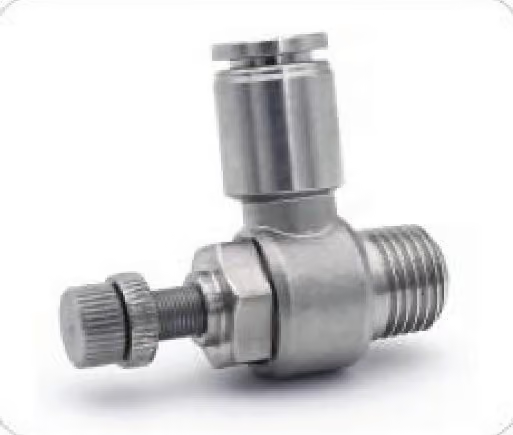
Air throttle valves settle an argument that pressure regulators cannot: how fast the cylinder rod moves. A rod that bangs out at full speed is not a pressure problem — pressure sets the force, flow sets the speed, and the throttle valve is the flow knob. Confuse the two and you will turn the regulator down until the cylinder is too weak to do its job, while the rod still slams. The throttle, metered correctly, is the cheap fix that makes motion controlled.
Key takeaways
- Pressure sets force; flow sets speed. The regulator answers “how hard,” the throttle valve answers “how fast.”
- Meter-out — throttling the exhaust — is the industry default because it damps stick-slip and controls overrunning loads; meter-in suits single-acting and small, light cylinders.
- A speed-control throttle is a needle plus a check valve: controlled flow in one direction, free flow in the other.
- Mount at the cylinder port for stability: less trapped volume between valve and piston means better response and repeatability.
- A cylinder that stays fast with the throttle nearly closed is telling you the valve is oversized, the load is light, the pressure is high — or the throttle is installed backward.
Meter-in vs meter-out
The directional question is which side of the piston you choke. Meter-out throttles the exhaust: the supply fills the cap end freely and the air leaving the rod end must squeeze through the throttle, governing the rod’s travel. Pneumatic references call it the most common industry practice, and the reason is stability — meter-out creates a back-pressure cushion that damps the stick-slip effect and holds an overrunning load in check, where meter-in can let the load run away faster than the circuit can fill. Meter-in throttles the supply instead, and its proper territory is narrow: single-acting cylinders and small, short-stroke, light-load applications where the exhaust should be free. Specify the control direction on the RFQ — meter-out, rod extend — because it decides the valve’s internal orientation and the installation.
Needle vs throttle with check
A plain needle valve is a restriction in both directions — simple, but it slows both the extend and the retract. The speed-control throttle adds a check valve in the same body: one direction passes through the needle and is metered; the reverse bypasses it and flows free. Fitting the two functions into one body is what lets a single elbow at the cylinder port govern the working stroke while the return runs unthrottled. This is the same component family as the push-to-connect versions used on panels, and the same one-way-flow logic appears across the valve catalog — the needle’s metering duty is covered in can a needle valve regulate pressure, where the answer for pressure is a regulator, not a needle.
Where to mount
At the cylinder, not at the valve. Mounting the speed control directly on the cylinder port — the banjo-shaped pattern — is the most commonly used arrangement, and the engineering reason is the trapped volume: the shorter the air column between the throttle and the piston chamber, the better the response, the adjustment sensitivity, the motion stability and the repeatability. A throttle mounted back at the valve leaves a long tube of compressible air between restriction and piston, and that volume is a spring that fights your setting. The cylinder-port rule also puts the adjustment where the technician can reach it, at the actuator being tuned.
Sizing
Sizing is concept, not calculus: cylinder speed equals airflow divided by piston area — the references publish the relation as speed = flow rate over area, and everything else follows from it. A bigger bore moves slower on the same flow; more flow moves faster at the same bore. The throttle’s job is to set the flow, so the practical sizing line on the RFQ is the cylinder bore and the desired stroke time, and the selection is the throttle’s flow capacity plus its port size. Under-size the throttle and the cylinder never reaches speed; over-size it and you will be at the bottom of the adjustment range trying to slow a cylinder that physics wants to run fast. The deeper needle-valve selection logic — fine-thread stems and small orifices for precision — is the instrumentation territory of the needle valves range, and the compression-side behavior of these fittings is compared in quick-screw vs compression.
RFQ lines
control direction— meter-out (state which stroke) or meter-in; this orients the check valve.cylinder bore and stroke time target— the sizing inputs.connection— push-in for tube, threaded for ports; both sides.mounting— cylinder-port banjo style or in-line.
FAQ
Why is my cylinder still fast with a throttle valve fitted?
Work the checklist in order. The throttle may be installed backward — the check valve passing flow free in the direction you are trying to meter. It may be meter-in on an overrunning load, which meter-in cannot hold. Or the valve may simply be oversized: vendor troubleshooting guidance says a needle nearly closed with the cylinder still too fast points to valve capacity, supply pressure, load or bore — not to more closing. And if the throttle is wide open and the cylinder is still slow, the valve is under-sized or the pressure is low. Direction first, then sizing.
Should I throttle the supply or the exhaust?
Exhaust, for almost everything. Meter-out is the industry default because the back pressure it builds damps stick-slip and controls overrunning loads. Reserve meter-in for single-acting cylinders and small, light, short-stroke applications where a free exhaust matters. If you are unsure, meter-out — and state the stroke direction on the RFQ so the check valve orients correctly.
What is the difference between a needle valve and a throttle speed control?
A needle valve meters both directions — it is a restriction with no opinion about flow sense. A speed-control throttle pairs the needle with a check valve in one body: one direction is metered through the needle, the other flows free past the check. That single difference is why throttles govern one stroke while returning fast, and why they belong at the cylinder rather than in the panel.
Why mount the throttle at the cylinder instead of at the valve?
Trapped volume. The throttle governs the air immediately at the piston chamber; mount it at the valve and the tube between them becomes a compressible spring that softens response, blurs adjustment and hurts repeatability. Maker guidance puts flow controls on the cylinder ports for exactly this reason — plus the adjustment lands where the motion is.
Does a throttle valve replace a pressure regulator?
No — they answer different questions. The regulator sets pressure, which sets force; the throttle sets flow, which sets speed. Turn the regulator down and the cylinder gets weak long before it gets smooth. The disciplined setup: regulator for the force the job needs, throttles for the motion it should have.


