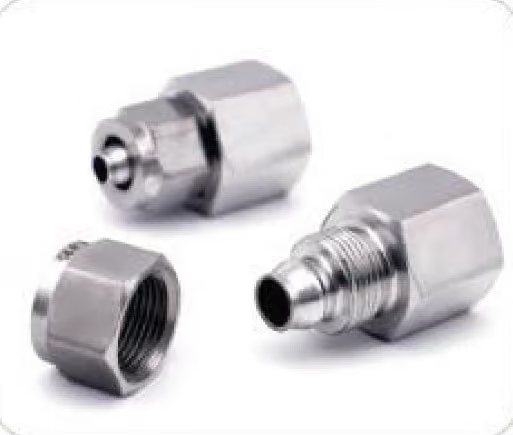
Quick screw fittings and compression fittings both seal by biting the tube, and that is where the similarity ends. One is a pneumatic assembly aid that grips soft plastic tube by hand-tight nut; the other is a metal-to-metal sealing system engineered to hold hundreds of bar on hard instrument tube. They are sold next to each other, compared in the same breath, and misapplied in both directions. The differences that matter — bite geometry, pressure class, tube hardness and remake behavior — are all consequences of one decision: how hard the tube is and how much pressure it must hold.
Key takeaways
- DIN 2353 bite-type compression is a 24° cone system with a single progressive cutting ring whose two edges bite into the tube — rated to roughly 315 bar in the L series and 630 bar in the S series for steel.
- Quick-screw (push-on, fast-twist) fittings grip soft pneumatic tube — PU at Shore A 95 is the intended material — and live in the 10–16 bar pneumatic class.
- Tube hardness splits the families: bite-type takes metal instrument tube within a hardness window (about ≤80–90 HRB); quick-screw assumes soft plastic tube.
- Bite-type joints are remakeable several times with lubrication and re-tighten to position; quick-screws are faster to assemble and remake by hand but hold less.
- Vibration favors the mechanical bite: double-ferrule instrumentation designs measurably outperform single-ring types, and both outperform push-on styles.
Same principle, different bite
The DIN 2353 fitting — the bite-type standard now mirrored by ISO 8434-1 — is three parts: body, nut and a single progressive cutting ring. On the 24° cone in the body, tightening the nut drives the ring forward; its two cutting edges bite into the tube OD while the ring’s rear shoulder springs against the cone to lock the grip. The joint seals at the metal-to-metal cone and tube interface. Do not confuse this with the twin-ferrule instrumentation design, where a separate front ferrule seals and a back ferrule grips — that is a different family with its own mechanism, compared in single ferrule vs double ferrule fittings.
The quick-screw fitting is a different animal wearing a similar silhouette. The tube pushes onto a barbed body; a nut screws down over it, and the nut’s internal grip element — teeth or a sleeve — bites into the soft tube wall as it tightens. Hand-tight is usually enough, a wrench makes it certain. Assembly takes seconds and needs no preset tooling, which is why pneumatic panels love them.
Pressure and tube hardness
The DIN 2353 pressure chart carries the verified series values — L series about 315 bar at 6–18 mm, S series about 630 bar at 6–14 mm, stepping down as sizes grow — because the numbers are size-dependent and the maker’s datasheet governs. Quick-screw fittings sit three orders of magnitude lower: 10–16 bar typical, air and light fluid service.
Tube hardness is the wall between the technologies. Bite-type works on metal tube inside a window — steel up to about 80 HRB, stainless up to about 90 HRB — hard enough to carry pressure, soft enough that the hardened ring can cut it. Quick-screw assumes soft plastic tube that the teeth can indent; PU at Shore A 95 is the maker-specified default. Put soft tube on a bite-type and the ring shreds it; put metal tube on a quick-screw and the teeth skate. Neither mistake is recoverable.
Reassembly behavior
Here the compression side earns its keep in maintenance-heavy plants. A bite-type joint can be disconnected and remade — maker guidance ranges from about five to eight satisfactory remakes for the bite-type family — by lubricating the threads and re-tightening the nut to its marked position until torque rises. The remake is a procedure, not a hope. Quick-screw joints remake even faster — loosen, pull, re-push, re-tighten by hand — but each remake on soft tube is gentler on the tube and weaker in the grip; treat frequent re-pulling as tube consumption, and carry spare tube. The DIN 2353 system’s full assembly logic is in bite-type fittings explained.
Where each belongs
Quick-screw: pneumatic panels, air and light-fluid circuits, field assembly without tools, anywhere the pressure is measured in bar-not-hundreds and the tube is PU or nylon. The quick-screw fittings range covers these panels.
Compression bite-type: instrument lines, process impulse runs, hydraulic and high-pressure working lines — anywhere metal tube, serious pressure or vibration lives. Vibration is the honest decider: maker data shows twin-ferrule designs running roughly 40% better vibration resistance than single-ring types, with bite-type joints in general rated vibration-resistant and push-on styles explicitly recommended only where vibration is minimal. For metal tube at any real pressure, the compression fittings range is the answer.
RFQ lines
DIN 2353, L series, 12 mm OD tube, 316— standard, series, size, material.cutting ring preset, lubricated assembly— assembly state matters.- Quick-screw:
8 mm PU tube, air, 10 bar, 60 °C— tube, media, pressure, temperature. - State vibration or pulsing duty explicitly — it changes the family recommendation.
FAQ
What is the real pressure difference between quick-screw and compression fittings? Three orders of magnitude. DIN bite-type compression runs to roughly 315 bar (L series) and 630 bar (S series) on steel; quick-screw fittings are 10–16 bar pneumatic parts. If the circuit is measured in tens of bar or more, quick-screw is not in the running.
Can I reuse either fitting after disassembly? Yes, both remake — differently. Bite-type: lubricate, re-tighten the nut to the marked position until torque rises; maker guidance allows roughly five to eight remakes for the family. Quick-screw: re-push the tube and hand-tighten; faster, but the soft tube takes wear, so inspect it and expect to trim or replace it over repeated remakes.
Why does quick-screw only work on plastic tube? The grip element bites by indenting the tube wall. Soft PU or nylon deforms and grips; metal tube defeats the teeth and the seal. Bite-type compression exists precisely for the metal-tube case — its hardened cutting ring is designed to cut into tube within a defined hardness window.
Which holds better under vibration — single or double ferrule? Double-ferrule designs measurably — maker data puts the margin around 40% better vibration resistance than single-ring types. Both mechanical bite systems beat push-on styles, which makers recommend only where vibration is minimal. Continuous vibration is a compression-fitting argument, not a quick-screw one.
My quick-screw fitting leaks at the tube — cause? The usual three: tube outside the hardness window or out of tolerance, a tube end not cut square, or a scored/ovaled tube from repeated pulls. Trim the tube square, re-push fully to the stop, and re-tighten the nut. If it still weeps, replace the tube section — the grip has shredded the wall.


