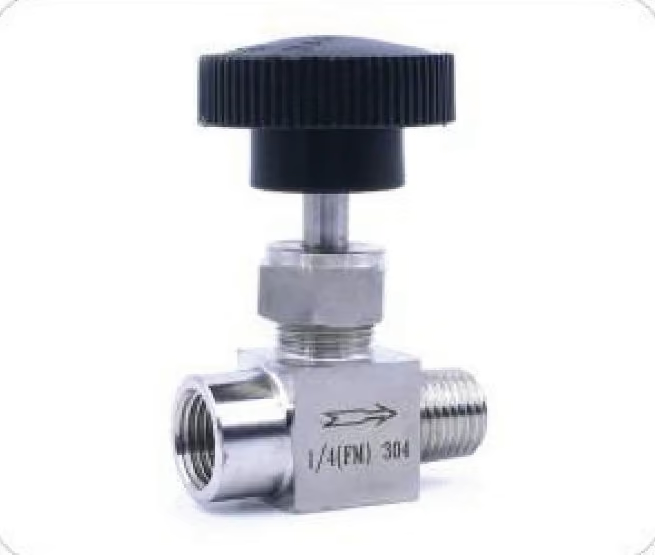
Short answer: a needle valve can reduce pressure, but it cannot regulate it. A needle valve set part-open imposes a fixed restriction, and any flow through that restriction loses pressure across it — so yes, downstream pressure falls. But the moment the flow changes, the downstream pressure changes with it, and the valve does nothing to correct that. Regulation — holding a set pressure regardless of flow — is a different machine entirely.
Key takeaways
- A needle valve drops pressure only while fluid is flowing: its fixed orifice converts flow into pressure drop, so downstream pressure floats with the flow rate — constant flow gives constant downstream pressure, changing flow does not.
- It is not a pressure regulator: a regulator senses downstream pressure and repositions itself against a spring or pilot; a needle valve holds whatever position you last set, whether the line needs it or not.
- Dropping a large pressure differential across a small needle orifice invites cavitation and wire-drawing; if you must throttle a big ΔP continuously, stage the drop or move to a valve designed for it.
Why the pressure drop is flow-dependent
The physics is the orifice equation: flow through the restriction is proportional to the orifice area and the square root of the pressure drop. A needle valve set at one position fixes the orifice area — and from that moment, pressure drop and flow rate are chained together. Double the flow and the ΔP across the same opening roughly quadruples; halve the flow and the downstream pressure climbs back toward upstream. The valve holds its geometry, not your pressure. That is perfectly acceptable for many instrument duties — a bleed line, a sampling line, a gauge that sees one steady flow — and completely unacceptable where the load varies.
What a real regulator does differently
A pressure regulator closes the loop you are missing. It senses the downstream pressure — through a diaphragm against a set spring, or through a pilot — and continuously repositions its restriction to hold that pressure as the demanded flow changes. Open a downstream tap and the regulator opens with it; close it and the regulator throttles back. No manual needle valve can do this, because nothing in the valve measures anything. The practical boundary is simple: if the downstream pressure must stay constant while flow varies, specify a regulator. If the flow is constant and you merely need less pressure at the end of a small line, a needle valve is the cheap, robust answer.
| Aspect | Needle valve | Pressure regulator |
|---|---|---|
| What it controls | Orifice area — a fixed position you set | Downstream pressure, sensed continuously |
| Pressure behavior | Downstream pressure floats with flow | Holds the set pressure as flow varies |
| Response to load change | None — stays where you left it | Reopens or rethrottles to correct |
| Large continuous ΔP | Cavitation and wire-drawing risk; stage the drop | Built for the duty (diaphragm or pilot) |
| Typical duties | Bleeds, sampling, gauge damping, constant-flow lines | Varying-load pressure holding |
| Cost and complexity | Simple and cheap | Sensing element, higher cost |
Where needle-valve pressure reduction works
The honest applications all share constant or near-constant flow. Bleeding a gauge or transmitter down to a working pressure on a test bench. Damping a pulsating gauge with a steady trickle. Feeding an analyzer at a fixed, small flow. Vented dead-leg control. In each case the flow is set once and stays there, so the pressure drop the valve creates is stable too. Where buyers get into trouble is assuming the same valve will hold a set pressure as valves open and closes elsewhere in the system — it will not, and the drifting readings get blamed on the gauge.
The cavitation and wire-drawing warning
Dropping a large ΔP across a needle orifice is hard on the valve as well as the physics. When the pressure fall inside the seat drops below the fluid’s vapor pressure, bubbles form and collapse violently — cavitation — which sounds like gravel in the line and pits the seat within weeks of continuous duty. A rough screening rule: if the intended ΔP approaches half the upstream pressure in ordinary liquid service, the valve is in choked territory and the simple Cv math no longer describes it. And operation at very small openings concentrates the flow into a jet that wire-draws grooves into the seat, creating permanent leak paths. Better valves survive this longer, but no needle valve is an anti-cavitation control valve. If the duty is a large, continuous pressure reduction, stage the drop across two restrictions, or specify a regulator or control valve built for it.
FerruleX supplies stainless needle valves for metering and bleed duty — needle valve category, straight and angle patterns — and throttle-style valves such as the push-to-connect throttle valve for flow control at pneumatic joints. Tell us whether you need a set flow or a held pressure; we will quote the right device. Request a factory quote. For how the metering mechanism itself works, see how does a needle valve work.
FAQ
Do needle valves reduce pressure? They drop pressure across their orifice whenever flow passes, yes — but the drop depends on the flow. At constant flow the downstream pressure is steady; change the flow and the pressure drifts. That is restriction, not regulation.
Can I use a needle valve instead of a pressure regulator? Only if the downstream flow is constant and the required pressure drop is modest. If the load varies, or the pressure must hold within a band, you need a regulator that senses and corrects — a needle valve merely sits where you left it.
Why does my needle valve whistle or rattle at part-open? Likely cavitation: the local pressure in the seat has fallen below the fluid’s vapor pressure and bubbles are collapsing downstream. The fix is to reduce the ΔP the valve must take — split it across two restrictions — or move the duty to an anti-cavitation valve.
What happens if I throttle a needle valve almost closed for a long time? The high-velocity jet at the tiny opening wire-draws grooves into the seat, creating leak paths that never heal, and the valve loses shutoff tightness. If the duty needs a near-closed position continuously, the valve is oversized for the job — size to run in the middle of the travel.
How do I choose between a needle valve and a regulator on an RFQ? State what must stay constant. If the answer is flow, a needle valve. If the answer is downstream pressure while flow varies, a regulator. Send both the flow range and the pressure requirement, and the factory will point you at the right device.
Why does my needle valve hunt or chatter at low flow? That is the part-open instability this page warns about, taken to its limit: throttled to a crack, the valve drops its entire ΔP across a hairline gap at the needle tip — the vena contracta, where velocity peaks and pressure bottoms out — and the jet there is inherently unsteady; any drift toward cavitation or flashing adds bubble-driven pulses to a downstream gauge. It differs from regulator hunting, where a sensing loop cycles around its setpoint. The fixes: a smaller Cv that does this duty at mid-travel, a second restriction sharing the drop, and pulsation damped at its pump or compressor source. Left long at high ΔP, the same jet wire-draws the seat — permanent leak paths, not just noise.


