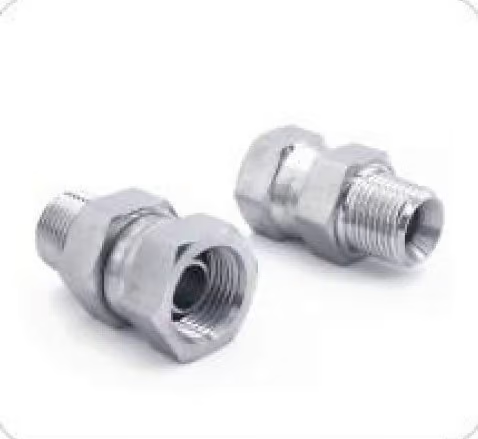
Pneumatic silencers are the cheapest compliance part in a pneumatic system: a sintered element screwed into the exhaust port of a valve, turning the sharp hiss of dumped air into a murmur. They cost less than the labor to install them and they protect two things at once — hearing and valve performance. Yet they are specced last and blamed first when a machine slows down. The two things worth knowing — how much noise they actually remove, and how they quietly kill system speed when they clog — are the whole post.
Key takeaways
- A silencer passes exhaust through a porous sintered element that splits the flow into thousands of small streams, dissipating the noise energy; published ratings run roughly 13–40 dB(A) depending on series and size.
- The classic failure is clogging: compressor oil mist plus dust plugs the pores, exhaust back pressure rises, and cylinders slow or valves hesitate — symptoms that masquerade as valve failure.
- Stainless bodies and elements are the documented pick for washdown, food, pharma, marine and chemical environments; bronze is the economical default for clean, dry air.
- Size the silencer to the port: flow capacity should equal or exceed the valve’s exhaust requirement, or the silencer itself becomes the restriction.
- Workplace noise limits (85 dB(A) action level, 90 dB(A) eight-hour limit in OSHA-territory practice) are the reason silencers exist; they are noise controls, not valve requirements.
What a silencer does
Exhaust noise is the sound of fast air shearing into still air. A silencer screws into the exhaust port and forces that air through a porous body — sintered bronze, sintered stainless, or resin — whose thousands of internal passages split the flow into small streams with a huge total surface area. The acoustic energy dissipates in the tortuous paths, and what leaves the port is a low murmur rather than a hiss. Published attenuation figures vary by series and size: cataloged values run from about 13 dB(A) for compact sintered-bronze units through 30 dB(A) for metal-body types to 35–40 dB(A) for high-attenuation designs — treat the number as model-specific, and match the maker’s rating to the actual exhaust flow rather than buying the quietest label. The workplace driver is real: occupational noise practice sets an 85 dB(A) action level and a 90 dB(A) eight-hour limit, and a bank of un-silenced valves can carry a cell past both. Our pneumatic silencer line covers the standard port sizes.
Clogging: the hidden failure
The failure mode nobody prices in is slow suffocation. Compressor oil mist — even from “oil-free” plants, where lubricant migrates from the compressor room — condenses on the porous element and traps dust; the pores narrow, the exhaust path chokes, and back pressure climbs. The symptoms look like a valve problem: cylinders extend slower, actuators hesitate, valves stick longer than they should. Maker literature states it plainly: a clogged silencer blocks the exhaust port and degrades system performance, and contaminated air turns the element into a slowly closing valve. The maintenance rule that follows is inspection-led, not calendar-led — when the exhaust stream weakens or cycle times stretch, pull the silencer first, because it is the cheapest suspect and the most commonly guilty one. This is the same back-pressure discipline that governs the rest of the exhaust path in push-to-connect on stainless: real limits: anything that throttles the dump side of the circuit taxes the valve.
Stainless vs plastic vs sintered bronze
Three material families divide the duty space. Sintered bronze is the durable default — corrosion-resistant in clean, dry air, cheap, and stocked everywhere. Plastics are the lightweight, low-cost option for chemically benign pneumatics, with pressure ratings in the single-digit bar class. Stainless steel — 304 or 316 body, sintered stainless element — is the documented choice for the environments that kill the other two: moisture-laden air, caustic washdown, food and beverage processing, pharmaceutical plants, marine atmospheres and chemical exposure. Maker guidance recommends 316 for coastal and hygiene-critical duty. The temperature spread is equally wide: bronze elements run to roughly 200 °C class ratings while stainless versions are published far wider. Pay for stainless where the environment justifies it; do not buy it for a dry panel.
Sizing
A silencer is a restriction on purpose — the sizing rule is to make sure it is not more of a restriction than the valve can tolerate. Match the silencer to the exhaust port size and the valve’s exhaust flow requirement; maker selection guidance is explicit that under-sizing creates excessive back pressure that reduces efficiency and shortens component life, while a correctly sized silencer keeps back pressure minimal. The same Cv language used across this catalog applies — see what is Cv — and the practical line on the RFQ is the valve model or its exhaust flow, not just the thread size. Our quick-screw fittings range pairs with these port treatments on panel builds.
RFQ lines
thread— 1/8, 1/4, 3/8 NPT or BSP, matching the port.body and element material— sintered bronze, or 304/316 stainless for washdown and corrosive duty.valve or exhaust flow— so the factory sizes flow capacity, not just the thread.environment— washdown, food, marine, chemical: the words that select stainless.
FAQ
Can I run a valve without a silencer?
Functionally yes — the valve exhausts fine without one, and nothing mechanical requires the silencer. The cost of omitting it is noise: a cluster of un-silenced exhausts can push a work cell past workplace noise limits, and the silencer is the cheapest engineering control on the board. Spec it for the people standing next to it, not for the valve.
Why did my cylinder get slow after installing a silencer?
The silencer is throttling the exhaust — either it is under-sized for the valve’s exhaust flow, or it is clogging. Check both: confirm the silencer’s flow capacity matches the valve, and inspect the element for oil-and-dust loading. Back pressure at the exhaust is the mechanism, and the fix is the right size or a fresh element.
How much noise does a silencer actually remove?
Published attenuation runs from about 13 dB(A) for compact sintered-bronze types to 30 dB(A) for metal bodies and 35–40 dB(A) for high-attenuation series. Treat the figure as model-specific: match the maker’s rated figure for the actual size and flow, and treat a claimed number without a rated flow with suspicion.
When do I need a stainless silencer instead of bronze?
When the environment attacks bronze or the hygiene rules demand it: washdown cells, food and beverage lines, pharmaceutical plants, marine and coastal atmospheres, chemical exposure. For clean, dry, indoor air, bronze is the honest value. The wrong material in a washdown cell fails in months; stainless there is cheap insurance.
Do silencers need maintenance?
Yes — inspection-led maintenance. There is no safe calendar interval because loading depends on air quality. The tell is performance: weak exhaust, stretched cycle times, sluggish valves. Pull and inspect the element; where the design allows, clean or replace. Budget them as consumables in dirty-air plants.


