Stainless steel hex plugs are the default answer to an open port — cheap, stocked, wrench-friendly. But the default leaves a small cavity in front of it, and in hygienic service or an instrument manifold that cavity is a dead volume: a pocket product or process fluid cannot sweep, where residue ferments, contaminates the next batch, or slows the sampling response. The flush plug exists for exactly that argument. The choice between them is a cleaning decision dressed as a hardware decision.
Key takeaways
- A hex plug closes a threaded port from outside; a flush (socket) plug sits level with or below the surface, leaving nearly no cavity to trap fluid.
- Dead volume is the enemy in hygienic, high-purity and sampling service: it defeats CIP, harbors contamination and delays response.
- Square-head plugs work where wrench swing is tight; flanged (washer-face) plugs seal on a gasketed face instead of the thread.
- Seal follows thread form: tapered plugs seal on the thread with sealant; parallel plugs need a washer, O-ring or bonded seal at the face.
- A cap is the mirror of a plug — cap closes a female thread, plug closes a male one — and the two are not interchangeable.
Hex plug
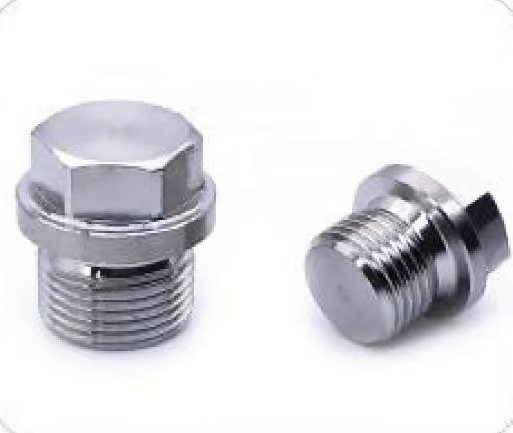
The standard hex head plug is a male-threaded fastener with an external hex you drive with a wrench, blocking unused ports on valves, blocks and manifolds. It is made in pressure-class families — forged ASME B16.11 styles are common at the 3000/6000 class end — and in both tapered and parallel threads. Its virtues are real: torque control is easy, removal is one wrench, and every distributor stocks it. Its limitation is geometry: the plug closes the port from the outside, and the drilled bore in front of its nose is a small reservoir. On a water-utility line, nobody cares. On a product line or a fast sampling loop, that reservoir is dead volume.
Flush plug
The flush plug — socket-head, countersunk, DIN 908-style — turns the hex drive inward. The plug screws into a counterbored port and finishes level with or below the surrounding surface, so the internal cavity shrinks to nearly nothing. Catalog descriptions market exactly this: flush-head profile for maximum space efficiency, installation flush inside crowded manifolds and valve banks, with the seal made at the face on a copper or aluminum washer rather than at the thread. Where dead volume matters — hygienic lines that must clean in place, high-purity systems, and instrument manifolds where a trapped pocket slows the reading — the flush plug is the right close. The logic is the same one that puts flush diaphragms on hygienic gauges: eliminate the cavity and you eliminate what lives in it.
Square head and flanged
Two head variants earn their keep in corners. The square head plug is the tight-clearance tool: where a hex wants swing room a square head does not have, the square takes an adjustable wrench in a narrow pocket and still breaks loose after service — vendor guidance puts square heads in confined spaces and hard-to-reach spots. The flanged hex plug carries a washer face under the head: a sealing ring or crush washer seats against the port, and the plug seals at that face rather than at the thread — the right form where the thread is parallel and face-sealing is the design, and an easier torque-and-seal story than relying on thread interference alone.
Thread seal choice
The plug’s sealing follows the same BSPP/BSPT logic as every other threaded joint, and the full treatment is in BSP thread seal: why BSPP needs a washer and BSPT does not. Compressed version: a tapered plug (NPT, BSPT) seals on the flank — add sealant, torque to spec, watch for galling on stainless. A parallel plug (BSPP, DIN 908 washer-face styles) seals at the face with a washer, O-ring or bonded seal — sealant cannot help because the flanks are not the sealing surface. Identify before you assemble, and the bench method is in how to identify NPT vs BSP threads. On stainless threads, lubricate and torque deliberately — galling is one over-zealous assembly away, per thread galling on stainless steel fittings.
RFQ lines
plug form— hex / square / flanged / socket flush.thread—1/2 NPTorG1/2, DIN 908, washer sealwith the seal named.class and material—3000 class, 316.service note—dead-volume-free requiredif the port sees product or sampling duty.
FerruleX stocks the plug family across heads and thread forms — see the plugs and barbs range. Request a factory quote with the RFQ lines above.
FAQ
Can I use a cap instead of a plug? Only if the port’s gender agrees. A plug is male-threaded and screws into a female port; a cap is female-threaded and closes a male end. Same sealing logic, mirrored geometry — if the drawing shows a female port, a cap physically cannot take the job.
When must I use a flush plug instead of a hex plug? When the cavity in front of the plug matters: hygienic or high-purity lines that clean in place, sampling and instrument points where trapped volume delays response, and any service where a stagnant pocket can contaminate. Dead volume is precisely the “area of entrapment” hygienic standards define against — flush plugs close the port without building one.
What is the flanged hex plug for? For face sealing. The washer face under the head seats a sealing washer or O-ring against the port, so the joint seals at the face — the correct pattern for parallel threads — and the head still takes a standard wrench. It is the plug form to pair with BSPP ports and washer-style seal designs.
Why a square head instead of a hex? Clearance. A square head takes an adjustable wrench in a narrow pocket where a hex wants swing room, and it breaks loose reliably after service. Spec square heads for confined, hard-to-reach ports; hex or socket heads everywhere else.
How do I seal a stainless plug without galling it? Match the seal to the thread form first — sealant for tapered, washer for parallel — then control the assembly: lubricate or anti-seize the threads, torque to the specified value rather than feel, and never run stainless dry to “tight plus a grunt.” Galled plug threads usually come out as drilled scrap.