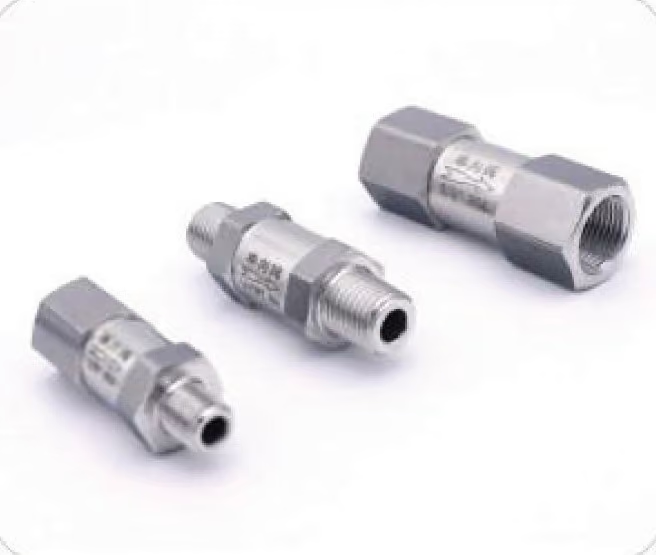
Cracking pressure is the minimum pressure difference across a check valve at which it first opens to flow — and it is a sizing number, not a quality number. A perfectly built 10 psi check valve is a failure on a line whose working differential is 2 psi: it simply never opens. Buyers routinely spec line size, ends and grade, then accept whatever spring the factory grabbed. The four things that actually decide whether a check valve works — cracking pressure, reseal behavior, orientation and fluid — are the subject here.
Key takeaways
- Cracking pressure is the differential at first detectable flow; reseal pressure is the (usually lower) differential at bubble-tight closure — for very light springs the order can reverse, and that surprises people.
- Spring-loaded instrument checks come in standard spring steps — commonly 1/3, 1, 5, 10 and 25 psi nominal — while swing checks crack near zero and dual-plate designs sit around 0.5 psi.
- Spring checks work in any orientation; swing checks are gravity devices that want horizontal lines.
- Cracking set too high never fully opens the valve: it chatters, wears and adds pressure drop. Set too low, it slams shut on flow reversal and hands you water hammer.
- Write cracking pressure as a nominal value with its tolerance plus a reseal requirement — catalog practice is exactly that, e.g. a 25 psi spring cracking at 20–30 psi and resealing at 16–20 psi.
What cracking pressure is — and what reseal pressure is
Cracking pressure is defined as the upstream pressure at which the first detectable flow passes the closed valve. Reseal (reseat) pressure is the back-pressure at which the valve closes bubble-tight again. For springs above roughly 3–5 psi, reseal sits below cracking — the classic hysteresis, like the 25 psi spring that cracks at 20–30 psi and reseals at 16–20 psi. The trap for buyers: very light springs reseal above their nominal cracking, because spring force alone cannot seat the poppet bubble-tight and the system must supply back-pressure. A 1/3 psi valve may need several psi of reverse differential to seal. If your line counts on tight shutoff at near-zero differential, say so explicitly instead of assuming it.
One more definition that matters: the valve is only fully open at a differential of roughly three times the cracking pressure. A check valve running at 1 psi against a 1 psi spring is cracked but throttling — living in the worst part of its stroke.
Typical ranges by valve type
| Type | Typical cracking pressure | Orientation | Notes |
|---|---|---|---|
| Spring-loaded inline (poppet) | Standard springs 1/3, 1, 5, 10, 25 psi nominal; makers build from fractions of a psi upward | Any, including vertical | The instrument-line default; cracking specified as nominal with a tolerance band |
| Swing check | Near zero — commonly under 1 psi | Horizontal only (vertical up in some designs, never down) | Gravity-assisted closure; slow to close, slam-prone |
| Dual-plate wafer | Low, around 0.5 psi class | Flow-direction set | Compact for larger line sizes; spring-assisted plates |
The spring family tree matters more than the table: for a given body, swapping the spring swaps the behavior, which is why the spring — not the valve — is the line to write.
When it matters
- Low-head and gravity lines. A cracking pressure above the available differential blocks flow, period — the valve sits shut on a line that should drain or trickle. Hydrostatic head on a vertical run adds or subtracts from the spring, so gravity-fed lines want the lightest sensible spring.
- Instrument sampling and impulse lines. Small flows develop small differentials; a heavy spring throttles the sample and distorts the reading. The routing side of the same problem is covered in instrument impulse lines.
- Backflow protection with pump cycling. Here the danger is the opposite spring: a weak or zero-cracking valve cracks open on vibration and pulses, and on reversal it closes late and slams — the classic water-hammer path. Spring-assisted poppets close before reverse flow builds; free-floating designs do not.
- Chatter from the too-high side. When available flow cannot hold the valve fully open against its spring, the disc or poppet flutters — noise, accelerated wear and a pressure drop you did not size for. Chatter is an under-opened valve, not a weak one.
How to write it on the RFQ
- Nominal cracking with tolerance:
cracking pressure 1 psi nominal— and ask for the band, since a nominal spring is a range, not a point. - Reseal requirement:
reseal bubble-tight at ≥ X psi back-pressure— the spec buyers forget, and the one that separates working valves from expensive spacers. - Orientation:
installed horizontal/vertical flow up— swing checks especially; a spring check re-sprung for vertical-down flow is a different part. - Operating differential: state the minimum and normal differential across the valve so the factory can check the valve actually reaches full-open at roughly 3× cracking.
- Fluid and temperature: viscosity and density move the numbers for gravity-dependent designs and any vertical installation; steam and hot media change seal selection.
The family-level view of what these valves do — spring versus swing versus dual-plate — is in types of stainless check valves, and how a check valve differs from a ball valve on the same line is in check valve vs ball valve. FerruleX quotes stainless spring checks from the check valves range with the spring written as its own line. Request a factory quote.
FAQ
Is lower cracking pressure always better? No. A weaker spring opens easier but reseals slower and less positively — slam, water hammer and leakage under low back-pressure. A stronger spring seals fast and holds against vibration but needs flow to fully open, or it chatters. Pick the spring for the differential you actually have, with margin both sides.
What is the difference between cracking pressure and reseal pressure? Cracking is the differential where flow first appears; reseal is the back-pressure where the valve closes bubble-tight. Above ~3–5 psi springs, reseal is lower than cracking; lighter springs often need more back-pressure to seal than their nominal cracking suggests. Both belong on the datasheet — ask for both.
Why won’t my check valve open? Almost always differential, not dirt: the available pressure drop is below the cracking pressure, or the valve is oversized so flow never reaches full-open. Check the line’s real differential at minimum flow and compare against the spring’s nominal band; also confirm orientation — a swing check in vertical flow can hang open or stay shut.
Does installation orientation change cracking pressure? For spring-loaded checks, no — they work in any orientation. For gravity-dependent designs (swing, and free-floating types), yes: vertical flow-up adds the trim weight and fluid column to the opening load; vertical flow-down can keep a swing valve from resealing. Gravity effects also make these designs sensitive to fluid density.
Are cracking pressure ratings given for water? Catalog cracking values describe spring and seat geometry; what changes with the fluid is the gravity side. Vertical installations and free-floating trims feel the fluid column’s weight, so dense or hot fluids shift effective opening and closing behavior. State the fluid, and treat vertical runs as a separate check case.


