Stainless Steel Fittings & Valves for Food & Beverage Processing
Food duty means cleanability. Say hygienic or utility on the RFQ, name the cleaning chemicals and temperatures, and the quote separates product-adjacent parts from plain industrial ones — no cast fitting substituted into a washdown line.
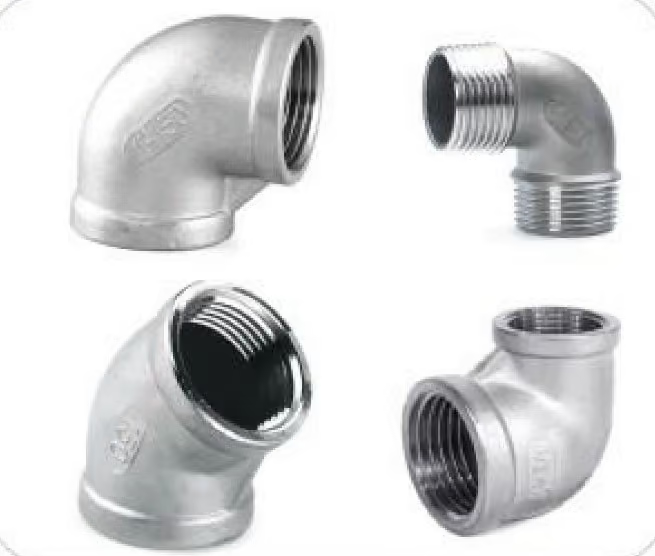
Why food processing needs stainless
Two drivers: the product and the cleaning. Product-contact surfaces must be cleanable to a microbiological standard, and cleaning means chlorinated detergents, acids and caustics at temperature in CIP and SIP cycles — a crevice-rich carbon steel fitting fails both. SS316 is the usual grade because it stands up to the washdown chemistry, and joints that must come apart for cleaning use tri-clamp connections while permanent instrument and utility runs use crevice-free compression joints. The hygienic design logic is covered insanitary stainless fittings, and the grade reasoning inSS304 vs SS316.
Typical duties on a food and beverage line
The stainless fittings on a food plant are split between product-adjacent duty and utility duty. Product-adjacent: CIP supply and return chemical dosing, tank vent and purge lines, and flexible connections on fillers and tankers that must hose apart for cleaning. Utility duty: instrument air panels, water and nitrogen utility runs, and caustic or acid dosing skids for the CIP system itself. The take-apart points are tri-clamp territory — the measuring and selection rules are in tri-clamp vs threaded vs flanged — while the hose assemblies that flex between fixed piping and moving equipment are covered in corrugated vs braided stainless hose.
Duty to product family
| Duty | Recommended FerruleX family | Grade / note |
|---|---|---|
| CIP chemical dosing (caustic, acid) | Needle valves + compression fittings | SS316; dosing chemistry is aggressive |
| Dosing pump outlet, one-way flow | Check valves | SS316; protects the metering pump |
| Tanker and filler flexible connections | Tri-clamp corrugated hose assemblies | SS316; hose ends that hose apart for cleaning |
| Take-apart joints on process equipment | Corrugated hose with tri-clamp ends | State clamp size and gasket on the RFQ |
| Plant air, water and nitrogen utility runs | Compression fittings | SS304 or SS316 by washdown exposure |
| Utility manifolds on imported fillers | Adapters and weld fittings | Mixed NPT/G threads are common on imported skids |
Standards context
Product-contact sanitary design is governed by 3-A, EHEDG and ASME BPE conventions — the landscape fromsanitary stainless fittings — and sanitary tube follows ASTM A270, referenced inbright annealed tubing. We serve the utility, dosing and CIP-support side of the plant in industrial grades of stainless: if a run must itself be 3-A sanitary, say so explicitly and we will tell you whether the catalog fits or the duty belongs elsewhere.
What to state on the RFQ for food duty
- Product-contact, product-adjacent or utility duty per line — the dividing line for hygienic versus industrial parts.
- Cleaning chemicals and temperatures — CIP and SIP exposure decides the grade.
- Grade call-out, usually SS316 on washdown exposure.
- Hose assembly end types and clamp sizes where take-apart joints are involved.
- Thread standard and tube OD × wall for utility runs.
Ready to order from the factory?