“Sanitary” is not a marketing adjective — it is a set of measurable requirements, and sanitary stainless fittings differ from industrial ones in ways an auditor can verify with a surface gauge and a flashlight. If your line carries food, dairy, beverage or pharma product, the differences decide whether your CIP cycle actually cleans the pipe or just rinses it.
Key takeaways
- The sanitary defaults are 316L (for welded chloride service), a controlled product-contact surface finish — commonly 20 µin Ra (≈0.5 µm) mechanical polish for food duty, 15 µin (≈0.38 µm) electropolish for pharma and high-purity water — and a crevice-free, fully drainable geometry.
- The frameworks do different jobs: 3-A Sanitary Standards cover food, dairy and beverage equipment design; ASME BPE governs bioprocess and pharmaceutical piping with stricter finishes and traceability; EHEDG publishes European hygienic design guidance, with cleanability validated to about Ra 0.8 µm.
- Dead legs, crevices and threaded connections are the audit killers: keep branch dead legs within roughly three pipe diameters, avoid thread and gasket crevices on product contact, and standard industrial fittings upstream of the process boundary are fine.
What “food-grade” actually specifies
Four things separate a sanitary fitting from its industrial cousin, and each is checkable:
| Aspect | Industrial standard | Sanitary / food-grade requirement |
|---|---|---|
| Material | SS304 or SS316 by cost and corrosion | SS316L default, especially for welded lines (weld decay — see SS304 vs SS316) |
| Surface finish (ID) | Mill finish or unspecified | Controlled Ra: ~20 µin (0.5 µm) mechanical polish food-grade; 15 µin (0.38 µm) electropolish pharma/WFI |
| Geometry | Any that holds pressure | Crevice-free, self-draining, no thread contact with product; dead legs ≤ ~3 pipe diameters |
| Documentation | Mill cert on request | Heat traceability, finish certification, 3-A symbol or BPE compliance where specified |
The surface number matters because of what lives in the valleys: above roughly Ra 0.8 µm, bacteria shelter from CIP flow in the surface texture, which is why hygienic standards sit well below that threshold — and why a “smooth looking” mill finish fails.
The three frameworks, and which one applies
3-A Sanitary Standards are the food, dairy and beverage framework: they name acceptable alloys, product-contact surface finishes, listed elastomers, and design rules for drainability and crevice-free internals. If your customer is a dairy or beverage plant, 3-A is the language the auditor speaks.
ASME BPE (Bioprocessing Equipment) is the pharmaceutical and bioprocess standard — stricter in finishes, welding quality and traceability. Its product-contact surface series runs SF1 through SF6: SF1 is the 20 µin mechanical polish that usually suffices for food-grade work, while SF4 — the same roughness ceiling achieved with electropolishing — is the usual callout for purified water, WFI and biological product contact.
EHEDG is the European hygienic design authority; its cleanability testing underpins the Ra thresholds above and its guidance covers layout and equipment design rather than certifying individual fittings. On export projects, expect European buyers to reference EHEDG logic and American buyers to reference 3-A — the engineering underneath is compatible.
Where standard industrial fittings are fine
Not every fitting on a food plant needs the sanitary treatment. Utility lines — compressed air, cooling water, CIP supply headers upstream of the process boundary, drain and vent plumbing — carry no product and face no audit of product-contact surfaces. Standard threaded compression fittings and valves are cheaper, stocked deeper, and perfectly appropriate there. The discipline is the boundary: mark where product contact begins, and hold that line in the BOM, because an auditor will.
Gaskets and CIP/SIP reality
Sanitary joints live on elastomer gaskets, and the gasket is as much a spec as the fitting: EPDM for steam and hot CIP, PTFE for aggressive chemistry, FKM where oils and solvents appear — the same logic as tri-clamp gasket selection covers in detail. Every gasketed joint is also a crevice by definition, which is why clamped sanitary connections are designed to be broken, inspected and rebuilt on a schedule. Design the line for CIP velocity and drainage — a fitting that traps product defeats a perfect surface finish.
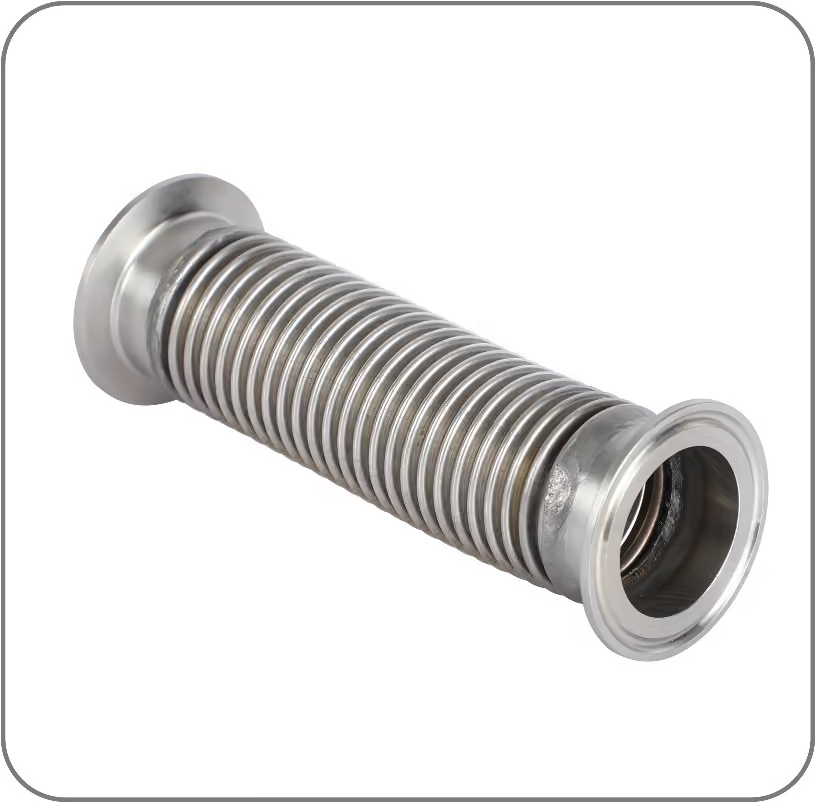
FerruleX manufactures sanitary-pattern cast fittings and tri-clamp-end assemblies — browse the cast fittings category or the tri-clamp corrugated hose style, and send the standard (3-A or BPE), finish, alloy and sizes with your RFQ. For clamp sizing, what are tri-clamp fittings has the measurement rules. Request a factory quote.
FAQ
What makes a fitting “sanitary” or food-grade? A controlled product-contact surface (roughly 20 µin Ra mechanical polish for food duty, 15 µin electropolish for pharma), an approved alloy such as 316L, crevice-free self-draining geometry, and documented compliance with a hygienic standard — 3-A for food and dairy, ASME BPE for pharma and bioprocess.
Is 316 required for food-grade fittings? 316L is the sanitary default, especially for welded lines where low carbon prevents weld decay. For non-wetted utility fittings or mild, non-chloride duty, 304 may be acceptable — but spec-sensitive food and pharma lines are normally written to 316L, and deviating should be a documented decision, not a silent substitution.
What Ra finish do I need? Food, dairy and beverage duty is commonly written to a 20 µin (≈0.5 µm) mechanical polish — ASME BPE’s SF1. Pharma, WFI and biological contact usually call for 15 µin (≈0.38 µm) electropolish — SF4. Electropolishing also enriches the passive layer, which is why high-purity systems pay for it. The full conversion and the SF0–SF6 designations are on our Ra surface finish chart sheet.
Do sanitary fittings have to be tri-clamp? No — weld ends and specialty dairy connections are equally sanitary when properly finished and qualified. Tri-clamp is dominant because it breaks down for inspection without tools; whatever the connection, the requirements are the same: crevice-free, drainable, cleanable, documented.
Where do industrial fittings fail an audit? On product contact: threaded joints that harbor product, unspecified surface finishes that shelter bacteria, dead legs beyond a few pipe diameters, unlisted elastomers, and no traceability. Each is a written finding — and each was cheap to avoid at specification time.


