Tri-clamp gaskets are the least-discussed third of every sanitary joint — the clamp supplies the squeeze, the ferrules supply the faces, and the gasket does the actual sealing. They are also the easiest part to order wrong, because the sizing system names the gasket after the pipe, not after any dimension on the gasket itself, and the material list runs six polymers deep with steam and chemical behavior that does not follow intuition. Here is the full decoder: how sizes really work, what each material handles, and how to write a gasket specification that cannot be misread.
Key takeaways
- A tri-clamp gasket is named for the fitting’s nominal size, not its measured diameter — a “2 inch” gasket measures about 1.900 in ID and 2.520 in OD.
- Flange sharing is real: 1/2 and 3/4 in joints use one 0.860 in OD mini-gasket (different IDs), and the 1 in and 1-1/2 in flanges both sit near 1.98 in OD — which is why the named size must travel with the order, not the measured one.
- ASME BPE, DIN 32676 and ISO 2852 ferrule systems are not dimension-for-dimension interchangeable; a “2 inch gasket” without the standard named is an incomplete callout.
- Materials divide on sterilization: EPDM is the usual steam-in-place (SIP) and caustic CIP choice; silicone is conditional for steam; PTFE covers the widest chemistry but cold-flows; standard FKM grades are not for continuous SIP or hot caustic.
- Certifications follow the compound, not the polymer: FDA 21 CFR 177.2600 (rubber), 177.1550 (PTFE), USP Class VI and 3-A are claims about a specific product from a specific maker.
What the gasket actually does
The tri-clamp joint is two ferrules — tube stubs ending in raised flanges — with the gasket seated between the flange faces, centered in the bore, and a clamp pulling the flanges together around it. The clamp is the load source; the gasket is the seal element; the ferrule faces define where compression lands. No threads, no welds at the joint, which is exactly why the system dominates food, beverage, dairy and bioprocess lines. The joint anatomy and the ferrule measuring procedure are covered in what are tri-clamp fittings.
Two consequences of that architecture matter here. First, the gasket is the consumable in the system — it is the component replaced at teardown intervals, and the one whose condition quietly decides whether the joint holds pressure and stays crevice-free. Second, its material governs not just sealing but cleanability: a gasket that survives CIP chemistry but hardens in steam becomes the contamination source the sanitary design was built to avoid.
Sizes: named for the pipe, not the gasket
The sizing convention is the single biggest ordering trap. A tri-clamp gasket is specified by the nominal pipe/ferrule size of the joint — and that nominal number matches no dimension on the gasket:
| Nominal size | Approx. ID (in) | Approx. OD (in) | Approx. thickness (in) |
|---|---|---|---|
| 1/2 | 0.370 | 0.860 | 0.085 |
| 3/4 | 0.620 | 0.860 | 0.085 |
| 1 | 0.900 | 1.984 | 0.085 |
| 1-1/2 | 1.400 | 1.980 | 0.185 |
| 2 | 1.900 | 2.520 | 0.185 |
| 2-1/2 | 2.400 | 3.050 | 0.185 |
| 3 | 2.900 | 3.580 | 0.185 |
| 4 | 3.870 | 4.680 | 0.185 |
Approximate catalog dimensions — they vary by profile and maker tolerance, so confirm per order rather than machining to them. Read the pattern, not the digits: the ID runs close to (slightly under) the nominal bore, and the “2 inch gasket” nobody can find is the one measuring 1.900 in.
The shared-flange quirks are worth memorizing. The 1/2 and 3/4 in joints take the same 0.860 in OD gasket — the “mini” gasket — differing only in ID, which is why a mixed 1/2-to-3/4 assembly uses the larger-ID gasket with the same flange. The 1 in and 1-1/2 in flanges both land near 1.98 in OD, which is why those two sizes interchange clamps. In both cases the safe rule is the one from the primer post: order by named size, and when joining different tube sizes that share a flange, use the larger gasket so the bore has no unsealed gap.
Three standards, three dimension sets
Sanitary ferrule systems are regional, and their gaskets do not cross over freely:
- ASME BPE — the North American bioprocessing standard; dimensions in inches, as in the table above.
- DIN 32676 — the European standard, dimensioned on metric tube ODs, and itself split into series A, B and C — a “DIN clamp gasket” without a series is as incomplete as an NPT callout without a size.
- ISO 2852 — the international attempt, close to but not interchangeable with either at every size.
A 2 in ASME BPE gasket will not reliably seal a DIN flange: flange OD, groove geometry and gasket thickness differ across the systems. The RFQ-proof callout names all of it — standard, series where applicable, nominal size, material, profile — for example: gasket, ASME BPE, 2 in, EPDM or DIN 32676 series B, DN25–OD34, silicone.
Material selection: the honest version
Published temperature ranges for sanitary gasket compounds — treat them as typical ranges for the compound family and verify the specific product rating for your duty:
| Material | Typical range | Stands out in | Watch out for |
|---|---|---|---|
| Silicone (VMQ) | −100 to 400 °F (−73 to 204 °C) | Low extractables, wide temp, high-purity water duty | Steam is conditional — repeated SIP hardens many grades; poor resistance to acids, alkalis, solvents, oils, abrasion |
| EPDM | −50 to 300 °F (−46 to 149 °C) | Steam and hot water — the usual SIP elastomer; water-based caustic CIP; dilute acids and alkalis | Fails in mineral oils, hydrocarbons, greases — one lubricated fitting ruins it |
| PTFE (solid) | −100 to 500 °F (−73 to 260 °C) | Broadest chemical resistance — acids, alkalis, solvents, oxidizers; lowest extractables | No elasticity: cold-flows under sustained clamp load, sensitive to under-compression and misalignment |
| FKM (fluoroelastomer) | −20 to 400 °F (−29 to 204 °C) | Oils, fuels, many solvents and acids | Standard grades are not for continuous SIP or hot caustic CIP — special grades exist, verified per compound |
| Buna-N (NBR) | −30 to 200 °F (−34 to 93 °C) | Oils and greases at modest temperature | Not for repeated SIP or hot caustic; ozone and heat aging limit service life |
Three of those rows carry the decisions most plants get wrong. Silicone’s steam tolerance is conditional — the common assumption that silicone handles SIP by default is a simplification; EPDM and PTFE take repeated steam notably better, and a silicone grade rated for steam is a per-compound question. EPDM’s weakness is oils — excellent in everything water-based, degraded by hydrocarbon contact. PTFE’s weakness is mechanical, not chemical — it creeps, so a solid PTFE gasket in a joint that cycles temperature or gets under-clamped will relax its seal even while chemically intact.
Envelope gaskets: PTFE chemistry with elastomer recovery
The envelope gasket answers the “PTFE chemistry but elastic sealing” problem with a two-part construction: a PTFE shell facing the product wetted surfaces, wrapped around an elastomer core — typically EPDM or FKM — that provides the compression and recovery. The shell takes the chemistry; the core takes the mechanics.
Two rules keep envelope gaskets honest. The temperature limit belongs to the core, not the shell — the assembly is limited to roughly the elastomer’s range, not PTFE’s 500 °F; specifying an envelope gasket by the shell rating overstates the joint. And the assembly is only as certified as its whole: shell integrity is a wear item (a cracked or perforated jacket ends the gasket’s life), core compatibility must be checked against the media independently, and certifications apply to the finished item, not to “PTFE + EPDM” as a concept. Envelopes earn their place where aggressive cleaning chemistry or product contact rules out plain elastomers — WFI systems, bioprocess skids, solvent duty.
Specialty gaskets: screen and orifice
Two functional variants show up in sanitary lines, both gasket-plus-device hybrids:
- Screen (mesh) gaskets — a stainless mesh disc sealed into the gasket profile, adding coarse inline straining to the joint: catching scale, weld beads and debris ahead of pumps, valves and instruments. Useful as a guard, but not a validated filter — expect a pressure drop, monitor it, and treat clogging as the maintenance signal it is.
- Orifice (restrictor) gaskets — a gasket with a reduced center bore, providing a fixed restriction for flow balancing, pressure drop, or branch equalization. The restriction is fixed — flow still moves with conditions — so it complements rather than replaces adjustable flow control.
The compliance decoder
Gasket compliance claims are compound-specific, and the acronyms get mixed up routinely:
- FDA 21 CFR 177.2600 — rubber articles for repeated food contact: permitted ingredients plus extraction limits in water and fat simulants. It is a materials compliance, not a pressure, temperature or design rating. Note the trap: PTFE is regulated under 21 CFR 177.1550, not 177.2600 — a “FDA silicone” and a “FDA PTFE” gasket are certified under different paragraphs.
- USP Class VI — biological reactivity testing (systemic injection, intracutaneous, implantation) for materials in contact with drugs and devices. It says nothing about food contact, chemical compatibility, or cleanability.
- 3-A — sanitary design criteria for dairy and food equipment, applied at the product level.
The meta-rule: certifications travel with the compound, not the polymer. “EPDM” is not USP Class VI; a specific EPDM compound from a specific maker, tested and documented, is. When the process demands it, request the compound’s compliance documentation with the batch — hardness, cure system, temperature rating and the certificates as one package.
Specifying without ambiguity
A complete gasket specification is six lines: standard and series, nominal size, material (compound, not just polymer), certification requirements, process media, and the cleaning regimen — CIP chemistry and temperature, SIP pressure and frequency. That last pair is where most material mistakes enter: the gasket that survives the product but not the cleaning cycle is still the wrong gasket.
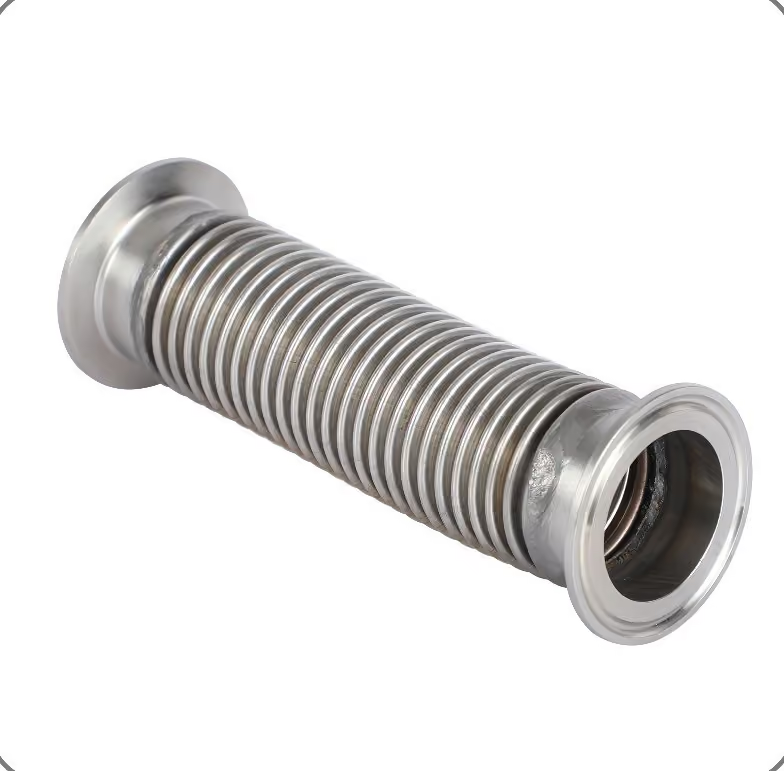
FerruleX works the hardware side of these joints — tri-clamp ends machined into stainless corrugated hose assemblies and the sanitary ranges of the fittings catalog, in 316/316L with surface finishes to match the line. The gasket specification above is the piece to hand your supplier either way: it is what lets the joint — ours at the hose end, theirs at the gasket — seal to the standard the process was designed around. Surface-finish context for the rest of the wetted path is in electropolishing vs passivation and our Ra surface finish chart; the valve side of sanitary service is in sanitary ball valves.
FAQ
Which gasket material is best for steam sterilization (SIP)?
EPDM, as the general rule — hot water and steam are its strengths, and it is the default SIP elastomer in food and pharma plants. PTFE and envelope gaskets also handle repeated steam. Silicone is the conditional one: some grades are rated for steam, many harden under repeated SIP cycles, so verify the specific compound’s steam rating instead of assuming the polymer’s reputation carries it.
What is the difference between a solid PTFE and an envelope gasket?
Solid PTFE is one material doing both jobs — maximum chemical resistance but no elasticity, so it cold-flows and needs well-aligned, properly compressed flanges. An envelope gasket splits the jobs: PTFE shell for the wetted chemistry, elastomer core (usually EPDM or FKM) for compression and recovery. The trade is temperature — the envelope is limited by its core, roughly EPDM range, not by the shell’s 500 °F.
Will a 2-inch ASME BPE gasket fit a DIN 32676 ferrule?
Not reliably, and it is not worth testing. The two systems dimension their ferrules and gaskets independently — flange OD, thickness and profile all differ, and DIN itself splits into series A, B and C. Mixing standards risks either a gasket that blows out under clamp load or an unsealed gap at the bore. Name the standard with the size: “ASME BPE 2 in” or “DIN 32676 series B, DN25” are orderable; “2 inch gasket” alone is a gamble.
Do all silicone gaskets handle steam sterilization?
No — “steam-rated silicone” is a compound-level claim. Many silicone grades take occasional SIP, but repeated steam cycling hardens standard grades and shortens their life noticeably; EPDM and PTFE hold up to repeated SIP better. If the duty is routine SIP, either specify a silicone explicitly rated for it or move to EPDM, and put the SIP cycle (pressure, temperature, frequency) on the specification so the supplier can match the compound.
Are tri-clamp gaskets sized by their measured diameter?
No — by the nominal size of the joint they serve, which matches no single gasket dimension. The 2 in gasket measures about 1.900 in ID and 2.520 in OD; the 1/2 and 3/4 in joints share one 0.860 in OD gasket with different IDs. Measure the ferrule flange and tube, identify the nominal size from the fitting system’s table, and order by that name — measuring the old gasket and rounding is how wrong gaskets get ordered.